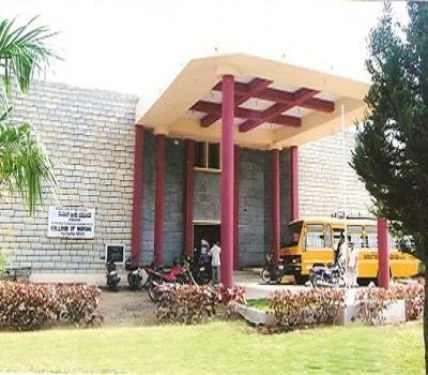
Loading Admission Guardian content
Loading Admission Guardian content

Find a program, read its fee details and explore the admission requirements.
Summary of the programs shown below. Fee amounts are not listed. Contact the college for its current fee schedule.
| Course | Stream | Fees |
|---|---|---|
| Bachelor of Science [B.Sc] (Nursing) | Paramedical | |
| General Nursing and Midwifery [GNM] | Paramedical | |
| Master of Science [M.Sc] (Nursing) | Paramedical |
Specializations
Eligibility: 10+2
Specializations
Eligibility: Graduation
If you're looking at nursing colleges in Mysore and clinical experience is your top priority, BGS Apollo Nursing College is a name that comes up for a specific reason. It's not about sprawling campuses or a vibrant social scene. The draw here is direct, daily access to a working, multi-specialty hospital. The college is essentially an academic wing of the Apollo BGS Hospital in Mysore, and that integration defines everything from your classroom learning to your internship and likely your first job. That's the trade-off. You get a highly disciplined, hospital-immersive education with a clear, if modest, career pathway into the Apollo network. But you pay private college fees for it, and the lifestyle is more about duty rosters than college fests.
The academic portfolio is standard for a nursing institute, covering the core pathways. The B.Sc Nursing program is the main draw, with an intake of 80 students. They also offer the three-and-a-half-year GNM diploma (60 seats), a two-year Post Basic B.Sc Nursing (40 seats, unverified), and M.Sc Nursing (25 seats) with specializations in Medical-Surgical, OBG, Pediatric, Psychiatric, and Community Health Nursing.
What sets the academics apart isn't the curriculum—that's dictated by RGUHS—but the delivery. The college's official website highlights its "integrated learning" approach. In practice, that means your theory classes in smart classrooms feed directly into clinical rotations at the attached 200-bed Apollo BGS Hospital. It's a continuous loop. You learn about a procedure in the morning and might observe or assist with it in the afternoon. The faculty, led by Principal Dr. N.T. Aruna Devi (a PhD with 18+ years experience), are largely M.Sc or PhD holders focused on graduate-level instruction. The teaching style is described as traditional but supported with digital presentations. The environment is intensely focused. Attendance rules are strictly enforced: 80% for theory and 100% for practicals. This isn't a place for a casual academic experience.
This is where the college's proposition becomes very clear, and a bit of a reality check is needed. The official line is "100% placement assistance" with guaranteed opportunities in Apollo Group hospitals. And that's largely true, but with important context.
For a fresher in 2024, the highest reported starting package was between ₹1.8 and ₹2.2 LPA. The average sits around ₹1.5 LPA. That translates to a monthly take-home of roughly ₹15,000 to ₹18,000. You have to weigh that against the total cost of a management quota education, which can approach ₹10 lakhs. The gap between the high fee and the starting salary is a recurring point of criticism in student reviews.
The placement percentage is high for students willing to join the Apollo ecosystem. Top recruiters are essentially the Apollo BGS Hospital in Mysore and the wider Apollo Hospitals Group across India. Some graduates also find roles at other local hospitals like JSS. For experienced nurses, especially those with additional certifications, opportunities in the Middle East through the Apollo network are a notable career path. But if you're expecting a bustling "placement week" with intense competition from a variety of external corporate hospital chains, you might be disappointed. The model is streamlined: train here, often intern here, and start your career here. It's a secure pipeline, but not necessarily a high-paying one at the entry level.
The fee structure is a classic two-tier system based on how you secure your seat. If you get in through the Karnataka government quota via KCET counseling, it's remarkably affordable—anywhere from ₹10,000 to ₹40,000 per year for B.Sc Nursing. The vast majority of students, however, come through the Management Quota, where fees are significantly higher.
For the B.Sc Nursing program under management, annual tuition is estimated between ₹1.5 and ₹2 lakhs. The M.Sc program ranges from ₹1.6 to ₹1.9 lakhs, and the GNM diploma has a package fee of around ₹1.2 lakhs. On top of tuition, you must budget for hostel and mess, which adds another ₹55,000 for a basic four-seater non-AC room to over ₹1.2 lakhs for a single AC room. Uniforms, university fees, and a refundable caution deposit (₹5,000) are extra. All in, the total four-year cost for a B.Sc Nursing student in a management seat, including mid-range hostel costs, can easily land between ₹8 and ₹10 lakhs. The college does not prominently advertise institutional scholarships, so financial planning is crucial.
Admission is primarily gatekept by the Karnataka Common Entrance Test (KCET). For B.Sc Nursing, securing a KCET rank is mandatory for both government and private quota seats, as per state norms. While NEET-UG scores are sometimes used for eligibility verification, they are not the primary ranking tool for the state counseling process.
The cutoffs reflect the demand for nursing seats. In the 2025 KCET Round 3, the rank range for the General Category was 74,558 to 1,58,420. The overall range extended up to 1,96,792 for reserved categories. These are not ultra-competitive ranks compared to top engineering or medical programs, but they do indicate steady demand. The selection is merit-based through the Karnataka Examination Authority (KEA) counseling process for government quota seats. For the Management Quota, the college conducts direct admissions based on 10+2 marks (PCB) typically requiring 45-50%, but the KCET rank is still a prerequisite. The application window usually opens in May and runs through July.
Don't imagine a traditional university campus. BGS Apollo is compact and urban, integrated into the hospital complex. The infrastructure is functional and geared toward professional training. The labs for Foundations of Nursing, Nutrition, OBG, and Pediatrics are reported to have standardized, modern equipment. The library holds over 4,000 books and journals. The biggest infrastructure advantage is, of course, the immediate access to the Apollo BGS Hospital for both training and emergency care.
Hostels are separate for boys and girls and are generally considered safe and secure with 24/7 security. Reviews rate them around 3.5 out of 5. Rooms are well-ventilated but the rules are strict—especially regarding outing timings and visitors. The most common complaint is about the hostel food, described as average and repetitive.
Student life is minimal. The focus is overwhelmingly on academics and clinical hours. There's an annual fest, but it's not a major social highlight. The campus has greenery and good parking, but this isn't a "college experience" in the broader sense. It's a professional training ground with a highly disciplined schedule.
Synthesizing feedback from platforms like CollegeDunia and Shiksha gives a consistent picture. The overwhelming positive is the clinical exposure. Students unanimously praise the hands-on experience gained by being part of a live hospital environment from day one. They also appreciate the qualified, graduate-level faculty and the use of smart classrooms.
The negatives cluster around administration and cost. The management, particularly the principal's office, is frequently described as rigid and strict, with complaints about administrative delays. The discipline is high, which some appreciate and others find stifling. The most frequent critique is the value proposition: many students feel the high management quota fees are not justified by the starting salaries offered through the campus placement pipeline. The hostel food quality is another perennial gripe.
It depends entirely on your priorities. If your primary goal is to become a competent, hospital-ready nurse with guaranteed job placement into a major healthcare network, and you value that security over initial salary, BGS Apollo is a solid, focused choice. The clinical training here is arguably better than at many standalone nursing colleges. It's best for students who are serious about the profession and comfortable with a disciplined, no-frills environment.
However, if you're looking for a vibrant campus life, a wide array of external placement options, or a higher return on investment from your tuition fees in the first few years, you might want to look elsewhere. The cost for a management seat is significant, and the starting salaries are modest. You're paying for the Apollo brand name and its integrated pathway. For a student securing a government quota seat through KCET, it becomes an excellent, high-value option. For everyone else, it's a calculated decision: trading off higher upfront cost and strict routine for a streamlined education-to-employment track in a respected hospital group.
Yes, BGS Apollo Nursing College is considered a good choice for B.Sc Nursing, primarily due to the superior clinical exposure provided at the affiliated Apollo BGS Hospital, which is a key advantage over many local colleges.
The approximate fee for the B.Sc Nursing program under the management quota is between ₹1.5 lakh to ₹2 lakh per year. This cost typically excludes hostel and accommodation charges.
The college provides 100% placement assistance. Most nursing graduates secure jobs within the extensive Apollo hospital network, though it is noted that the starting salaries are modest, generally ranging from ₹15,000 to ₹18,000 per month.
Yes, as per the latest Karnataka government admission norms, qualifying the Karnataka Common Entrance Test (KCET) is mandatory for securing admission to the B.Sc Nursing program at BGS Apollo Nursing College.
The girls' hostel at BGS Apollo Nursing College is described as safe and secure with 24/7 security. However, the rules are very strict regarding outing timings and visitor policies.
Share what future students should know about BGS Apollo Nursing College.
Student voices are not rewritten by colleges. We remove spam and abuse.
Wider admission question? Community PulseWhat should future students know?
Tell us which course you're considering. We'll help you work out the next step.
Get instant Partner access after mobile verification. Your public edits are reviewed before they go live.
Claim this college