Loading Admission Guardian content
Loading Admission Guardian content
Provisional score based on available data. It may change as more information is verified.
Find a program, read its fee details and explore the admission requirements.
Summary of the programs shown below. First-year fee. Check the note beside each amount for inclusions and exclusions.
| Course | Stream | Fees |
|---|---|---|
| Master of Arts [MA] | Arts | 6500 |
| Bachelor of Arts [BA] | Arts | 7000 |
| Bachelor of Science [B.Sc] | Science | 15000 |
| Bachelor of Computer Applications [BCA] | Computer Applications | 16000 |
| Master of Science [M.Sc] | Science | 27000 |
Specializations
Eligibility: Graduation
Specializations
Eligibility: 10+2
Specializations
Eligibility: 10+2
Specializations
Eligibility: 10+2
Specializations
Eligibility: Graduation
Dev International College in Alwar is a study in practical compromises. Established in 2004, this private college has built a reputation for delivering affordable, no-frills education to students from the region. It’s not a nationally ranked powerhouse, and its NAAC Grade D accreditation tells you that upfront. But for a student looking to earn a legitimate university degree from Raj Rishi Bhartrihari Matsya University (RRBMU) without a crushing financial burden, DIC serves a clear purpose. The faculty gets consistently high marks for being accessible and dedicated, which is often the trade-off for a smaller, quieter campus that lacks the buzz of a major university. If your goal is a low-cost stepping stone to government job coaching or a local IT role, it’s an option. If you’re dreaming of high-flying corporate placements and a vibrant campus life, you’ll need to look much further afield.
DIC offers a standard slate of undergraduate and postgraduate degrees in Arts, Science, Commerce, and IT, all following the curriculum of its affiliating university, RRBMU. The intake is modest, with around 120 seats each for B.A. and B.Sc. programs, and 60 for B.Com. and BCA. The BBA and BCA programs are a point of local pride, having been the first of their kind offered in Alwar.
The academic rhythm depends on your course. Traditional streams like B.A. and B.Sc. often follow an annual exam system, while professional courses like BCA run on a semester schedule. You won’t find cutting-edge electives or a heavily industry-modified syllabus here. The focus is on covering the RRBMU-prescribed material thoroughly.
And that’s where the faculty comes in. With about 42 to 52 members, the teaching staff is repeatedly cited as the college’s strongest asset. Names like Dr. V.K. Sharma (Principal, Botany), Shipra Saini (Chemistry), and Anant Kumar Jain (Computer Science) are noted. The consensus from students is that teachers are humble, helpful, and willing to give individual attention—a significant advantage in a low-cost institution. The academic culture is described as quiet and disciplined, geared towards syllabus completion rather than extracurricular exploration.
This is where expectations need serious calibration. The college’s official placement claim sits around 73-75%, but student reviews suggest that figure includes participation in local job fairs and off-campus opportunities. The actual on-campus placement rate for recognizable companies is lower.
The numbers are modest. The highest package students talk about is around ₹45,000 per month (roughly 5.4 LPA), but that’s an outlier. The working average is between ₹1.8 and ₹3.0 LPA. That translates to ₹15,000 to ₹25,000 a month—entry-level wages for entry-level roles.
Recruiters are a mix of e-commerce names like Snapdeal and Mamaearth, small-scale IT firms, and local Alwar manufacturing units. Sectors are IT, retail, education, and local industry. For BCA grads aiming for the NCR tech market, the college degree is the ticket, but landing the job usually requires external skill-building. Many students use the college’s internal internship certificates, often done with faculty, to bolster their local job applications. The honest take? Placement support exists, but it’s geared towards the local economy. Most graduates either take these local jobs, pursue higher studies like B.Ed or M.Sc., or dive into government exam preparation.
The affordability is undeniable. This is perhaps DIC’s most compelling argument. Where metropolitan private colleges charge lakhs, DIC’s fees are in the thousands.
For a three-year B.A., you’re looking at a total course cost of about ₹21,000. A B.Sc. will run you ₹42,000 to ₹45,000. The professional BCA course totals between ₹48,000 and ₹60,000 for three years. Postgraduate degrees are similarly priced. It’s a fraction of the cost of most private institutions.
Hostel facilities are mentioned but not heavily utilized due to the college’s central location in Alwar city. Most students opt for private PGs or flats in areas like Kala Kuan, costing between ₹3,000 to ₹6,000 per month. Other costs include a nominal application fee (around ₹500) and standard university exam fees.
Financial aid is available primarily through Rajasthan Government schemes for SC/ST/OBC and merit-based students, administered by the Social Justice and Empowerment Department. It’s a system that works for those who qualify.
The process at DIC is straightforward and merit-based. There are no major entrance exams to worry about. Admission is granted primarily on the basis of your 10+2 marks. For a course like BCA, having a Mathematics background might give you a slight edge, but it’s not a strict barrier.
The college releases its own merit list. The application window typically opens in June and wraps up by late July, aligning with the RRBMU academic calendar. It’s a system that favors local students who can act quickly.
There is also a management quota for a limited number of seats, which likely applies to NRI candidates or others seeking direct admission. That requires contacting the college administration directly. But for the vast majority, it’s a simple formula: apply with your marksheet, check the list, and enroll if you make the cut.
Manage your expectations. The campus spans about 2.5 acres, with 1.5 acres built up. Students describe it as small—it won’t give you that sprawling university feel. The infrastructure is functional. There are over 11 labs for Physics, Chemistry, Zoology, Botany, and Computer Science. The computer labs have LAN and basic internet. The library’s reported stock varies wildly in sources from 6,000 to 100,000 books, but it is digitized and contains journals.
Hostels exist separately for boys and girls, but as noted, many students live off-campus in private accommodations. The college canteen is described as average, serving basic snacks and tea. For recreation, there are facilities for basketball, cricket, and badminton, and the college hosts an annual sports meet. Wi-Fi is available across the campus grounds.
The overall vibe is quiet and academic. This isn’t a party college. The location behind Ram Mandir in the South West Block is central, close to Alwar Junction railway station (3-4 km) and the Jaipur-Alwar Road. That convenience for day scholars is a big plus. Campus life is about attending lectures, studying, and maybe playing some sports. Not much more.
Sifting through student feedback paints a consistent picture. The praise is almost universally reserved for the faculty. Words like “humble,” “helpful,” and “focused on individual students” come up again and again. In a low-cost setting, this accessible teaching is the core value proposition.
The affordability is the other major positive. Students and parents appreciate the extremely low fees for a private college education. The central Alwar location is also seen as a convenience.
But the criticisms are just as consistent. The small campus size is frequently mentioned as a downside. There’s a feeling that the curriculum, especially in IT-focused courses, can be too theoretical and doesn’t adequately prepare students for modern industry roles without significant self-study or external coaching. And of course, the placement outcomes are a recurring theme—packages are low, and high-profile recruiters are absent.
The median student sentiment is one of pragmatic acceptance. They knew they weren’t signing up for a top-tier institute. They got approachable teachers, a cheap degree, and a quiet place to study. For many, that was enough.
It depends entirely on your context and goals. Dev International College is a specific solution for a specific need. If you are a student from the Alwar region or surrounding areas with a limited budget, seeking a recognized university degree to qualify for government exams, teaching roles, or local private jobs, DIC makes solid economic sense. The dedicated faculty is a bonus you don’t always get at this price point.
However, if your aspirations involve high-paying corporate careers, a vibrant campus life with lots of clubs and events, or a degree with strong brand recognition outside Rajasthan, you will likely be disappointed. The NAAC Grade D and lack of an NIRF ranking are red flags for those with broader ambitions. The college is best viewed as an affordable launchpad for further studies or local employment. It’s a practical choice, not a prestigious one. For the right student, that’s exactly what’s needed.
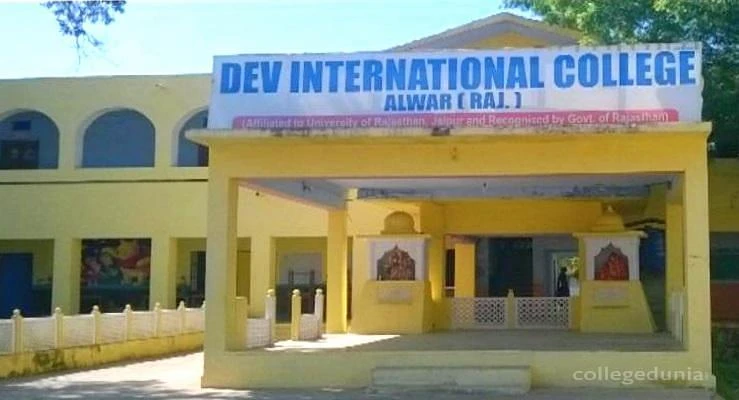
In this preview: 1 photo · 0 videos
Yes, Dev International College is considered a good option for BCA in Alwar. It was one of the first colleges in the city to offer the course and provides decent lab facilities. However, it's noted that placement opportunities are mostly local.
The fee for the B.Sc. program at Dev International College is approximately ₹15,000 per year. For the full three-year course, the total fee amounts to around ₹45,000.
No, Dev International College is not currently affiliated with Rajasthan University. It was previously, but it is now officially affiliated with Raj Rishi Bhartrihari Matsya University (RRBMU), Alwar.
Yes, Dev International College provides hostel facilities for its students. However, due to the college's central location within Alwar city, many students opt for private paying guest (PG) accommodations instead.
The average placement package for students at Dev International College typically ranges between ₹1.8 Lakhs Per Annum (LPA) and ₹2.5 LPA.
Share what future students should know about Dev International College.
Student voices are not rewritten by colleges. We remove spam and abuse.
Wider admission question? Community PulseWhat should future students know?
Tell us which course you're considering. We'll help you work out the next step.
Get instant Partner access after mobile verification. Your public edits are reviewed before they go live.
Claim this college
 Computer Labs
 Science Labs
 Sports Complex
 Study Library