Loading Admission Guardian content
Loading Admission Guardian content
Provisional score based on available data. It may change as more information is verified.
Find a program, read its fee details and explore the admission requirements.
Summary of the programs shown below. Fee amounts are not listed. Contact the college for its current fee schedule.
| Course | Stream | Fees |
|---|---|---|
| Bachelor of Electro - Homeopathy Medicine and Surgery [BEMS] | Medical | |
| Doctorate of Medicine [MD] | Medical |
Eligibility: 10+2
Specializations
Eligibility: Post Graduation
Annai Nivetha Electropathy Medical College (ANEMC) occupies a unique and legally ambiguous space in Indian medical education. It’s a private institution in Nagercoil, Tamil Nadu, offering a path into medicine for students who haven’t cleared NEET, but that path leads to a system—Electropathy—that exists outside the officially recognized medical frameworks of India. The college’s own marketing is bold, claiming 100% placement and international reach. The reality, shaped by court rulings and the experiences of its alumni, is far more nuanced and comes with significant caveats about professional scope and recognition. This isn't a typical medical college profile; it's an examination of an alternative pathway that prospective students must approach with eyes wide open.
The academic focus here is singular: Electropathy, which the college terms the "Fifth Pathy." The cornerstone program is the B.E.M.S. (Bachelor of Electropathy Medicine & Surgery), a 4.5-year course that includes a rotatory internship. The curriculum covers standard pre-clinical subjects like Anatomy and Physiology, but the core is dedicated to Electropathy's Materia Medica, Pharmacy, and Practice, based on the principles of Count Cesare Mattei. The intake isn't officially published, but batches are estimated to be modest, around 50-100 students.
For postgraduates, they offer a 2-year M.D. (Electropathy) for BEMS or other degree holders, and a Master Diploma in IVF Technology. A notable, and somewhat divergent, aspect of their academic operations is their role as a consultancy for MBBS admissions in private European colleges, quoting a total 5-year package around ₹13.4 Lakhs. This sits alongside claims of MoUs with 25 international universities, primarily in Ukraine. The faculty is small, with about 32 academic staff, led by Chairman Dr. Yousef Ali. The teaching style is described as traditional and lecture-heavy, with a strong philosophical grounding in the system's origins.
This is where the college's official narrative meets the practical world. ANEMC boldly claims 100% placement, even branding itself as South India’s first to guarantee it before degree completion. But you have to understand what "placement" means here.
There are no campus recruitment drives from major hospital chains like Apollo or Fortis. The BEMS degree isn't recognized by the bodies that govern employment in those systems. So, the 100% figure largely refers to the college's facilitation of self-employment. Most graduates open their own private Electropathy clinics. Some may find roles in the alternative therapy wings of private hospitals. International placement claims are vague, with no specific hospital names provided.
Financially, the starting point is low. Earnings for a new BEMS practitioner running a clinic are estimated to begin between ₹2.5 to ₹3.5 Lakhs Per Annum. It’s a grind-it-out private practice model, not a corporate salary trajectory. The college’s placement promise is less about handing you a job offer and more about asserting that the training equips you to start your own venture—a crucial distinction many prospective students miss.
Affordability is ANEMC's undeniable strong suit. The total cost for the entire 4.5-year BEMS program is around ₹1,07,050. That breaks down to an annual tuition fee in the ₹45,000-55,000 range, with additional one-time registration and exam fees. Compared to even a single year's tuition at a private BAMS/BHMS college, let alone an MBBS seat, this is minuscule.
Hostel and mess charges are extra, estimated at ₹40,000 to ₹60,000 per year, though this is based on student reports. The college claims to offer merit-based scholarships and support for reserved categories, but specific details on amounts and eligibility are not prominently detailed. The low fee structure is the primary financial aid, making it accessible to a wide socioeconomic range. You can view the official fee structure on their website at http://www.electropathi.com/.
The admission process here is straightforward, and its key feature is the absence of the national medical entrance exam. NEET is not required for admission to the BEMS or MD programs.
Eligibility is based on your 10+2 marks: you need to have passed with Physics, Chemistry, and Biology (PCB), with a minimum of 50% aggregate generally preferred. Selection is direct and merit-based on those marks. There’s no complex counseling or centralized allotment. The application window typically runs from April to July, with the course commencing in June.
It’s widely understood that most seats are filled via the management quota. You apply directly to the college trust, your documents are verified, and you’re in if you meet the academic criteria and seats are available. The barrier to entry is academic, not competitive in the national sense, which is precisely its appeal for many.
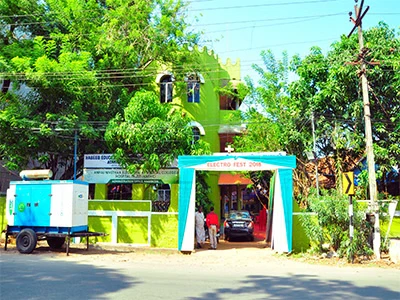
Don’t expect a sprawling, residential university campus. ANEMC operates from a hospital campus on K.P. Road in Nagercoil, with claims of access to 100 acres for future development that remain unverified for current students. The infrastructure is functional. There are separate hostels for boys and girls, reported to have basic amenities with 24/7 Wi-Fi and power backup—adequate, not luxurious.
Labs are equipped for Anatomy, Physiology, and Electropathy Pharmacy needs. The library offers digital access and a collection focused on alternative medicine journals and texts. The critical infrastructure piece is the clinical attachment to HIMS Hospital and Habeeb Electro Medical College & Hospital. This is where students get hands-on patient training, which is consistently noted as a positive. Social life is likely quiet and insular, centered on campus and the small batch. The location is convenient, just 2-3 km from Nagercoil Junction railway station and near NH 66.
Talking to students and alumni reveals a clear, divided consensus. The positives are practical: accessibility for NEET-droppers and extreme affordability. Many appreciate the direct clinical exposure at the attached hospital, feeling they get to practice patient care from early on.
But the negatives are profound and career-defining. The overwhelming concern is legal and professional ambiguity. Students are acutely aware their degree isn’t recognized by the NMC or AYUSH. A 2024 Allahabad High Court ruling explicitly stated Electropathy practitioners should not use the "Doctor" prefix to avoid misrepresenting themselves as allopathic practitioners. This stings. The scope of practice is limited to plant-based Electropathy remedies; no allopathic prescriptions or procedures are allowed.
There’s also deep skepticism about the marketing. Claims of "100% placement in international hospitals" are often met with eye-rolls. The management is seen as approachable but running a small-scale operation. The teaching is adequate for the system but doesn’t translate to recognized medical credentials. The sentiment isn’t of betrayal, but of a clear-eyed understanding of the trade-off: a low-cost, accessible medical education in exchange for a niche, self-driven career path with significant legal limitations.
ANEMC isn't "worth it" in the conventional sense of ROI on a medical degree. It’s a specific solution for a specific problem. It is worth considering only if: You have a genuine passion for alternative medicine and are specifically interested in Electropathy as a philosophy and practice; AND you cannot clear NEET or afford recognized private medical courses; AND you are an entrepreneurial self-starter comfortable with opening your own clinic, not seeking a government or corporate hospital job.
You must go in fully accepting that you will be a practitioner of an alternative therapy, not a doctor in the legally recognized sense. The Supreme Court (2015) hasn't banned the practice, but the Allahabad High Court (2024) has clipped its titles. For the right person—deeply interested in the field, business-minded, and clear-eyed about the constraints—the low investment can lead to a modest, self-made practice. For anyone dreaming of being a broadly recognized physician, this is the wrong path. The college delivers on its promise of affordable Electropathy education, but that promise itself exists in a carefully circumscribed legal and professional box.
The college is affiliated with the National Electropathy & Holistic Medicine (NEHM) of India, a body that promotes Electropathy. However, the Electropathy system itself is not formally recognized by the Ministry of AYUSH as a mainstream medical system like Ayurveda or Homeopathy.
Legally, recent High Court rulings (2024) state that Electropathy practitioners should not use the "Doctor" prefix. This is to prevent misleading the public into believing they are practitioners of modern (Allopathic) medicine.
No, NEET is not required for admission to either the BEMS (Bachelor of Electropathy Medicine and Surgery) or the MD (Electropathy) programs offered at this college.
Currently, a BEMS certificate is generally not valid for state or central government medical officer positions. This is because the Electropathy system is not recognized under the National Commission for Indian System of Medicine.
Homeopathy is a recognized system under the Ministry of AYUSH. Electropathy, which Annai Nivetha Electropathy Medical College specializes in, is an alternative therapy based on bio-electrical plant extracts and is not a formally recognized AYUSH system.
Share what future students should know about Annai Nivetha Electropathy Medical College.
Student voices are not rewritten by colleges. We remove spam and abuse.
Wider admission question? Community PulseWhat should future students know?
Tell us which course you're considering. We'll help you work out the next step.
Get instant Partner access after mobile verification. Your public edits are reviewed before they go live.
Claim this college Auditorium
 Cafeteria
 Computer Labs
 Medical
 Study Library