Loading Admission Guardian content
Loading Admission Guardian content

Provisional score based on available data. It may change as more information is verified.
Find a program, read its fee details and explore the admission requirements.
Summary of the programs shown below. First-year fee. Check the note beside each amount for inclusions and exclusions.
| Course | Stream | Fees |
|---|---|---|
| Emergency Medical Technician Certificate Course [EMTC] | Medical | 63000 |
| Certification | Science | 63000 |
| Diploma | Medical | 73000 |
| Diplomate National Board [DNB] | Medical |
Specializations
Specializations
Specializations
Specializations
All accepted exams
2 exams with cutoff data available - showing recent entries
If you're looking for a traditional medical college campus with sprawling lawns and a buzzing student union, you've come to the wrong place. The Asian Institute of Medical Sciences (AIMS) in Faridabad is something else entirely: a high-volume, 425-bed super-specialty hospital that doubles as a clinical training ground. Think of it less as a college and more as a working, breathing medical ecosystem where your classroom is the ICU, the OPD, and the operating theatre. For postgraduate medical (DNB) aspirants and nursing students, that's the core appeal. You're signing up for an immersive, often grueling, apprenticeship in one of Delhi-NCR's top-ranked private hospitals. The trade-off is clear: you sacrifice a typical campus life for a level of hands-on clinical exposure that can be hard to match.
Forget the broad UG spectrum. AIMS is built for specialized, clinical training. Its academic structure is a direct extension of its hospital services.
The crown jewel is the DNB (Diplomate of National Board) program. Seats are limited, often just 1-4 per specialty, covering core areas like Internal Medicine, General Surgery, and Pediatrics, plus super-specialties like Medical Oncology. The faculty are the hospital's 100+ senior consultants—practicing surgeons and physicians who teach during rounds. The pedagogy is almost entirely bedside. You'll have theory sessions, sure, but the real learning happens while managing a full patient load. They operate on a "Center of Excellence" model, so a Radio Diagnosis resident trains within the advanced imaging department, and an Oncology resident works directly in the Asian Cancer Centre.
For Nursing and Allied Health Sciences, the institute runs separate schools. The B.Sc Nursing, Post Basic B.Sc, and GNM programs are rigorous and heavily practical. Paramedical offerings include B.Sc/Diploma courses in Medical Lab Technology, Operation Theatre Technology, and Radiology. A key differentiator here is the mandatory in-house internship. From day one, students are integrated into the hospital's workflow, which is a massive advantage for building competency and employability.
The placement story here is straightforward and heavily internal. For Nursing and Paramedical graduates, placement is nearly 100%—but that's because the Asian Hospital network itself is the primary recruiter. They know the protocols and the environment, so they're a natural fit for staff nurse and technician roles. Starting salaries for these roles are in the ₹3.5 to 5 LPA range, which is standard for the region.
For DNB residents, the path is different. During your 3-year residency, you receive a monthly stipend (as per Haryana/NBE norms, roughly ₹55,000-65,000). Post-completion, many are absorbed as Senior Residents within AIMS or move to other major corporate hospital chains like Apollo, Fortis, Max, and Medanta. The average package for a DNB graduate falls between ₹8 and 12 LPA. There are claims of higher packages (₹18-22 LPA) for super-specialty DrNB graduates, but that's less a formal placement and more a competitive hiring outcome for experienced specialists.
The gap between official claims and reality is minimal here, mainly because the "placement" is so intrinsically linked to the hospital's own staffing needs. If you perform well during your training, a job offer is highly probable. It's a closed-loop system.
Costs are relatively transparent. The DNB program's tuition is standardized by the NBEMS at about ₹1,25,000 per year. For the B.Sc Nursing program, annual tuition ranges from ₹1,20,000 to ₹1,50,000. Paramedical diplomas are cheaper, at ₹60,000 to ₹80,000 per year.
Hostel fees are an additional ₹60,000 to ₹90,000 annually, depending on whether you opt for AC accommodation and single or shared occupancy. All-in, a 4-year B.Sc Nursing degree with hostel will cost approximately ₹7.5 to 8.5 lakhs.
Financial aid is available in the form of merit-based scholarships for top entrance exam scorers. The institute also reportedly offers fee concessions for students from Economically Weaker Sections (EWS) as per Haryana government norms. It's worth checking the official website for the latest scholarship announcements.
Admission routes are completely dependent on the program.
The application window for DNB counseling opens after NEET-PG results (July-September). For nursing, it's usually between May and July. You don't apply directly to AIMS for the major courses; you go through the central or state counseling bodies.
Let's be blunt: the "campus" is the hospital. The infrastructure is world-class for medical care—think NABL-accredited labs, a specialized medical library with resources like UpToDate, and cutting-edge tech like Varian’s Rapid Arc for oncology. As a student, you have 24/7 access to this for learning.
The hostels are functional. They're separate for boys and girls, safe, and located on-premises or very close by. Reviews often describe them as "cramped" but adequate. The canteen (Asian Cafe) serves standard hospital food, rated around a 3/5—it's fuel, not fine dining.
Social life is virtually non-existent. There are no large cultural fests or sports tournaments. Your social circle is your department, and celebrations are limited to small hospital-day events. The work schedule, especially for DNB residents, is punishing, with 24-hour calls being a standard part of the grind. This isn't a place for a balanced, leisurely college experience. It's a professional training ground with intense hours.
Scouring platforms like Shiksha, CollegeDunia, and Reddit's r/indianmedschool reveals a consistent, two-sided picture.
The praise is almost universally about clinical exposure. "The patient load is massive," one DNB resident noted. "You see everything. For hands-on experience, it can beat many government colleges." Students appreciate the accessibility of the consultant faculty during rounds and the quality of the equipment they get to work with daily.
The criticisms are just as uniform. The chief complaint is the complete lack of work-life balance. "Extremely hectic" is a common phrase. Administrative processes are described as slow and corporate, with some grumbling about occasional delays in stipend disbursement. Nursing students often mention strict hostel curfews. The overall sentiment is that you come here to work and learn relentlessly, not to enjoy a traditional student life. That's a conscious choice.
AIMS Faridabad is a specialist's institute. Its value proposition is crystal clear. If you are a NEET-PG qualifier seeking fierce, hands-on DNB training in a well-equipped private hospital and you prioritize clinical skills over campus life, this is a strong contender. The exposure is real, and the pathway to a job in a corporate hospital chain is well-trodden. Similarly, for nursing and paramedical students, the near-guaranteed absorption into a major hospital network is a significant security blanket, making the investment sensible.
However, if you envision a balanced college experience with extracurriculars, a vibrant social scene, and a more relaxed academic pace, you will be miserable here. The environment is demanding and all-consuming. It's also not an option for MBBS aspirants. Ultimately, AIMS is a professional launchpad, not a traditional university. For the right student—one who is single-mindedly focused on a clinical career—it delivers exactly what it promises: a rigorous, hospital-floor education that gets you job-ready.
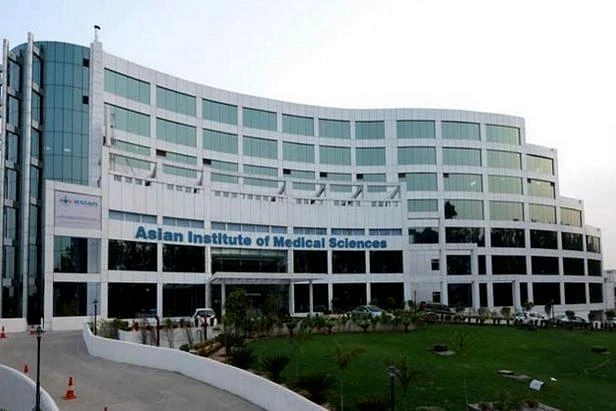
In this preview: 1 photo · 0 videos
No, the Asian Institute of Medical Sciences (AIMS) in Faridabad does not offer an MBBS degree. The institute focuses on postgraduate and paramedical education, offering courses such as DNB (Diplomate of National Board), Nursing, and various Paramedical programs.
Yes, according to the National Medical Commission (NMC) guidelines, a DNB degree obtained from Asian Hospital is considered equivalent to an MD or MS. This equivalence applies specifically to DNB programs conducted in NABH-accredited hospitals with a bed capacity nearing 500, which AIMS fulfills with its 425+ beds.
The stipend for DNB residents at the Asian Institute of Medical Sciences, Faridabad follows the Haryana state and National Board of Examinations (NBE) guidelines. The typical monthly stipend ranges from approximately ₹55,000 to ₹65,000.
The hostel for nursing students at AIMS is reported to be safe and is located within or very close to the hospital premises. However, the facility is strictly regulated, which includes the enforcement of early curfews for residents.
Yes, Asian Hospital has a preference for hiring its own graduates for nursing and technician roles. This is primarily due to the graduates' existing familiarity with the hospital's specific systems, protocols, and operational environment.
Share what future students should know about Asian Institute of Medical Sciences.
Student voices are not rewritten by colleges. We remove spam and abuse.
Wider admission question? Community PulseWhat should future students know?
Tell us which course you're considering. We'll help you work out the next step.
Get instant Partner access after mobile verification. Your public edits are reviewed before they go live.
Claim this college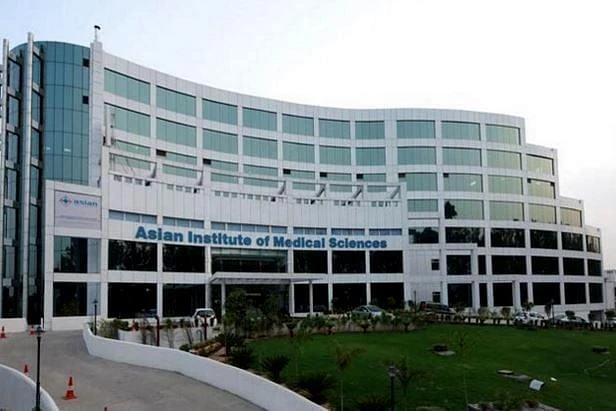
 Auditorium
 Cafeteria
 Computer Labs
 Hostel
 Science Labs
 Sports Complex
 Study Library