Loading Admission Guardian content
Loading Admission Guardian content

Provisional score based on available data. It may change as more information is verified.
Find a program, read its fee details and explore the admission requirements.
Summary of the programs shown below. Fee amounts are not listed. Contact the college for its current fee schedule.
| Course | Stream | Fees |
|---|---|---|
| Ph.D | Science |
Eligibility: Post Graduation
If you're looking for a typical college experience—big fests, sprawling campus life, a guaranteed corporate job—the Interactive Research School in Health Affairs (IRSHA) will disappoint you. But if you're the kind of student who gets excited about a BSL-3 containment lab, whose idea of networking is talking to a former NIV director, and whose career goal is a lab coat over a business suit, this is one of the most serious private research institutions in Western India. It's a niche, intense, and expensive proposition. The trade-off is access to equipment and mentorship usually reserved for top-tier national institutes, all housed within Bharati Vidyapeeth's sprawling, commercially-minded deemed university. You come here to become a scientist, not just a graduate.
Let's be clear: IRSHA is not an undergraduate teaching college. It's a research school. The postgraduate M.Sc. programs—Biotechnology (60 seats), Bioinformatics (25 seats), and Medical Biotechnology—are taught in collaboration with the Rajiv Gandhi Institute of IT & Biotechnology (RGITBT), but the academic soul is here. The curriculum is built around translational research, meaning they try to bridge the gap between a lab discovery and a clinical application. That's not just brochure talk. It's evident in the course structure, which leans heavily into virology, immunology, and clinical data analysis.
The real action, though, is in the doctoral programs. Ph.D. admissions here are competitive, hinging on guide availability and your own research proposal. Specializations range from straight Biochemistry to Interdisciplinary Sciences and even Ayurveda, reflecting the institute's broad "health affairs" mandate. The research thrust areas are where IRSHA's reputation is built: translational virology (they worked on Dengue and SARS-CoV-2), mother & child health, cancer biology, and herbal medicine. Having 100% Ph.D.-holding scientific staff is a given at this level. What stands out are names like Dr. A.C. Mishra, former Director of the National Institute of Virology, and Dr. Vidya Arankalle, a scientist ranked in the top 2% globally. These aren't just professors; they're scientist-mentors with deep networks in institutions like the ICMR, DBT, and the International Vaccine Institute in Korea. That's the academic currency here.
Forget mass recruitment drives with IT companies. Placement at IRSHA is a specialized affair, and managing expectations is crucial. The institute's own data points to an average package for M.Sc. graduates in the INR 4.5 to 6.5 LPA range. The median seems to hover around 5.5 LPA. That's a decent starting point for a fresh M.Sc. in life sciences, but it's not a tech salary. The highest packages, hitting INR 12-15 LPA, are typically for R&D roles in top pharma or for candidates landing international post-doc positions—these are the exceptions, not the rule.
The recruiter list tells the story: Serum Institute of India, Lupin, Biocon, Intas Pharmaceuticals, Dr. Reddy’s. These are core biopharma players. You'll also see research publishers like Springer Nature and Molecular Connections hiring bioinformatics grads for data curation and analysis roles. A significant number of graduates also get absorbed as Project Assistants within IRSHA's own funded projects or at collaborating ICMR labs. The placement percentage isn't shouted from the rooftops because the pathways are diverse—some go into CROs (Clinical Research Organizations), some into academia, others into healthcare consulting. If you want a guaranteed, high-paying corporate job the day you finish your degree, this might not be your best bet. If you see your M.Sc. as a stepping stone to a Ph.D. or a research career, the placement support is relevant and industry-connected.
This is the biggest hurdle for many. IRSHA is expensive. For the M.Sc. programs, the annual tuition fee is around INR 1,55,000, making it a INR 3.1 lakh commitment for the two-year degree. Ph.D. tuition is slightly lower at about INR 1,03,000 per year. Then come the living costs. Hostel and mess fees on the Dhankawadi campus add another INR 1.04 to 1.2 lakh annually for a non-AC shared room. Want an AC single? That can shoot up to an astonishing INR 4.16 lakh per year just for accommodation and food. The total cost of an M.Sc. can easily cross INR 5-6 lakhs.
Financial aid, therefore, isn't a perk; it's a necessity for many. The university does offer some merit scholarships, but the primary focus is on external government fellowships. For Ph.D. students, this is non-negotiable. Having a CSIR-NET, DBT-JRF, or ICMR-JRF fellowship is strongly encouraged and practically expected—it's your ticket to a stipend and often a waiver of tuition fees. For M.Sc. students, these fellowships are less common, so the financial burden rests more heavily on the family. It's a significant investment, and one you'd weigh against the lower costs of a state university or the potentially higher ROI of a different field entirely.
Admission to the M.Sc. programs is through the Bharati Vidyapeeth Entrance Test for Biotechnology/Bioinformatics (BV-MBT). It's a university-specific exam that tests core biology, chemistry, and general aptitude. Students describe it as moderately difficult—not as intense as a national-level test, but not a walkover either. The selection is strictly merit-based: your rank in the entrance exam determines your call for the centralized counseling session where you lock in your seat and specialization. The application window usually runs from February to May, with a non-refundable fee of INR 1,700.
For the Ph.D. program, the process is more nuanced. The university conducts its own entrance test and interview. However, if you hold a valid NET (UGC-CSIR), GATE, SET, or M.Phil. qualification, you're typically exempt from the written test and proceed directly to the interview round. The final selection hinges on your research proposal, your performance in the interview, and most critically, the availability and willingness of a faculty guide to take you on. It's less about a cutoff and more about fit.
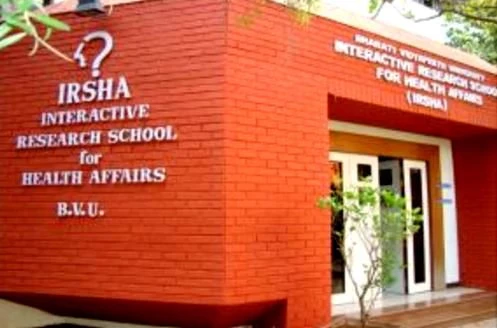
The IRSHA research building is part of the massive 85-acre Dhankawadi campus of Bharati Vidyapeeth. Don't picture a secluded, leafy research enclave. It's a bustling, somewhat chaotic university campus shared with engineering, management, and medical colleges. The infrastructure that matters to an IRSHA student, however, is top-notch. The BSL-3 (Biosafety Level 3) lab is a serious facility for working with high-pathogen microbes. The National Immunogenicity & Biologics Evaluation Center (NIBEC), funded by the DBT, is another major asset. Access to the central library and specialized journals is solid.
Hostel life gets mixed reviews. The girls' hostels are generally reported to be better maintained than the boys'. The facilities range from basic triple-sharing non-AC rooms to very expensive AC singles. It's a functional, not luxurious, setup. The presence of Bharati Hospital on campus is a major plus for both healthcare and clinical research exposure. Social life? It's what you make of it. The "campus life" of fests and events is dominated by the larger undergraduate colleges. IRSHA students often describe their experience as insular, focused on their lab and their cohort. Pune's location is a saving grace—the city is a major educational and biotech hub, offering plenty of external networking and social opportunities.
Talking to students and scanning forums reveals a consistent, almost unanimous consensus. The positives are powerful and specific. They rave about the "unmatched research exposure for a private university," citing hands-on time with equipment like flow cytometers and PCR systems that many only read about elsewhere. The faculty's real-world credibility as active scientists is a huge draw. The location in Pune, India's vaccine capital, is seen as a strategic career advantage.
But the negatives are equally persistent. The "administrative bureaucracy" is a common pain point, with stories of slow, frustrating paperwork processes. The high cost is a constant refrain, with many feeling the pinch compared to government alternatives. And the strict 75% attendance policy, even for research scholars who might be deep in lab work, is cited as an outdated and frustrating rule.
The median verdict? IRSHA is widely seen as a "Research Powerhouse within a Commercial University." It's respected as a serious scientific institution that operates somewhat independently of the broader university's more profit-driven reputation. It's ideal for the self-driven, research-oriented student. It's a poor fit for someone seeking a traditional, vibrant campus life or a direct pipeline to high-salaried corporate jobs.
IRSHA presents a very clear value proposition, but it's not for everyone. It's worth the significant investment if you are unequivocally committed to a career in biomedical research, clinical sciences, or academia. The access to advanced infrastructure, the mentorship of nationally renowned scientists, and the immersion in a genuine research environment are tangible benefits that can fast-track a serious candidate. If your goal is a Ph.D. or a research scientist role in a major pharma company, IRSHA provides a strong launchpad.
You should probably look elsewhere if your primary motivation is a high-paying job immediately after your M.Sc., if you thrive on a vibrant, event-filled campus culture, or if the fee structure is a severe financial strain. This institute demands a specific kind of focus. It's a professional investment in a research career, not a broad-based university experience. For the right student—the one who lights up at the mention of a virology paper or a vaccine trial—it can be an exceptional choice. For others, it might feel like an expensive detour.
Yes, Bharati Vidyapeeth University's Interactive Research School in Health Affairs (IRSHA) is considered a good choice for M.Sc. Biotechnology, specifically for students interested in research and clinical applications rather than just industrial production.
RGITBT (Rajiv Gandhi Institute of Information Technology and Biotechnology) is the teaching college for undergraduate and postgraduate programs. In contrast, IRSHA is the dedicated research school where most high-end research projects and Ph.D. work are conducted.
IRSHA provides stipends for Ph.D. students only if they have secured external fellowships (like from CSIR or DBT) or are working on specific funded research projects.
Placements for Bioinformatics at IRSHA are decent, with graduates securing roles in data analysis and editorial positions at companies like Springer Nature and various Contract Research Organizations (CROs).
The BV-MBT entrance exam for IRSHA is considered moderately difficult, with a focus on core biology, chemistry, and basic aptitude.
Share what future students should know about IRSHA.
Student voices are not rewritten by colleges. We remove spam and abuse.
Wider admission question? Community PulseWhat should future students know?
Tell us which course you're considering. We'll help you work out the next step.
Get instant Partner access after mobile verification. Your public edits are reviewed before they go live.
Claim this college Auditorium
 Cafeteria
 Computer Labs
 Medical
 Science Labs
 Sports Complex
 Study Library