Loading Admission Guardian content
Loading Admission Guardian content
Provisional score based on available data. It may change as more information is verified.
Find a program, read its fee details and explore the admission requirements.
Summary of the programs shown below. First-year fee. Check the note beside each amount for inclusions and exclusions.
| Course | Stream | Fees |
|---|---|---|
| Bachelor of Technology [B.Tech] | Engineering | 54970 |
| Bachelor of Technology [B.Tech] {Lateral} | Engineering | 54970 |
| Master of Business Administration [MBA] | Management | 125020 |
Specializations
All accepted exams
Eligibility: 10+2 with 50% + KEAM
Specializations
All accepted exams
Eligibility: 10+3
Specializations
Eligibility: Graduation with 50%
1 exam with cutoff data available
 Cognizant
 Dalmia Cement
 Ernst & Young
 Hewlett-Packard (HP)
 Hindustan Copper Limited (HCL)
 IBM
IBM IBS
IBS IndusInd Bank
 Infosys
 Nest Technologies
 Poornam Infovision
 QBurst
 Quest Global
 SAP
SAP SLK
SLK TCS
TCS UST Global
 VVDN Technologies
 Wipro
WiproPerched on a hilltop with views stretching to the Arabian Sea, the College of Engineering Thalassery (COET) offers a trade-off that defines its identity. It's a government-aided institution where you get a peaceful, scenic campus and significant student freedom, but you'll need to be proactive about your career, especially if you're not in Computer Science. With an average placement package hovering around 4-4.5 LPA and a stark divide between IT and core branch outcomes, it’s a college that rewards self-starters. The campus vibe is relaxed, the faculty is generally supportive, and the fees are a fraction of what private colleges charge. But that remote, beautiful location comes with logistical headaches, and the academic pressure from its affiliating university, APJ Abdul Kalam Technological University (KTU), is very real. For students with a KEAM rank in the 15,000 to 50,000 range looking for a decent, affordable engineering education in North Kerala, COET is a solid, if unspectacular, choice.
COET runs a standard set of engineering programs under KTU. The intake numbers tell you where the focus is. Computer Science and Electronics & Communication have the largest batches at 120 seats each, reflecting both student demand and placement trends. Information Technology, Electrical, Mechanical, and Civil Engineering each take in 60 students. There's also a newer Electronics and Computer Science program with 60 seats.
The academic rhythm is dictated by the KTU semester system, which students often describe as hectic. The grading is a 10-point CGPA system, split between internal assessments and final university exams. Faculty strength is around 135, including ad-hoc staff. You'll find notable PhD holders like Dr. Aby David (Principal) and department heads, but as with many colleges, the quality of teaching can vary. The consistent student feedback is that professors are approachable and helpful with projects, which is a big plus.
Where COET is trying to build an edge is through its Kerala Future Technology Hub, a ₹50-crore project aimed at boosting research and innovation on campus. It also has an active Innovation and Entrepreneurship Development Centre (IEDC) supported by the Kerala Startup Mission. These are promising initiatives, though their full impact on the average undergraduate's experience is still unfolding.
This is where you need to read between the lines. The official website and brochures might highlight the highest package, which students report was around 11 LPA last year (with some unverified claims of 15 LPA). But the working number that matters is the average, and that sits firmly in the ₹3.5 to ₹4.5 LPA range. The median package is reported to be around ₹4.5 LPA.
The real story, however, is the massive disparity between branches.
The takeaway? If you're in CSE or IT, you have a clear, well-trodden path to a job. If you're in ECE, you can make it work with some extra effort. If you're in a core branch, you should plan from day one to either target IT roles, prepare rigorously for GATE, or look at higher studies. The college's placement cell facilitates the process, but the market demand dictates the outcomes.
Affordability is one of COET's strongest selling points. As a CAPE institution, it follows government-mandated fee structures for merit seats.
For the 2024-25 academic year, the B.Tech tuition fee for merit seats is between ₹35,000 and ₹45,000 annually. There's also a "Merit (Full Fee)" or management quota seat category costing about ₹65,000 per year, and an NRI quota at ₹1,00,000 per year.
On top of tuition, budget for one-time charges like a ₹500 admission fee and a refundable ₹5,000 caution deposit. There's also a PTA fund of ₹6,000 and university fees of around ₹2,500.
Hostel and mess costs are separate. The on-campus girls' hostel rent is ₹13,200 per year. For boys, who stay in private accommodations, rents vary. The mess operates on a dividing system, costing roughly ₹3,500 to ₹4,500 per month for food.
All in, the total estimated cost for a four-year B.Tech from a merit seat is remarkably low, ranging from ₹2.8 to ₹4.5 lakhs. That's a fraction of the cost at most private engineering colleges. Specific scholarship information isn't heavily promoted, but as a government-aided college, students are typically eligible for state and central government schemes.
Admission to the B.Tech programs is entirely through the Kerala Engineering Architecture Medical (KEAM) entrance exam and the subsequent Centralized Allotment Process (CAP) run by the Commissioner for Entrance Examinations (CEE), Kerala.
The competition and cutoff ranks give you a clear idea of branch popularity. Here are the KEAM 2024 Round 1 closing ranks for the General category:
As you can see, CSE is the most sought-after, requiring a rank under 14k. ECE follows, while IT, Civil, and Mechanical have ranks that stretch into the 40,000s. These ranks are a reliable benchmark for planning. The college also fills a 5% NRI quota directly through CAPE based on merit.
For M.Tech, admissions are based on GATE scores or the DTE Kerala rank list. MBA admissions consider scores from KMAT Kerala, CMAT, or CAT.
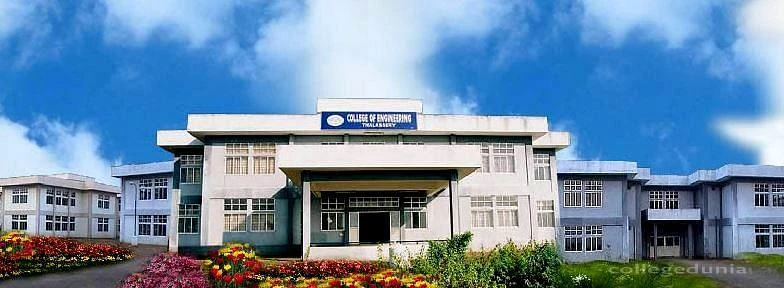
The campus is COET's most distinctive feature—for better and worse. Spread over 25-30 acres on a hilltop at Kundoormala, it's undeniably scenic, green, and peaceful. The flip side is that it's remote. If you miss the college bus, you're relying on auto-rickshaws, which can be expensive and scarce.
Infrastructure is a mixed bag. Labs for CSE and ECE are generally well-equipped. The mechanical workshop is extensive. But students on forums like Reddit and Quora note that some equipment in EEE and Civil labs feels dated and could use an upgrade. The central library has a good collection of over 25,000 books and digital access to journals like IEEE and ScienceDirect. Campus Wi-Fi exists but is often restricted to department zones rather than being ubiquitous.
Hostel life is gendered. The on-campus girls' hostel is highly rated for its security and quality. For boys, there is no official on-campus hostel. Most male students live in private paying guest accommodations or hostels in areas like West Ponniam or Thalassery town, commuting daily by college bus or auto.
The student life is where COET gets high marks. There's an active college union that organizes frequent cultural events. The annual technical fest, Agnitus, is a major highlight. Compared to many private colleges in Kerala, the atmosphere is notably less restrictive, with students appreciating the relative freedom and lack of excessive moral policing.
Synthesizing feedback from Shiksha, CollegeDunia, Reddit, and Quora paints a consistent picture.
The Good: Students love the campus ambiance and the freedom. Phrases like "chill atmosphere," "supportive faculty," and "active union" come up repeatedly. The low fee structure is a huge relief for families. Girls feel particularly secure due to the on-campus hostel's strict protocols.
The Not-So-Good: The remote location is the biggest practical complaint. Placement anxiety for non-CS branches is a major theme. Comments about "aging infrastructure" and the relentless pressure of the KTU syllabus and exams are very common. Boys express frustration over the lack of an on-campus hostel.
The consensus, as one Reddit user put it, is: "If you want a vibrant college life with freedom, this is the place. But don't expect high-end placements if you aren't in CS." Another review on Shiksha noted, "The girls' hostel is very safe, but the boys have to find their own way in PGs nearby." It's a pragmatic, balanced view from the student body.
COET is a value proposition. It's not a top-tier NIRF-ranked powerhouse—it typically sits in the 201-300 band or simply participates. Its KIRF 2024 ranking of 39th in Kerala gives you a more localized sense of its standing.
So, who is it for? It's an excellent fit for a student with a KEAM rank between 15,000 and 50,000 who prioritizes low cost, a peaceful study environment, and a decent shot at an IT job (especially from CSE/IT). If you're self-motivated, can handle the commute or PG life, and are proactive about internships and skill-building, you can get a good return on your very modest investment.
Who should look elsewhere? If you're dead-set on a core engineering job from campus, or if you require the buzz and convenience of a city campus, COET's remote hilltop location and placement profile will be a drawback. Similarly, if your rank is high enough for a premier government college like TKM or CET, you should aim there.
In short, the College of Engineering Thalassery delivers exactly what its profile suggests: a no-frills, affordable, government-aided engineering education in a uniquely serene setting. Manage your expectations on placements accordingly, and you likely won't be disappointed. For more official details, you can visit the college website.

In this preview: 1 photo · 0 videos
College of Engineering Thalassery (COET) is a government-aided, self-financing institution operating under CAPE (Centre for Advanced Professional Excellence), which is an undertaking of the Government of Kerala. It adheres to government fee regulations for merit quota seats.
The college does not have an official on-campus boys' hostel. Male students typically arrange accommodation in private hostels or paying guest (PG) facilities located within 1 to 2 kilometers of the campus.
Placement opportunities in core mechanical engineering companies are limited. Most Mechanical Engineering graduates secure positions in major IT firms like TCS and Infosys, or they opt to pursue higher studies or prepare for competitive exams like GATE.
Agnitus is the flagship National Level Technical Festival of COET Thalassery. It is a major annual event featuring technical workshops, robotics competitions, and professional entertainment shows (pro-shows).
Yes, the campus is considered safe for girls. It maintains a dedicated Anti-Ragging Committee and provides a secure, on-campus girls' hostel with strict rules governing entry and exit.
Share what future students should know about College of Engineering Thalassery.
Student voices are not rewritten by colleges. We remove spam and abuse.
Wider admission question? Community PulseWhat should future students know?
Tell us which course you're considering. We'll help you work out the next step.
Get instant Partner access after mobile verification. Your public edits are reviewed before they go live.
Claim this college
 Auditorium
 Cafeteria
 Campus Shuttle
 Computer Labs
 Hostel
 Medical
 Science Labs
 Study Library