Loading Admission Guardian content
Loading Admission Guardian content

Provisional score based on available data. It may change as more information is verified.
Find a program, read its fee details and explore the admission requirements.
Summary of the programs shown below. Programs record different fee periods. Compare the individual amounts and their notes below.
| Course | Stream | Fees |
|---|---|---|
| Bachelor of Arts [B.A] {Hons.} | Arts | 4830 |
| Bachelor of Science [B.Sc] {Hons.} | Science | 8750 |
| Bachelor of Business Administration [BBA] | Management | 50100 |
| Bachelor of Education [B.Ed] | Education | |
| Bachelor of Physical Education [B.P.Ed] | Education |
Specializations
Eligibility: 10+2
Specializations
Eligibility: 10+2
Specializations
Eligibility: 10+2
Specializations
Eligibility: Graduation
Eligibility: 10+2 or Graduation
Deshbandhu College for Girls in Kolkata has just pulled off a quiet but significant academic coup. In 2025, it secured an NAAC A+ grade with a CGPA of 3.34, a major leap from its previous B++ status. That’s a big deal for a 70-year-old government-aided institution on Rashbehari Avenue. It tells you the place is serious about its core mission: providing an affordable, focused, and peaceful education for women, primarily in the arts and commerce. Don’t come here expecting sprawling lawns or corporate recruiters lining up at the gate. Come here if you want a solid University of Calcutta degree from a respected local college, taught by accessible faculty, all for a tuition fee that’s often less than a month’s rent in the city. The recent accreditation upgrade is the headline, but the real story is in the everyday experience—a compact urban campus, a strict 75% attendance rule, and a student body where higher studies, not immediate placements, are the default path forward.
The college runs on the University of Calcutta’s system, which means it has fully transitioned to the NEP 2020’s Curriculum and Credit Framework (CCF). The intake varies widely by subject. For B.A. Honours, popular departments like English or Political Science might take around 50-60 students, while others like Sanskrit have a smaller intake of about 10. The B.Sc. stream is limited, with a total of about 60 seats across subjects like Geography, Mathematics, and Environmental Science. Geography is a particular strength here, known for its lab and fieldwork.
The B.Com. Honours program is the largest, with around 124 seats. But the standout offering is the BBA (Honours), introduced back in 2003. It’s one of the few girls’ colleges under Calcutta University to have a dedicated business administration course, which explains its higher fee structure. The faculty mix includes permanent professors and State Aided College Teachers (SACT). Student reviews consistently highlight the approachability of teachers, especially in the English and Geography departments. The academic culture is described as supportive but disciplined—the 75% attendance rule is strictly enforced. You’ll find the college active in collaborations, with recent MoUs for faculty and student exchange with local colleges like Kidderpore College and Women’s Christian College.
This is where you need a clear-eyed view. As a traditional arts and commerce college, the placement cell is not a powerhouse like an engineering institute. The official NIRF 2024 report is telling: for the 2023 graduates, the median package was ₹96,000, and only about 30 students were placed from a graduating class numbering in the hundreds. That translates to a placement rate of roughly 10-15%, which aligns with student sentiment. The highest package cited for 2023-24 was around ₹1.8 LPA, with an average hovering between ₹1.4 and ₹1.5 LPA.
Recruitment is driven by the BBA and B.Com. departments. Top recruiters are typically local firms, TCS through its ‘Smart Hiring’ program, private banks, and retail management companies. The sectors are finance, education, retail, and ITES. The college’s own placement claims are modest, and student reviews on portals like CollegeDunia and Shiksha confirm the reality: most students here aim for higher studies—an M.A., M.Com., B.Ed., or preparing for government exams. The new CCF-NEP system mandates internships in the 2nd and 4th semesters, which is becoming a more valuable avenue for gaining practical experience than the formal placement process.
The affordability is arguably the college’s biggest draw. For the 2024-25 session, annual tuition fees for most B.A. and B.Com. programs range from about ₹4,500 to ₹8,500. Even the more expensive B.Sc. Honours courses are under ₹10,000 per year. The BBA program is the exception, with fees around ₹50,100 annually, totaling approximately ₹1.5 lakhs for the three-year degree.
Hostel fees are separate and significant in comparison. There’s a one-time admission fee of ₹1,000 and a monthly charge of ₹6,500 covering food and lodging, pushing the annual hostel cost to around ₹78,000-₹80,000. However, with a capacity for only 40 boarders, getting a hostel seat is competitive. Other costs include semester exam fees (₹400-800) and refundable deposits. As a government-aided college, there is no management quota. Financial aid is typically routed through state government scholarships for eligible students from economically weaker sections.
Admission is straightforward and entirely merit-based. There are no entrance exams. Selection is based purely on Class 12 (Higher Secondary) marks. The process is centralized through the West Bengal Centralized Admission Portal (WB CAP), after which the college releases its own merit lists.
Eligibility criteria follow University of Calcutta guidelines. For Honours courses, you generally need a minimum of 50% aggregate and 45% in the relevant subject (or 55% in the subject if the aggregate is lower). For BBA, it’s 50% aggregate with English as a compulsory subject. Cutoffs vary yearly by subject. For a sought-after program like English Honours, the first merit list cutoff can be as high as 75-80% aggregate. Less subscribed subjects have lower thresholds. The application window usually opens in June-July, right after the Class 12 results are announced.
Manage your expectations about campus life. The college is housed in a multi-story building on a compact urban plot. Student reviews often note, sometimes with disappointment, that “the campus is very small; it’s just one building.” There’s no sprawling playground or vast greens. What you get is a functional, city-based academic enclave.
The infrastructure is adequate. There are two IT labs with 30+ computers, and the Geography lab is well-regarded. The library has a collection of over 20,000 books, with a noted specialty in Women’s Studies, and a Web OPAC for searches. The canteen is considered hygienic and affordable. The on-campus hostel, a 3-story building, is praised for being clean and airy, though rooms typically accommodate four students. The consensus on hostel life is clear: the food is standard Bengali fare deemed better than many private PGs, but the discipline is strict. There’s a matron/warden system with strict curfews. Security is 24/7. The location is unbeatable—a 5-7 minute walk from Kalighat Metro Station and right next to the Rashbehari Crossing bus stand, making it extremely accessible for day scholars.
Sifting through student feedback on CollegeDunia, Shiksha, and forums gives you a consistent picture. The positives are strong but specific. The “peaceful ambience” is mentioned repeatedly—it’s seen as a place conducive to studying without major distractions. Faculty accessibility is a major plus, with teachers described as supportive and helpful. The South Kolkata location is a huge advantage for commuting. And the value for money is almost universally applauded, especially for students from middle-class or economically challenged backgrounds.
The negatives are just as consistent. The small, single-building campus is a letdown for many. The placement scene is understood to be minimal; students don’t come here for on-campus jobs. Some complain about administrative delays in the college office for certificates or documents. Hostel life, while good quality, comes with a reputation for stringent rules. The overall sentiment isn’t one of raving excitement, but of pragmatic satisfaction. It’s viewed as a good, solid, no-frills college that delivers exactly what it promises: a reputable and affordable degree.
It depends entirely on what you’re looking for. If your goal is a low-cost, respected University of Calcutta degree in the arts, commerce, or their unique BBA program, and you plan to pursue higher studies or government exams afterward, Deshbandhu College for Girls is an excellent choice. Its recent NAAC A+ grade validates its academic standards, and the faculty support is genuine. For a student who needs an affordable education in Kolkata without the distractions of a massive campus, it’s a perfect fit. However, if you envision a typical “college life” with big sports fields, a vibrant placement cell guaranteeing jobs, or a sprawling campus, you’ll be disappointed. This college is about academics and empowerment within a tight urban footprint. It’s best for the pragmatic, focused student who sees her undergraduate degree as a stepping stone, not a final destination. For that purpose, it delivers remarkable value.
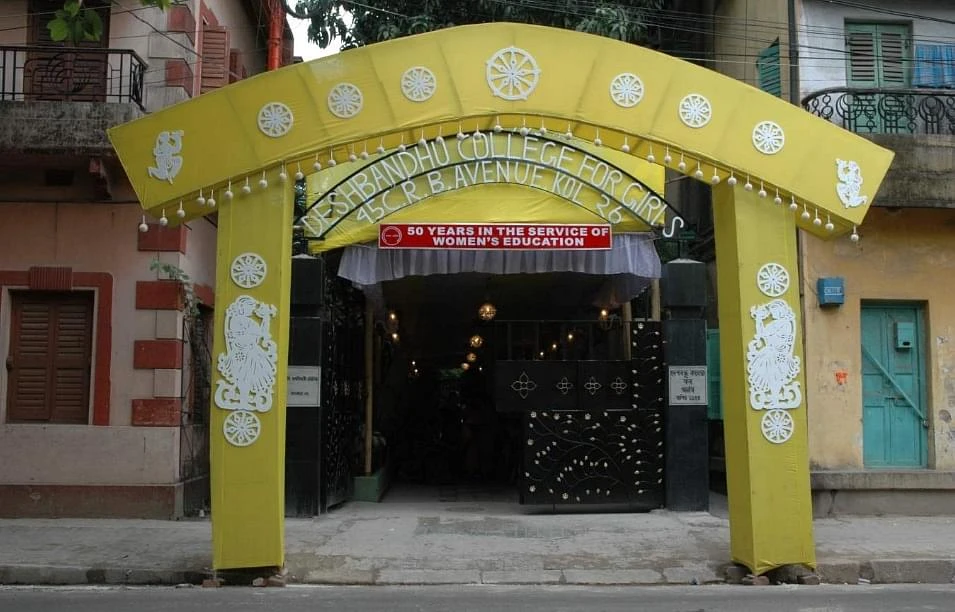
In this preview: 1 photo · 0 videos
Yes, Deshbandhu College for Girls is considered a good option for BBA. It is one of the few affordable girls' colleges under the University of Calcutta offering the BBA program, and it maintains a decent faculty-to-student ratio.
Yes, the college provides an on-campus hostel for its students. The hostel has a capacity to accommodate 40 students.
The cutoff for the BA English Honours program typically requires between 75% to 80% in the Class 12 aggregate for admission through the first merit list.
Deshbandhu College for Girls is a Government-Aided college. It is affiliated with the University of Calcutta.
The college is conveniently located approximately 600 meters from Kalighat Metro Station, which is about a 5 to 7 minute walk.
Share what future students should know about Deshbandhu College for Girls.
Student voices are not rewritten by colleges. We remove spam and abuse.
Wider admission question? Community PulseWhat should future students know?
Tell us which course you're considering. We'll help you work out the next step.
Get instant Partner access after mobile verification. Your public edits are reviewed before they go live.
Claim this college
 Auditorium
 Hostel
 Science Labs
 Sports Complex
 Study Library