Loading Admission Guardian content
Loading Admission Guardian content
Provisional score based on available data. It may change as more information is verified.
Find a program, read its fee details and explore the admission requirements.
Summary of the programs shown below. Total course fee. Check the note beside each amount for inclusions and exclusions.
| Course | Stream | Fees |
|---|---|---|
| Bachelor of Business Administration [BBA] | Management | 16800 |
| Bachelor of Arts [BA] | Arts | |
| Bachelor of Commerce [B.Com] | Commerce | |
| Bachelor of Computer Applications [BCA] | Computer Applications | |
| Bachelor of Science [B.Sc] | Science |
Specializations
Eligibility: 10+2
Specializations
Eligibility: 10+2
Specializations
Eligibility: 10+2
Specializations
Eligibility: 10+2
Specializations
Eligibility: 10+2
 Alcance Technologies
 Belize
 Cemco
Cemco HCL Technologies
 IDBI Federal Life Insurance
 JSR
JSR Kuruntham
 Vedanta
Devanga Arts College in Aruppukottai is a study in contrasts. It's a sprawling 40-acre campus with a solid 'A' grade from NAAC, yet it doesn't crack the national NIRF rankings. It offers some of the most affordable arts and science degrees in Tamil Nadu's Virudhunagar district, but its placement record is modest at best. For over five decades, it has served as a crucial access point for higher education, particularly for the local Devangar community and economically weaker students. But its recent history is also shadowed by a high-profile scandal involving a former faculty member, a reminder that institutional reputation is fragile. Understanding this college means looking past the brochure to the lived student experience—where low cost and supportive faculty often balance out limited infrastructure and career opportunities.
The college runs on a two-tier system: government-aided programs with ultra-low fees and self-financing streams for more contemporary courses. The aided side covers traditional B.A. (Tamil, English, History, Economics), B.Sc. (Maths, Physics, Chemistry), and B.Com. degrees. That's where you'll find the most experienced faculty, many holding PhDs. The self-financing wing includes B.Sc. in Computer Science and IT, B.Com. Computer Applications, BBA, and BCA, with fees ranging from ₹12,000 to ₹18,600 per year.
Academically, they've been using a Choice Based Credit System (CBCS) since 2008, which is fairly standard. A notable feature is the on-campus Community College, offering vocational diplomas in areas like Graphics Design. There's also an MoU with Sutherland Global Services for soft-skills training, though its impact seems limited. The faculty-to-student ratio is about 1:25, and students consistently report that professors, especially in core subjects, are accessible and willing to help. It's a teaching-focused environment, not a research powerhouse, though M.Phil. and Ph.D. programs exist in a few departments like Physics and Commerce.
This is where you need to read between the lines. The official placement cell might claim high percentages, but the on-ground reality is more tempered. For the 2024 batch, the highest package recorded was 4.1 LPA, with an average of 2.2 LPA and a median of 2.0 LPA. The placement rate for on-campus drives is estimated by alumni to be between 30-40%, not the 80% sometimes advertised. Many of those "placements" are for off-campus or local roles.
Recruiters are a mix of regional and national names like HCL, Vedanta, and Eureka Forbes, but roles are often in sales, telecalling, or entry-level IT support. For a B.Sc. Chemistry graduate, a job as a lab assistant in a local firm is a typical outcome. The college has made internships mandatory from 2024, which is a positive step. The verdict? If you're looking for a degree with minimal debt and a chance at a basic job, it works. If you're aiming for high-paying corporate roles straight out of campus, you'll likely be disappointed. You'll need to hustle off-campus.
Affordability is the undisputed headline here. For government-aided undergraduate courses, the annual tuition is almost unbelievably low, between ₹3,000 and ₹6,000. Self-financing programs cost more, but are still reasonable at ₹12,000 to ₹18,600 per year. Postgraduate fees range from ₹6,000 to ₹12,000.
Hostel facilities, however, are only for female students. The total annual cost for the girls' hostel, including a dividing mess system, ranges from ₹27,000 to ₹48,000. Financial aid is primarily through state government scholarships for BC, MBC, SC, and ST students, along with some national merit scholarships and college-specific endowments for top performers. The low fee structure is the primary financial aid for most students here.
The process is straightforward and merit-based. There are no entrance exams for undergraduate admissions. Selection is purely based on your 12th standard (HSC) marks. The application fees are nominal: ₹25 for aided courses, ₹50 for self-financing, and ₹100 for PG programs (waived for SC/ST candidates for aided streams).
The application window typically opens in May or June, right after the HSC results are declared. For postgraduate courses, while the brief mentions TANCET/MAT scores might be used for management streams, the primary mode for most M.A., M.Sc., and M.Com. programs is likely based on the relevant undergraduate degree marks. It's a system that favors local students who have scored well in their board exams.
The 40-acre campus is a mix of old and new. Infrastructure is functional. There's a library with over 40,000 books and N-LIST e-journal access, and specialized labs for sciences and a 60-seat language lab. Wi-Fi is available, but mainly in designated "Smart Class" areas. Sports facilities are decent, with large grounds for cricket and football.
The catch is maintenance. Student reviews point to ageing equipment in some labs and a canteen with limited variety. The girls' hostel has basic amenities like a gym and indoor games. A significant point for prospective male students: there is no boys' hostel. The campus culture is traditional and disciplined, with strict attendance requirements (75%+) and a dress code. That can feel restrictive to some, but it's what many local parents actively seek for their children.
Synthesizing feedback from platforms like CollegeDunia and Shiksha gives you a clear, balanced picture. The positives are strong: the college is almost universally praised for being affordable. It's a gateway to a degree for many who couldn't otherwise afford one. Faculty accessibility is the other major plus; students feel the teachers are approachable and supportive.
But the negatives are consistent and weighty. The "Nirmala Devi" scandal—where a former maths professor was convicted in 2024 for attempting to lure students—is a dark cloud that still comes up in online discussions. While the college acted against the individual, the reputational stain remains. Placement quality is the other big gripe. As one review put it, "The college is good for those who want a degree at a low cost, but don't expect high-end placements." Others note the placement cell needs to attract better companies. Complaints about infrastructure upkeep and strict rules round out the common critiques.
It depends entirely on your goals and resources. Devanga Arts College is an excellent, arguably essential, option for students from the Virudhunagar region and surrounding districts who need a reputable, NAAC 'A' grade degree at the lowest possible cost. If you are from an economically constrained background, plan to pursue government jobs, teaching, or local entrepreneurship, and value a disciplined, safe environment, this college makes a lot of sense. The supportive faculty is a real asset.
However, you should probably look elsewhere if your primary aim is robust campus placements into high-paying corporate careers, cutting-edge research, or a liberal campus life with minimal rules. The placement numbers and recruiter profile are limiting. The lack of a boys' hostel is a practical constraint for out-of-town male students. Think of DAC as a solid, no-frills foundation. It gives you a platform—a respected degree—but for career trajectory, you'll likely need to build beyond it through your own networks, competitive exams, or further studies. It's a college that serves its core community well, with clear strengths and equally clear limitations.

In this preview: 1 photo · 0 videos
Devanga Arts College was autonomous from 2007 to 2018. It is currently an affiliated college of Madurai Kamaraj University.
No, the college does not have a boys' hostel. Hostel facilities are strictly for female students.
The B.Com Computer Applications is a self-financing course with an approximate annual fee ranging from ₹15,000 to ₹18,000.
Admission to the B.Sc Computer Science program is strictly based on 12th-grade academic merit. There is no entrance exam.
Placements for the Chemistry department are moderate, primarily in local chemical industries or for lab assistant roles. The average placement package is around 2 Lakhs Per Annum (LPA).
Share what future students should know about Devanga Arts College.
Student voices are not rewritten by colleges. We remove spam and abuse.
Wider admission question? Community PulseWhat should future students know?
Tell us which course you're considering. We'll help you work out the next step.
Get instant Partner access after mobile verification. Your public edits are reviewed before they go live.
Claim this college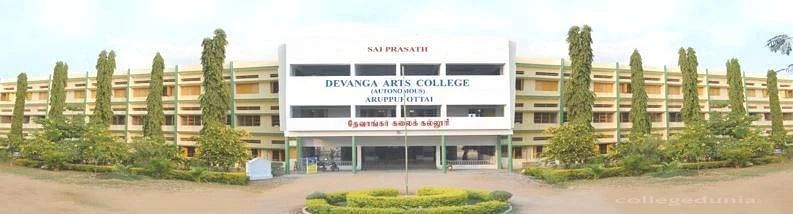
 Auditorium
 Cafeteria
 Computer Labs
 Gym
Gym Hostel
 Medical
 Science Labs
 Sports Complex
 Study Library