Loading Admission Guardian content
Loading Admission Guardian content
Provisional score based on available data. It may change as more information is verified.
Find a program, read its fee details and explore the admission requirements.
Summary of the programs shown below. Fee amounts are not listed. Contact the college for its current fee schedule.
| Course | Stream | Fees |
|---|---|---|
| Bachelor of Arts [BA] | Arts | |
| Bachelor of Science [B.Sc] | Science |
Specializations
Eligibility: 10+2
Specializations
Eligibility: 10+2
If you're looking for a traditional, government-aided women's college in Upper Assam with a long history and a focus on core arts and sciences, DeviCharan Barua Girls' College (DCB) in Jorhat is a name you'll hear often. Established in 1955, it holds the distinction of being the first women's college in the region. It’s an institution that’s deeply respected locally, known more for producing teachers and civil servants than for corporate placements. The campus, centered around a peaceful pond, offers a safe and academically focused environment, but it’s also one where you’ll hear students talk about strict hostel rules and a campus that feels a bit cramped. For the right student—one aiming for government exams or a solid foundation in subjects like Zoology—it represents incredible value. For others seeking a vibrant campus life or direct job pipelines, it might feel limiting.
DCB operates on the new FYUGP (NEP 2020) pattern, offering standard three-year Bachelor's degrees. The college's strength lies in its traditional liberal arts and science streams. For B.A., the highest intake is in Assamese and Political Science, with about 100 seats each. English, Economics, and History are also popular. On the science side, B.Sc. programs in Zoology and Botany are the most sought-after and competitive to get into, with students often citing the Zoology department as one of the best in the area. Physics, Chemistry, and Mathematics round out the science offerings.
Beyond the UG programs, they run a couple of postgraduate courses: an M.A. in Assamese and an M.Sc. in Life Sciences, each with 20 seats. There's also a self-financed Post Graduate Diploma in Computer Applications (PGDCA). The faculty is a strong point, with over 60 permanent members and a high percentage—around 60% or more—holding PhDs. The academic culture is described as rigorous and supportive, with teachers known for completing the syllabus on time. It’s a place for serious study.
Let's be clear upfront: DCB is not a placement-oriented college. Anyone advertising lakhs or crores in packages is spreading misinformation. The highest package claims you might see on some review sites (like 90 LPA or 1.37 Crore) are verified as fake marketing spam. The real picture is different.
There is no formal, high-volume campus recruitment drive for the majority of BA or BSc graduates. The primary career paths are higher education (MSc, MA, B.Ed.) or preparation for competitive exams like the Assam Public Service Commission (APSC) and UPSC. For the small number of students who do secure a job directly after graduation—often in local education, banking, or sales—the median salary ranges from ₹1.8 LPA to ₹2.4 LPA. A few companies like TCS (through its Smart Hiring program) and HDFC Bank have conducted off-campus drives or small sessions. Internships are also limited, though science students, particularly in Zoology and Botany, sometimes get project opportunities at local research institutes like NEIST or the Tocklai Tea Research Institute.
Affordability is one of DCB's biggest draws. For the 2024-2024 session, annual tuition fees are remarkably low: between ₹5,000 and ₹7,000 for B.A. programs and ₹6,000 to ₹8,500 for B.Sc. Hostel fees add another layer of cost. The admission and maintenance charge for the hostel (Devi Nivas) is around ₹10,000 per year, with monthly mess fees running ₹2,000 to ₹2,500.
Financial aid is available, primarily through state government schemes. The key one is the Assam Government's fee waiver for students whose family income is below ₹2 lakhs per annum, provided they don't have a parent in a government job. The college also administers a few merit-based memorial scholarships, like the Lakshmi Priya Memorial and Padma Baruah Memorial scholarships.
Admission is purely merit-based. For the 2024-25 and 2024-25 cycles, the college accepts scores from the Common University Entrance Test (CUET-UG). However, the primary and traditional route is through the Assam government's SAMARTH Portal, where selection is based on your Class 12 (HS) marks.
The cutoffs are high for the popular courses. For B.Sc. Zoology or Botany, you typically need between 85% to 92% in your HS exams. For sought-after B.A. streams like English or Political Science, the cutoff usually ranges from 80% to 88%. The application window generally opens in May or June, right after the AHSEC and CBSE results are declared. The process is centralized through the Samarth portal, so keep an eye on their official announcements.
The campus is compact, cited as between 2.6 to 6 acres, with 2.6 acres being the most commonly referenced size for the core area. This leads to the most frequent student complaint: it feels congested, and there's no proper playground for sports. The infrastructure is a mix. The library is decent, with over 26,000 books and digital access via N-LIST. There are 36 labs, with the Zoology and Chemistry labs noted as well-equipped. Wi-Fi exists in specific zones like the library, but students report the speed as just average.
The defining feature of campus life is the central pond—a serene spot that students love. The hostel, Devi Nivas, is known for two things: safety and strictness. With a capacity of only about 150, seats are allotted on merit. Reviews consistently mention extremely rigid rules, with recurring (though unverified by the college) complaints about mobile phones being restricted to just two hours a day (6-8 PM). The canteen food is described as mediocre. It’s a peaceful, studious environment, but not a particularly lively one.
Synthesizing feedback from portals and forums, a clear consensus emerges. On the positive side, students overwhelmingly praise the academic rigor and supportive faculty, especially in departments like Zoology. The safe and peaceful environment is a major plus for parents and students alike. And everyone agrees it offers tremendous value for money.
The negatives are just as consistent. The small, congested campus with limited sports facilities is a letdown for many. Hostel strictness is the biggest grievance, with rules often perceived as overly harsh. Infrastructure gaps—like some classrooms needing renovation and the average canteen—are noted. Students also mention that the administrative office can be slow, creating delays in paperwork.
DeviCharan Barua Girls' College is a very specific kind of institution. It's worth it if you are a student from the region seeking an affordable, safe, and academically solid foundation in traditional arts or sciences with the goal of pursuing higher studies or cracking government service exams. Its Zoology and Botany programs have a strong regional reputation. However, it's probably not the right fit if you're looking for a vibrant campus life, extensive extracurriculars, modern infrastructure, or a direct pipeline to corporate jobs. The hostel's strict regime is a deal-breaker for some. Think of DCB as a serious academic launchpad rather than a holistic college experience. For that purpose, and given its fee structure, it delivers what it promises.

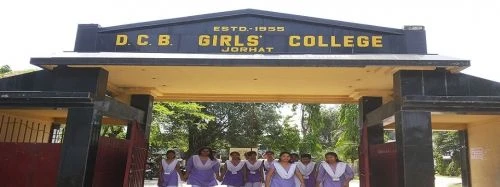

In this preview: 5 photos · 0 videos
JB College is generally ranked higher overall, but DCB is often preferred by students seeking a safe environment and is known for strong specific departments like Zoology.
The hostel rules at DCB Girls College are very strict. They include early curfews and specific, restricted hours for mobile phone usage.
No, DeviCharan Barua Girls College does not offer hostel seats to all students. Accommodation is limited to approximately 150 seats, which are allotted strictly on the basis of merit.
Yes, B.A. students may be eligible for a fee waiver under the Assam Government's "Pragyan Bharti" scheme, which is designed for students from low-income families.
Yes, DeviCharan Barua Girls College offers postgraduate courses. The primary regular PG programs are an M.A. in Assamese and an M.Sc. in Life Sciences.
Share what future students should know about DCB.
Student voices are not rewritten by colleges. We remove spam and abuse.
Wider admission question? Community PulseWhat should future students know?
Tell us which course you're considering. We'll help you work out the next step.
Get instant Partner access after mobile verification. Your public edits are reviewed before they go live.
Claim this college
 Auditorium
 Cafeteria
 Computer Labs
 Gym
Gym Hostel
 Medical
 Science Labs
 Sports Complex
 Study Library