Loading Admission Guardian content
Loading Admission Guardian content

Provisional score based on available data. It may change as more information is verified.
Find a program, read its fee details and explore the admission requirements.
Summary of the programs shown below. First-year fee. Check the note beside each amount for inclusions and exclusions.
| Course | Stream | Fees |
|---|---|---|
| Bachelor of Education [B.Ed] | Education | 45000 |
| Bachelor of Business Administration [BBA] | Management | 75000 |
| Bachelor of Technology [B.Tech] | Engineering | 80000 |
| Diploma in Pharmacy [D.Pharm] | Pharmacy | 120000 |
| Bachelor of Technology [B.Tech] {Lateral} (Civil Engineering) | Engineering |
Specializations
Eligibility: Graduation
Specializations
All accepted exams
Eligibility: 10+2
Specializations
All accepted exams
Eligibility: 10+2 with 75% + UPTAC
Specializations
Specializations
All accepted exams
Eligibility: 10+3+UPTAC
1 exam with cutoff data available
If you're looking at engineering colleges in Western Uttar Pradesh and your budget is tight, DNS College of Engineering and Technology (DNSCET) in Amroha is a name you'll encounter. It's a sprawling 40-acre campus on the Delhi-Lucknow highway, offering some of the lowest tuition fees in the region. But that affordability comes with a well-documented trade-off. Student reviews are blunt: this is a place where you get your AKTU degree, but you're largely on your own for building a career. The gap between the college's promotional claims and the on-ground student experience is, frankly, the most critical thing to understand before you consider applying.
DNSCET operates as a group of institutions, with engineering as its core offering under AKTU. The B.Tech program includes standard branches: Computer Science and Engineering (CSE) with the highest intake, followed by Mechanical, Civil, Electrical, ECE, and IT. They also run MBA, M.Tech, Polytechnic (Diploma), B.Pharm, B.Ed, and BBA programs.
The academic rhythm is dictated entirely by the AKTU calendar. You'll follow their syllabus, their exam schedule, and their notorious paper-checking delays. Faculty is a mixed bag, and student feedback skews negative. There are PhD holders, typically the HODs, but a significant portion of the teaching staff consists of recent graduates or those with limited industry experience. Turnover can be high. That means while the curriculum is set, the quality of delivery in the classroom is inconsistent. You might get a passionate teacher one semester and someone just reading from a PDF the next. It's a setup that demands a high degree of self-study from day one, especially in a fast-moving field like CSE.
This is the section where you need to read carefully. The college's official materials and website often tout "100% placement assistance." In the world of private engineering colleges, that phrase is a classic weasel word. Assistance doesn't mean an offer letter.
Here’s the consensus from aggregated reviews on platforms like Shiksha and MouthShut: the actual on-campus placement rate for B.Tech is likely below 30-40%. For core branches like Civil and Mechanical, it's negligible. The companies that do visit are largely IT service giants like TCS, Wipro, Infosys, and HCL, along with BPOs like Genpact. Packages for these on-campus roles typically fall in the 2.5 to 3.2 LPA range. Claims of 6 or 10 LPA packages are, according to alumni, exceptional outliers not representative of the cohort.
Most students secure jobs through off-campus drives, the AKTU central portal, or by relocating to NCR after graduation. The Training & Placement Cell exists, but its efficacy is a common complaint. The verdict from former students is clear: view DNSCET as a degree-granting institution, not a placement gateway. Your job hunt will be a personal project.
The primary draw here is cost. With annual tuition fees between ₹55,000 and ₹80,000 for B.Tech, it's one of the most affordable private engineering options in the state. A full four-year degree can cost roughly ₹2.4 to ₹3.2 lakhs in tuition. Add to that hostel and mess charges, which run about ₹50,000-₹55,000 per year. There are additional one-time and annual fees for uniforms, exams (paid to AKTU), and security deposits.
Where the financial picture gets interesting is scholarships. The college actively facilitates UP Government schemes (like Saksham) for SC, ST, OBC, and EWS students. For eligible candidates, these scholarships can cover a substantial portion, if not all, of the tuition fee. This is a major reason many local students from reserved categories choose DNSCET. It makes a professional degree financially accessible.
The path in is straightforward and not intensely competitive. For B.Tech, 85% of seats are filled through the state's UPTAC counseling based on your JEE Main score. The cutoffs here are low; you don't need a top rank. The remaining 15% are management quota seats, where admission is granted directly by the college based on your 10+2 (PCM) marks. If you have around 50-60% in PCM, you can typically secure a direct admission spot in most branches, though CSE might require a slightly higher percentage.
For MBA, they accept scores from CUET-PG, CAT, or MAT. Polytechnic admissions go through the state's JEECUP exam. The process isn't complicated. If you meet the basic eligibility and have the funds (or scholarship), you're likely in.
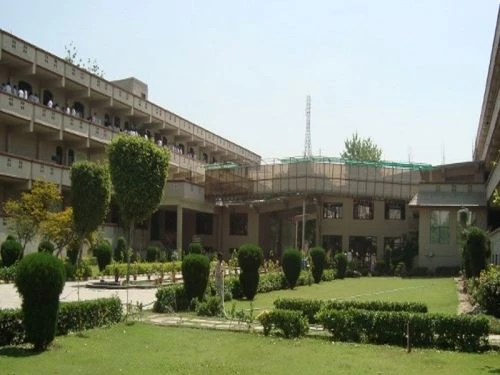
The 40-acre campus is the college's most visually impressive asset. Compared to other local private institutes crammed into city plots, the space feels open. There are sports facilities—a large cricket field, volleyball courts, and indoor game rooms. Infrastructure includes departmental labs, though student reports suggest equipment in core engineering labs can be outdated or poorly maintained. The library has a physical collection and digital access via AKTU.
Hostels are separate for boys and girls, housing around 500 students. Rooms are described as basic, often accommodating 3-6 students. Common complaints in reviews point to maintenance issues: dirty washrooms, broken furniture in classrooms, and inconsistent Wi-Fi that doesn't cover the entire campus. The cafeteria and food quality in the mess are frequent points of criticism. On the plus side, the location on NH-24 makes it accessible for day scholars from Amroha, Moradabad, and nearby towns. The college also runs a fleet of buses for transportation.
Synthesizing the feedback gives you a clear, if stark, picture. The median student view is that DNSCET is a classic Tier-3, budget-friendly college. It serves a specific purpose.
Positives consistently highlighted are affordability, the spacious campus, and the highway location for commute. The facilitation of government scholarships is a huge plus for eligible students.
The negatives are more numerous and specific. Beyond the placement reality already discussed, faculty quality is the biggest academic grievance. Phrases like "freshers who just read from books" appear often. Administrative rigidity and unprofessional behavior during exam conduction are also reported. There's a palpable sentiment that the management's focus is on admissions, with support tapering off after you enroll.
As one review summarized: "The college focuses only on admissions; once you are in, you are on your own for placements." Another noted, "Infrastructure looks good from the outside, but labs lack working equipment."
DNSCET is a college of specific, limited utility. It's worth serious consideration only if you fit a particular profile. If you are a local student from Amroha or Western UP, have a constrained budget, and are eligible for a state government scholarship that will cover your fees, it provides a legitimate path to an AKTU B.Tech or MBA degree. In this scenario, the low cost mitigates the risk of poor placements.
However, if you have higher aspirations, the ability to pay more, or the option to migrate, you should almost certainly look elsewhere. It is not a good choice for students seeking vibrant campus life, high-quality teaching, or a reliable on-campus placement pipeline. For core engineering branches (Mechanical, Civil), it's a particularly weak option due to the near absence of relevant recruiters. Ultimately, it's a functional, no-frills institution for obtaining a degree with minimal financial outlay. Everything else—skills, internships, a good job—will be up to you.
For official information, you can visit the DNS College website. To verify its university affiliation and standing, you can check the AKTU affiliated college list.

In this preview: 1 photo · 0 videos
The college is considered acceptable for obtaining a CSE degree. However, prospective students should be aware that the core curriculum and faculty are basic. Success in the field will require significant independent learning of key programming languages and technologies like Java, Python, and the MERN stack.
While official college claims often cite very high placement percentages, the realistic on-campus placement rate for students is reported to be closer to 20-30%. The majority of these secured positions are typically in BPOs or small-scale technology firms.
Yes, direct admission is possible through the Management Quota. To be eligible for this route, candidates generally need to have secured a minimum of 50% marks in their 10+2 examination with Physics, Chemistry, and Mathematics (PCM).
The hostel facilities are described as average. A common point of feedback from students is that the food quality is a frequent complaint. On a positive note, the hostel rooms themselves are reported to be spacious.
Yes, the college facilitates scholarships, primarily by helping students apply for the UP Government Scholarship scheme. This opportunity is noted as a major draw for eligible students, particularly those from reserved categories.
Share what future students should know about DNS College of Engineering and Technology.
Student voices are not rewritten by colleges. We remove spam and abuse.
Wider admission question? Community PulseWhat should future students know?
Tell us which course you're considering. We'll help you work out the next step.
Get instant Partner access after mobile verification. Your public edits are reviewed before they go live.
Claim this college
 Auditorium
 Cafeteria
 Computer Labs
 Medical
 Science Labs
 Sports Complex
 Study Library