Loading Admission Guardian content
Loading Admission Guardian content

Provisional score based on available data. It may change as more information is verified.
Find a program, read its fee details and explore the admission requirements.
Summary of the programs shown below. First-year fee. Check the note beside each amount for inclusions and exclusions.
| Course | Stream | Fees |
|---|---|---|
| Bachelor of Arts [BA] | Arts | 2305 |
| Bachelor of Commerce [B.Com] | Commerce | 2435 |
| Bachelor of Arts [BA] {Hons.} | Arts | 3110 |
| Bachelor of Commerce [B.Com] {Hons.} (Accountancy) | Commerce | 3240 |
Specializations
Eligibility: 10+2
Specializations
Eligibility: 10+2
Specializations
Eligibility: 10+2
Specializations
Eligibility: 10+2
Dr. Gour Mohan Roy College in Monteswar, West Bengal, is a story of access, not ambition. Established in 1986, this government-aided college under the University of Burdwan serves a clear, vital purpose: providing an affordable, quality undergraduate degree to students in a rural belt. With first-year fees often under ₹3,500 and a strong focus on women's education, it’s a lifeline for thousands. But you need to understand what it is—and what it isn’t. This isn't a campus where recruiters from MNCs line up. The official NIRF 2026 report is blunt: zero students placed through campus interviews for three consecutive years. The real outcome here is a respected degree, a foundation for higher studies or government exams, and a step up for a community. That’s its success metric.
The college operates under the NEP 2020 framework mandated by Burdwan University, offering both 3-year and 4-year UG degree options. The academic portfolio is classic for a West Bengal general degree college, heavy on arts and sciences. Honours programs are available in Bengali, English, History, Political Science, Philosophy, Sanskrit, Sociology, Education, Physics, Chemistry, Mathematics, Botany, Zoology, and Accountancy (B.Com). Geography is a notable strength, often cited by students as a well-run department with lab facilities and field tours. The sanctioned intake is sizable—over 1,400 for 3-year and 800 for 4-year programs—reflecting its role as a district education hub. Faculty quality is the college's strongest card in student reviews. With a core of around 40-50 permanent teachers, students consistently describe professors as helpful, approachable, and dedicated. The academic culture is traditional and lecture-based, geared towards mastering the University of Burdwan syllabus. It’s a place for foundational learning, not experimental pedagogy.
Let's be unequivocal: campus placements, in the corporate sense, do not exist here. The data from the official NIRF Rankings portal for the 2024, 2024, and 2026 reporting cycles lists the number of students placed as "0." The highest and average package are also recorded as 0 LPA. This isn't an oversight; it's the reality for nearly all rural general degree colleges in the state. The career pathway is different. The primary documented outcome is progression to higher studies. In the 2024-25 academic year, 602 students were selected for postgraduate programs; the year before, it was 750. After their degree, students typically prepare for the West Bengal Primary TET, Upper Primary TET, SSC, WBCS, or pursue CA/CMA certifications independently. Some take up local tutoring or retail jobs. The college provides the degree credential and knowledge base for these paths, but zero recruitment infrastructure. If you're looking for on-campus job fairs, you are looking at the wrong institution entirely.
Affordability is the cornerstone of DGMRC's value proposition. Fees are heavily subsidized by the state government. For the 2024-25 session, first-year costs are remarkably low: around ₹2,305 for BA General and between ₹3,110 to ₹3,240 for Honours programs in Arts or Commerce. Over three years, the total tuition cost typically stays between ₹7,000 and ₹12,000. The ladies' hostel fee is equally subsidized, ranging from ₹2,000 to ₹4,000 per annum. This low cost is complemented by robust scholarship access. The college actively facilitates applications for the West Bengal government's Kanyashree Prakalpa (K1 & K2) scholarships, a major draw for its significant female student population. The Swami Vivekananda Merit-cum-Means Scholarship (SVMCM) and OASIS scholarships for SC/ST/OBC students are also widely availed. The financial model makes a bachelor's degree attainable for families where even ₹50,000 a year is prohibitive.
Admission is straightforward and merit-based. There are no entrance exams. Eligibility hinges entirely on your marks in the West Bengal Council of Higher Secondary Education (WBCHSE) or equivalent board's 10+2 examination. The process is conducted online through the college's admission portal, typically opening in June or July. After applications close, the college publishes subject-wise merit lists. Selection happens through an online counseling round where you choose your seat based on your rank. Cutoffs vary significantly by subject popularity. For general category seats in sought-after departments like English Honours or Geography Honours, you'll often need scores above 75-80% in the relevant subject. Less competitive subjects may fill seats at the university's minimum eligibility mark, which is usually around 45-50%. It's a transparent, score-driven system. Keep an eye on the official college website for notification dates.
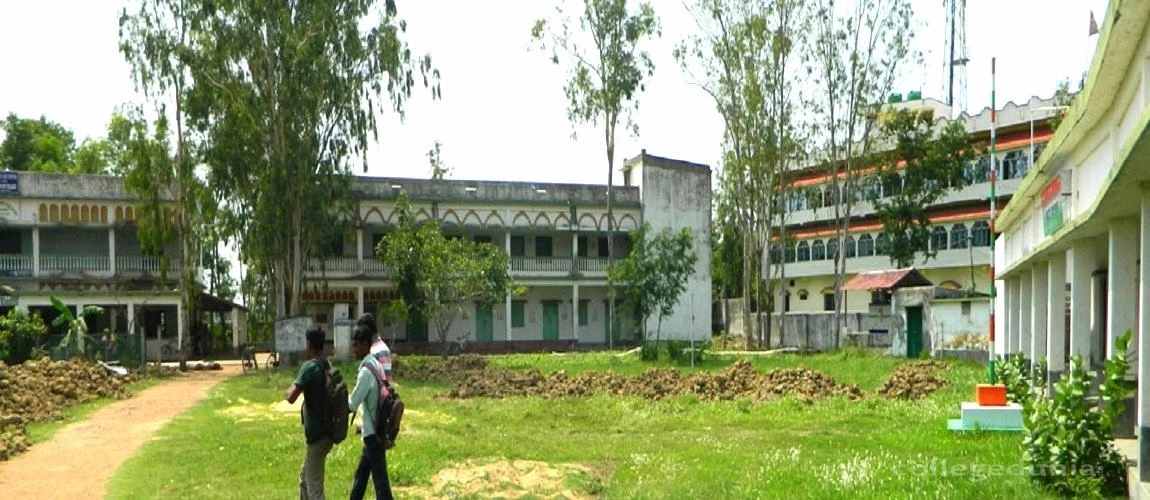
The campus is functional, not flashy. Spread over 4 acres, it's described in reviews as "simple but clean" and an "oasis in the desert" for local students. Infrastructure includes a central library with a reading room and over 15,000 books, plus access to digital resources via INFLIBNET's N-LIST. Science departments have basic but maintained labs for practical work. There's a Wi-Fi network, though coverage can be spotty. A multi-gym, a canteen serving subsidized meals, an auditorium, and a large playground for football and cricket round out the facilities. Hostel life is primarily for women. The ladies' hostel is a three-tier building with about 50 rooms and is rated positively for safety and security. For male students, the situation is different. A dedicated boys' hostel isn't currently operational, so students rely on private paying guest accommodations or mess facilities in the nearby town. Social life revolves around college festivals, departmental events, and the ubiquitous adda in the canteen or grounds. Some student reviews note that union politics can occasionally become intrusive, which is a common feature in many Bengali colleges.
The consensus from platforms like CollegeDunia and Shiksha is strikingly consistent. Teaching quality receives glowing praise, with ratings often above 4.5/5. Faculty are repeatedly called "supportive," "knowledgeable," and "pious." The value-for-money aspect is the other major positive. Reviews are filled with phrases like "best college in our local area" and "boon for poor students." The supportive environment for women, thanks to Kanyashree and the secure hostel, is a frequent highlight. The negatives are just as clear. The complete absence of placement support is the biggest gripe, with a typical sentiment being, "Don't come here expecting a job; come for the degree." The rural location means limited exposure to urban professional networks or internships. Occasional disruptions from student politics are also mentioned. Students understand the trade-off: you get dedicated teachers and a reputable Burdwan University degree at a rock-bottom price, but you are entirely on your own for career steps after graduation.
It depends entirely on your context and expectations. For a student from Monteswar or the surrounding rural blocks of Purba Bardhaman district, DGMRC is an excellent and often the only viable choice. It provides a quality education from engaged teachers, a safe environment (especially for women), and a recognized degree—all for a sum that won't burden a family. It's a perfect launchpad for someone aiming to complete a BA or B.Sc and then immediately prepare for WBCS, TET, or a Master's program. However, if you are from an urban center looking for a "college experience" with clubs, internships, and placement drives, you will be deeply disappointed. This college doesn't offer that ecosystem. Its worth is measured in accessibility and academic foundation, not in corporate outcomes. For its intended demographic, it fulfills its role very well. For others, it's simply not designed to meet those needs.
Yes, the Geography Honours department is one of the most popular at the college. It is known for its dedicated laboratory facilities and maintains a tradition of organizing field tours for students.
No, the college does not typically provide placement assistance for B.Com students. Graduates from this program usually pursue higher studies like M.Com or professional courses such as CA or CMA independently.
Currently, the college primarily offers a Ladies Hostel. Male students generally stay in private accommodations available in the vicinity of the college.
While the general eligibility criterion is 45-50%, admission is competitive. For popular subjects like English and Geography Honours, the cut-off percentages often close above 70%.
Dr. Gour Mohan Roy College is a government-aided public college. It is affiliated with the University of Burdwan.
Share what future students should know about Dr Gour Mohan Roy College.
Student voices are not rewritten by colleges. We remove spam and abuse.
Wider admission question? Community PulseWhat should future students know?
Tell us which course you're considering. We'll help you work out the next step.
Get instant Partner access after mobile verification. Your public edits are reviewed before they go live.
Claim this college Auditorium
 Cafeteria
 Computer Labs
 Medical
 Study Library