Loading Admission Guardian content
Loading Admission Guardian content

Provisional score based on available data. It may change as more information is verified.
Find a program, read its fee details and explore the admission requirements.
Summary of the programs shown below. Fee amounts are not listed. Contact the college for its current fee schedule.
| Course | Stream | Fees |
|---|---|---|
| Bachelor of Arts [BA] | Arts | |
| Bachelor of Computer Applications [BCA] | Computer Applications | |
| Bachelor of Science [B.Sc] | Science |
Specializations
Eligibility: 10+2
Specializations
Eligibility: 10+2
Specializations
Eligibility: 10+2
Gore Lal Mehta College sits on 30 acres in Banmankhi, a subdivisional town in Bihar's Purnea district. Established in 1955 and now a constituent college of Purnea University, it’s a classic example of a regional government institution—offering basic undergraduate education to local students at a very low cost. The story here is one of stark contradictions. The official website lists a full suite of facilities, but student reviews paint a picture of significant gaps in basic infrastructure. It’s a college where the promise on paper doesn’t always match the reality on the ground, yet for many in the region, it remains a primary, affordable gateway to a degree. If you’re looking at it from outside Bihar, you’ll need to calibrate your expectations. This isn’t a nationally competitive campus. It’s a local institution serving a local need, with all the attendant strengths and limitations.
The college sticks to foundational undergraduate streams. You won’t find niche specializations or professional courses outside of B.C.A. The offerings are straightforward: B.A., B.Sc., B.Com, and B.C.A. Specializations within B.A. include English, Hindi, History, Political Science, and Philosophy. For B.Sc., students can opt for Physics, Chemistry, Botany, Zoology, or Mathematics. The B.C.A. program, with its significantly higher fee, is the sole offering in the computer applications space.
Faculty strength is listed at around two dozen teachers. Several hold PhDs, indicated by the ‘Dr.’ prefix in the department listings on the college website. Names like Dr. U. N. Singh (Principal), Dr. T. N. Yadav, and Dr. Giridhari Prasad Hazra suggest a core of qualified senior faculty. The academic calendar follows a semester system, evident from notices for UG Sem-IV exams. A mention of ‘smart classes’ is the only nod to modern teaching infrastructure. There’s no data on industry tie-ups or MoUs, which aligns with the college’s traditional, theory-focused model.
This is the biggest data black hole. There are no official figures for highest, average, or median packages. No list of top recruiters exists in the public domain. The placement picture is entirely shaped by conflicting student feedback, which itself is sparse. One review on Shiksha gave placements a rating of 4, while Collegedunia shows a dismal 1.5. An unverified student claim suggests “lots of students get jobs before graduation,” but without sector or role details, it’s impossible to evaluate.
Another review flatly stated they received no internships. The takeaway? You cannot come to Gore Lal Mehta College with any expectation of structured, campus-driven placement support. Any job outcomes will almost certainly be the result of individual student hustle, family networks, or government exam preparation. The B.C.A. program, given its cost, raises questions about return on investment without a placement cell to facilitate IT sector entry.
The fee structure is its most compelling feature, especially for the arts and science streams. At roughly ₹4,500 per year for B.A. and ₹5,400 for B.Sc., the cost is negligible compared to private colleges. The B.C.A. fee of ₹45,000 annually is an outlier, nearly ten times higher, and needs to be scrutinized against the lack of placement assurance.
Then there’s the hostel situation. The college charges a hostel fee of ₹500, but multiple student reviews assert that actual hostel facilities are not available. If true, this is a serious administrative red flag. A mess facility is also reported as absent. Other mandatory fees add around ₹700. Scholarships are offered, reportedly focusing on meritorious students and those from lower caste categories, which is standard for government colleges in Bihar.
Admission is refreshingly simple—and entirely marks-based. There are no entrance exams. Eligibility hinges on your 10+2 marks from recognized boards like CBSE or BSEB. The general cutoff is stated as more than 50% in Class 12. For B.Sc., an unverified source mentions a 60% cutoff in Biology, suggesting some subject-specific requirements for science streams.
The process is online via the college portal, involving registration, OTP verification, and a multi-tab form. Application fees are minimal (e.g., ₹100 for Intermediate Spot Apply). Admission lists are released in cycles, with a fourth list for UG Sem-I (2025-29) having a deadline as late as October 10, 2025. This extended timeline is common in state university systems. There’s no mention of an NRI or management quota.
Here’s where the contradiction between official claims and student experience becomes impossible to ignore. The college website lists a library, labs, hostel, Wi-Fi, medical facilities, and a canteen. Student reviews directly contest almost all of these.
One review states there is “no lab, no library, no food/mess facility, no medical facilities, and no sports and game facilities.” Another says Wi-Fi is “not yet established.” The most damning is the repeated claim that a hostel fee is charged but no hostel exists. It’s a classic case of “pay for the facility, but don’t expect to use it.”
On the positive side, the campus is large (30 acres) and has basic academic buildings, smart classes, and two playgrounds. The list of sports activities is surprisingly long—from cricket and football to kabaddi and track events—and an annual sports meet is held. Cultural events are also organized. Social life seems to be what you make of it; one student lamented no campus crowd, while another called it the “best life in College.” Your experience will likely depend on your peer group.
The sentiment is deeply mixed, and you have to read between the lines. On faculty, there’s relative consensus: a 3/5 rating, with comments praising teachers as decent, qualified, and experienced. One even called the teaching quality “best.” That’s the consistent bright spot.
The overwhelming negativity is reserved for infrastructure and administration. The litany of “no library, no lab, no hostel” complaints points to a significant gap between promised and delivered services. Charging a fee for a non-existent hostel is a major trust issue. Exams are described as difficult and often conducted late, which can delay academic timelines.
Placement reviews are too scarce and contradictory to form a clear picture. The college seems to function adequately for students who live locally, have low cost expectations, and value a basic degree. For anyone needing residential facilities or career support, the reviews sound multiple alarms.
It depends entirely on your context and what you’re optimizing for. If you are a student from the Purnea/Banmankhi region looking for an ultra-affordable way to earn a B.A. or B.Sc. degree from a government college, Gore Lal Mehta College serves that purpose. The faculty is reportedly decent, and the cost is almost impossibly low. For a commuter student, it’s a functional, no-frills option.
However, if you require hostel accommodation, look elsewhere immediately—the evidence suggests you’ll pay for it but not get it. If you’re enrolling in the B.C.A. program, seriously question the ₹45,000 annual fee against the complete lack of visible IT placement records. If you’re from outside Bihar and comparing it to colleges with better infrastructure, this isn’t a competitive choice.
In short, it’s a classic local college for local students. Its value is defined by its accessibility and price, not by its amenities or career launchpad. Go in with eyes wide open about the infrastructure gaps, and it can be a viable path to a degree. Expect anything more, and you’ll be disappointed.

In this preview: 1 photo · 0 videos
The main UG programs are Bachelor of Arts (B.A.), Bachelor of Science (B.Sc.), Bachelor of Commerce (B.Com), and Bachelor of Computer Applications (B.C.A.). For the 2026 academic session, the approximate annual tuition fees are ₹4,500 for B.A., ₹5,400 for B.Sc., and ₹45,000 for B.C.A. B.Com fees were not specified in the latest available data.
This is a major point of contention. The college's official website lists a hostel as a facility and charges a hostel fee of ₹500. However, multiple student reviews state that actual hostel facilities are not available on campus, despite the fee being levied. Prospective students should verify this situation directly with the college administration before admission.
Admission is merit-based, relying solely on marks obtained in the 10+2 examination (CBSE or BSEB). Candidates generally need more than 50% marks in Class 12, with some science streams potentially having higher subject-specific cutoffs. The entire process is conducted online through the college portal, involving registration, OTP verification, and form submission with a nominal application fee.
Student reviews consistently rate the faculty as a positive aspect, with an average rating of 3 out of 5. Feedback describes teachers as decent, qualified, and experienced. Some students have specifically praised the teaching quality. This stands in contrast to more negative reviews concerning campus infrastructure.
Yes, the college offers scholarships for meritorious students. Additionally, various government scholarship schemes are organized, which, according to some student accounts, are primarily accessed by students from reserved categories, as is common in many government colleges in Bihar.
Share what future students should know about Gore Lal Mehta College.
Student voices are not rewritten by colleges. We remove spam and abuse.
Wider admission question? Community PulseWhat should future students know?
Tell us which course you're considering. We'll help you work out the next step.
Get instant Partner access after mobile verification. Your public edits are reviewed before they go live.
Claim this college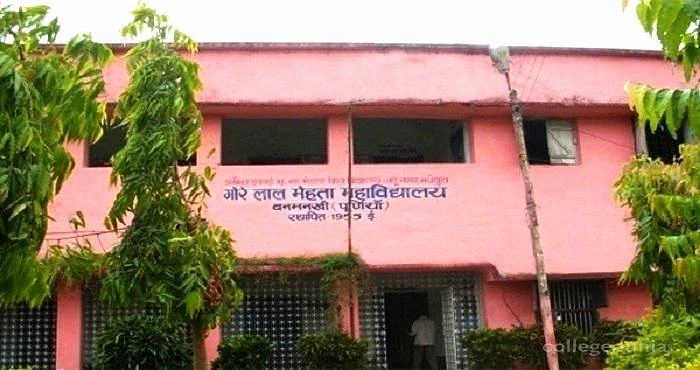
 Auditorium
 Cafeteria
 Computer Labs
 Gym
Gym Hostel
 Medical
 Science Labs
 Sports Complex
 Study Library