Loading Admission Guardian content
Loading Admission Guardian content

Provisional score based on available data. It may change as more information is verified.
Find a program, read its fee details and explore the admission requirements.
Summary of the programs shown below. First-year fee. Check the note beside each amount for inclusions and exclusions.
| Course | Stream | Fees |
|---|---|---|
| Bachelor of Arts [BA] | Arts | 2580 |
| Bachelor of Commerce [B.Com] | Commerce | 2580 |
| Bachelor of Science [B.Sc] | Science | 2580 |
| Master of Arts [MA] (Kannada) | Arts | 4000 |
| Master of Science [M.Sc] (Industrial Chemistry) | Science | 6000 |
Specializations
Eligibility: 10+2
Specializations
Eligibility: 10+2
Specializations
Eligibility: 10+2
Specializations
Eligibility: Graduation
Specializations
Eligibility: Graduation
 Kansai Nerolac Paints Ltd
Government Arts and Science College in Karwar is a study in contrasts. It’s a government institution with fees that are almost laughably low—under ₹3,000 a year for most undergraduate degrees. And it sits on a surprisingly lush, green 4.5-acre campus in coastal Uttara Kannada. But ask about placements, and you’ll get a shrug. The data just isn’t there. This isn’t a college for corporate pipeline dreams. It’s a foundational, affordable gateway to higher education for the region, with a solid NAAC ‘A’ grade accreditation from its last cycle and a faculty that students consistently praise. If you’re looking for a no-frills, academically sound government college where the primary investment is your time and effort, not a massive loan, this place has a clear role. Just don’t expect a glossy brochure experience.
This is a classic arts and science college model, heavy on fundamentals. The intake numbers tell the story: 280 seats each for B.A. and B.Sc., and about 150 for B.Com. That’s where the bulk of the student body is. They’ve added more contemporary options like BBA and BCA, but the soul of the place is in the traditional combinations.
For B.A., you’re looking at pairings like History, Economics, and Kannada or Political Science. Sociology makes an appearance too. The B.Sc. options are firmly in the life and physical sciences—Biotechnology with Botany and Chemistry, or the standard PCM (Physics, Chemistry, Mathematics) track. It’s a straightforward, no-nonsense curriculum governed by Karnatak University, though the autonomous status allows for some internal control.
At the postgraduate level, the offerings are narrower but focused: M.A. in Kannada, and M.Sc. in Industrial Chemistry, Zoology, and Computer Science. The faculty count listed in the brief is curiously low (14 dedicated, 8 total), which might be a data discrepancy or reflect a core permanent staff supplemented by visiting faculty. What’s not in doubt, according to student reviews, is their quality. The college also hosts a Karnataka State Open University study centre and runs NCC and NSS programs, which is pretty standard for a government college. An interesting future plan is a proposed Diploma in Phyto-Pharmaceutical Technology, hinting at a desire to link with local industry.
Here’s the blunt truth: there is no published placement data. No highest package, no average package, no median package, and no list of top recruiters. In the context of a government arts and science college in a non-metro location, that’s not entirely shocking, but it’s a critical gap for prospective students to understand.
The student sentiment metrics are telling. On Collegedunia, the placement rating is a low 2.5 out of 5. That’s the hard number that confirms the anecdotal reality. This isn’t a campus where major corporates line up for recruitment drives. Career outcomes are far more likely to be self-driven—students preparing for government exams, competitive tests, or pursuing higher studies. The college’s value is in providing the degree and the knowledge, not a job offer at the end of it. If a structured placement cell with high-volume recruitment is your priority, you’ll need to look at larger universities or private institutes in bigger cities.
This is where the college’s government status shines. The fees are a throwback. First-year tuition for B.A., B.Sc., and B.Com. was ₹2,580 as of 2019-20. Even for postgraduate courses, it maxes out at around ₹6,000 for an M.Sc. A total course fee figure of ₹15,610 was noted for 2023, which is almost comically affordable in today’s higher education market. Hostel fees aren’t specified, but given the tuition, they will be minimal.
The flip side of low fees is that infrastructure and amenities might not be "premium." But the college counters this with a robust scholarship apparatus aimed at its demographic. They list support for SC/ST, OBC, and Minority students, along with specific named scholarships like Rajeev Gandhi, C.V. Raman, and Sanchi Honnamma. For eligible students from the region, this combination of ultra-low fees and scholarship access makes it a viable, debt-free option.
Admissions are merit-based, pure and simple. There’s no mention of entrance exams. For UG courses, your 10+2 or Karnataka PUC marks are the sole ticket. For PG courses, it’s your bachelor’s degree percentage in the relevant field. The process is administrative and transparent: get the form from the college website or office, submit your docs, wait for the merit list, attend counselling, and pay the fees.
They don’t publish cutoff ranks or percentiles, which is common for colleges that fill seats through university-affiliated centralised or local merit lists. The intake numbers are fixed (280 for BA/B.Sc., etc.), so admission depends on how many applicants are above you on the list for your chosen combination. It’s not a high-stakes, high-competition game like engineering or medicine. For many students, it’s about meeting the basic eligibility and securing a seat in a government institution.
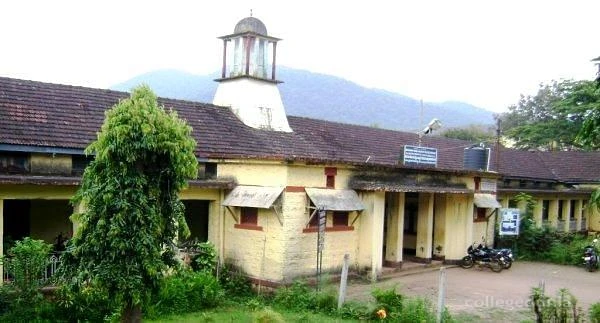
The campus itself gets high marks. Reviews describe a pollution-free, green space with good landscaping—a pleasant environment to be in. Infrastructure is a mixed bag in the best way. Academically, they claim 10 well-equipped labs and a library with over 35,000 books, which is a decent stock for a college of this size.
Where it surprisingly punches above its weight is in sports. The list is extensive: large playgrounds for cricket and football, an indoor sports hall, basketball and tennis courts, a gymnasium with a fitness lab, and even equipment for archery, wrestling, and weightlifting. For a small government college, these facilities are a significant asset and suggest a focus on extracurricular development.
There are separate hostels for boys and girls, with the boys' hostel having a 48-student capacity. Reviews say they provide a secure, study-friendly atmosphere. A canteen and basic medical facilities are on campus. Wi-Fi is noted as available, but speed and coverage aren’t specified. Don’t expect a sprawling, tech-saturated campus. Expect a functional, clean, and activity-friendly one.
Synthesizing the feedback, a clear picture emerges. Students are very satisfied with the core academic delivery. The faculty gets a 4.5/5 rating on Collegedunia, with comments highlighting their qualifications and commitment. The teaching quality is consistently the top positive.
Infrastructure and campus life are also praised. The green campus, the library, the sports facilities, and the hostel environment all get good mentions. The social life is described as vibrant with various activities, which aligns with the strong NSS/NCC presence and the range of sports available.
The overwhelming negative, as noted, is placements. The 2.5/5 rating is a major red flag for students with immediate corporate job aspirations. There’s no sugar-coating it. The other common gripe in many government colleges—bureaucratic administrative delays—isn’t explicitly mentioned but is always a potential factor. Ragging is stated to be strictly prohibited.
It’s worth it for a very specific student profile. If you are a learner from the Uttara Kannada region or surrounding areas looking for an accredited, affordable, and academically solid government college to complete your BA, B.Sc., or B.Com., this is a compelling option. The cost is negligible, the faculty is good, and the campus is conducive to studying and extracurriculars. It’s an excellent launchpad for preparing for competitive exams like UPSC, KPSC, banking, or for pursuing an MSc or PhD later.
However, if your primary goal is a bachelor’s degree that leads directly to a campus placement in a private company, you will likely be disappointed. The placement support appears minimal. Also, if you crave the anonymity and vast opportunities of a big city university, this small-town campus might feel limiting. Ultimately, this college fulfills a vital, traditional role in the higher education ecosystem: providing accessible quality education. It does that job well, as long as you understand exactly what it is—and isn’t—offering.
In this preview: 1 photo · 0 videos
The college offers traditional undergraduate programs including Bachelor of Arts (B.A.), Bachelor of Science (B.Sc.), and Bachelor of Commerce (B.Com.) with high intake, alongside BBA, BCA, and BVA. Postgraduate options include M.A. in Kannada, and M.Sc. in Industrial Chemistry, Zoology, and Computer Science, as well as M.Com.
Admission is strictly merit-based. For UG courses, eligibility is based on marks in the 10+2 or equivalent exam. For PG courses, it's based on the percentage in the relevant bachelor's degree. The process involves submitting an application form (available from the college office or website), document verification, merit list publication, counselling, and fee payment.
Fees are extremely low, characteristic of a government college. As per older data, first-year tuition was around ₹2,580 for B.A./B.Sc./B.Com., ₹6,000 for M.Sc., and ₹4,000 for M.A. Numerous scholarships are available, including SC/ST, OBC, Minorities, Rajeev Gandhi, C.V. Raman, and Sanchi Honnamma scholarships, making it highly accessible.
The 4.5-acre campus features separate hostels, a library with 35,000+ books, 10 academic laboratories, and exceptional sports facilities including large playgrounds, an indoor sports hall, a gym, and courts for basketball, tennis, and badminton. It also has Wi-Fi, a canteen, a medical facility, and an auditorium.
Student reviews consistently praise the faculty, rating them 4.5/5 for being qualified and committed. However, placement opportunities are a significant concern, receiving a low rating of 2.5/5. The college does not publish placement statistics, indicating that career outcomes are largely self-driven or through higher studies.
Share what future students should know about Government Arts and Science College.
Student voices are not rewritten by colleges. We remove spam and abuse.
Wider admission question? Community PulseWhat should future students know?
Tell us which course you're considering. We'll help you work out the next step.
Get instant Partner access after mobile verification. Your public edits are reviewed before they go live.
Claim this college
 Cafeteria
 Communication Centre
 Computer Labs
 Medical
 Science Labs
 Study Library