Loading Admission Guardian content
Loading Admission Guardian content

Provisional score based on available data. It may change as more information is verified.
Find a program, read its fee details and explore the admission requirements.
Summary of the programs shown below. Programs record different fee periods. Compare the individual amounts and their notes below.
| Course | Stream | Fees |
|---|---|---|
| Master of Arts [MA] | Arts | 590 |
| Master of Science [M.Sc] | Science | 610 |
| Bachelor of Arts [BA] | Arts | 1345 |
| Bachelor of Business Administration [BBA] | Management | 1345 |
| Bachelor of Science [B.Sc] | Science | 1365 |
Specializations
Eligibility: Graduation
Specializations
Eligibility: Graduation
Specializations
Eligibility: 10+2
Specializations
Eligibility: 10+2
Specializations
Eligibility: 10+2
Government Arts College for Women in Sivaganga is a study in contrasts. It’s a government institution on a 7.5-acre campus offering an incredibly affordable education—think annual tuition fees under ₹2,100 for most programs. With over 2,700 students and 23 courses, it’s a significant educational hub for women in the region. But the data tells a clear story: this is a college for building a foundation, not a corporate launchpad. Placement percentages are in the single digits, and the median salary for graduates hovers around ₹2 LPA. For students seeking a low-cost, supportive environment to earn a degree from Alagappa University before pursuing higher studies or government jobs, it’s a pragmatic choice. For those with eyes set on immediate, high-paying corporate placements, the picture is different.
The college runs a classic arts and sciences curriculum typical of an Alagappa University affiliate. You’ve got the standard trio of undergraduate streams: B.A., B.Sc., and B.Com., plus a BBA. The B.Sc. options are fairly robust for a government arts college—Computer Science, Physics, Chemistry, Mathematics, Botany, Zoology, and Home Science. On the arts side, B.A. programs in Tamil, English, History, and Economics cover the essentials.
At the postgraduate level, the offerings narrow to M.Sc. in Computer Science, Mathematics, Chemistry, and Home Science; M.A. in Tamil and Economics; and an M.Com. They also offer M.Phil and Ph.D. programs, primarily in Commerce and Tamil.
With a total of 14 faculty members (including the principal, Dr. R.R. Jeyanthi) for over 2,700 students, the student-teacher ratio is high. That’s the reality of many government colleges. The teaching medium is English across all courses. Where this college tries to differentiate is in academic support. They offer remedial coaching and special entry-into-services coaching for SC, ST, OBC (Non-Creamy Layer), and minority students. There’s also mention of coaching for slow learners. It’s a clear effort to provide a ladder for students who might need extra help. Don’t expect industry MoUs or cutting-edge corporate collaborations here. The academic model is traditional, university-driven, and focused on core syllabus completion.
Let’s be direct. The placement cell here is not a primary gateway to the workforce for most students. The official data for 2024 makes that clear.
Placement percentages are modest, to put it mildly. For Undergraduate Arts, Humanities and Social Sciences, it was 1.23%. For the Postgraduate cohort in the same streams, it was 4.39%. The college notes that a “significant number of students opt for higher studies,” which aligns with the low placement activity. It’s a common path in such institutions.
For the few who do get placed, the compensation is entry-level. The median salary for UG Arts/Humanities graduates was ₹2.40 LPA. For PG graduates in the same fields, it was ₹2.16 LPA. Overall medians ranged from ₹1.92 LPA to ₹2.40 LPA across streams. There’s no data on highest or average packages, nor a list of top recruiters. The sectors mentioned are broad: Arts, Humanities, Social Sciences, Sciences, Commerce, and Management.
So, what’s the reality check? If you’re enrolling here, you should not bank on an on-campus placement offer. The strategy for most successful graduates likely involves using this affordable degree as a stepping stone—to prepare for government service exams (which the college’s coaching aims to support), to pursue a higher degree like an M.Sc. or M.A. elsewhere, or to seek employment through off-campus drives and personal networks. The placement stats are less a criticism and more a transparent reflection of the college’s role in the ecosystem.
This is where the college’s value proposition shines brightest. The fees are almost symbolic, a hallmark of a government institution.
For the 2026 academic year, annual tuition is remarkably low. BBA and B.Com will cost you ₹2,055 per year. A B.A. is ₹2,015. B.Sc. programs range from ₹1,675 to ₹2,075. Postgraduate fees are even lower: M.A. at ₹590, M.Com at ₹945, and M.Sc. between ₹965 and ₹1,165. The total first-year fee for BBA, including caution and security deposits, is around ₹2,150.
Hostel and mess fees aren’t specified in the data, but given the low tuition, they would be the major cost component for out-of-town students. The college doesn’t list specific scholarship programs on its website, but its structured coaching support for SC, ST, OBC, and minority students indicates an institutional focus on aiding disadvantaged groups. The ultra-low fee structure itself acts as a massive financial aid program, making higher education accessible.
The process is straightforward and merit-based, typical for a government college affiliated with a state university.
For UG and PG programs, admissions are based on academic merit. Your marks in the qualifying exam (12th standard for UG, bachelor’s degree for PG) are what matter. There’s no mention of entrance exams for these courses. The college states that admission notifications are released on its official website and in local newspapers. Application forms can be picked up from the college office or downloaded from the site.
Specific cutoff marks or ranks for recent cycles aren’t available. Given the merit-based system and the college’s affordable nature, competition for seats, especially in sought-after streams like B.Sc. Computer Science or BBA, could be significant locally. For M.Phil and Ph.D. programs, selection is based on academic merit and may involve entrance tests or interviews conducted by the college or the university.
There’s no information on an NRI or management quota, which is unsurprising for a pure government college.
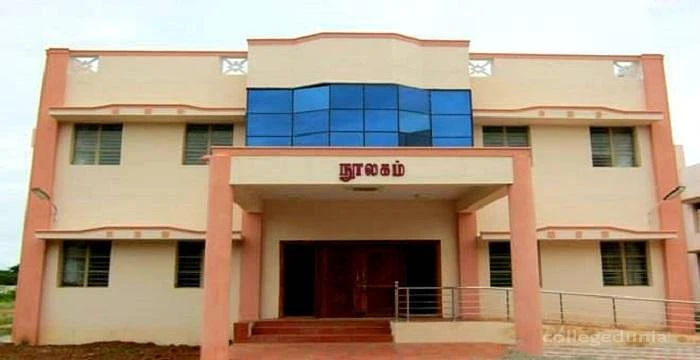
The campus spans 7.5 acres near the Sivaganga Collector Office. It’s described as having an “elegant” main building in a peaceful environment. Infrastructure is adequate for its purpose. Classrooms, an auditorium, a gym, and parking space are noted.
Academically, there are departmental labs, including a computer lab that received an upgrade over two decades ago. The library is a point of mention, with over 14,000 books and a journal collection (though subscriptions are noted up to 2015). Digital access is available. The campus has Wi-Fi with 24/7 internet.
For daily life, there’s a canteen and a health center with first-aid facilities. An on-campus hospital and pharmacy are also mentioned. Sports facilities cover both indoor and outdoor activities. Hostel accommodation is confirmed as available, but details on capacity, room quality, or food are absent from the data. The nearest bus stand is 2.3 km away, and the railway station is 1.9 km away, so the campus is reasonably connected.
Student life likely revolves around academics, library time, and campus events. The college mentions a commitment to holistic development and regular extracurricular activities, but specifics on fests or clubs aren’t provided. It’s a commuter-friendly campus for locals and provides basic residential facilities for those from farther away.
Here’s a challenge: there’s a notable scarcity of detailed, public student reviews for this college. Platforms like CollegeDunia or Shiksha show very few, if any, specific testimonials. A Justdial listing shows an average rating of 3.9 from 67 reviews, but the content of those reviews isn’t detailed in the research.
This lack of digital chatter is itself a data point. It often typifies regional government colleges where the student body may be less active on national review platforms. The positives and negatives listed in the brief are drawn from the college’s own descriptions and the limited review sentiment available.
On the plus side, the consensus highlights the affordable quality education for women, a well-equipped and peaceful campus, qualified faculty, and the special academic support programs. These are tangible benefits.
The negatives aren’t student complaints per se, but observable gaps. The modest placement record is a fact, not just a complaint. The lack of detailed reviews leaves unknowns about the granular realities of hostel life, administrative responsiveness, and the vibrancy of the social scene. You’re not seeing reports of bad management or ragging, but you’re also not seeing glowing accounts of an amazing campus culture. The picture is neutral, defined more by what the college officially provides than by shared student narratives.
It depends entirely on what you’re looking for. This college is an excellent, almost unbeatable option for a specific type of student. If you are a young woman from the Sivaganga region or Tamil Nadu seeking a recognized, affordable bachelor’s or master’s degree from Alagappa University, this is a solid choice. The fees are minimal, the campus provides the necessary infrastructure, and the academic support for disadvantaged groups is a genuine plus. It’s a perfect launchpad if your plan is to complete your degree and immediately prepare for competitive government exams (which the college coaches for) or pursue a higher degree at a central university.
However, you should look elsewhere if your primary goal is campus placements into corporate jobs, exposure to a bustling metropolitan campus life with numerous fests and industry interactions, or studying under a highly personalized faculty-student ratio. The placement data is clear, and the college’s strengths lie in a different direction.
In short, it’s a worthy institution that fulfills its core mandate of providing accessible higher education for women. Just go in with clear, realistic expectations about what that education will lead to. For the right student with the right plan, it represents tremendous value. For others, its limitations might be a dealbreaker.
In this preview: 1 photo · 0 videos
The college offers a wide range of undergraduate (UG) and postgraduate (PG) programs. Key UG courses include Bachelor of Business Administration (BBA), Bachelor of Commerce (B.Com), Bachelor of Science (B.Sc) in Computer Science, Physics, Chemistry, Mathematics, Botany, Zoology, and Home Science, and Bachelor of Arts (B.A) in Tamil, English, History, and Economics. At the PG level, programs include Master of Science (M.Sc) in Computer Science, Mathematics, Chemistry, and Home Science; Master of Arts (M.A) in Tamil and Economics; and Master of Commerce (M.Com).
For the 2026 academic year, the annual tuition fee for the BBA program is ₹2,055. For B.Sc programs, the annual tuition fees range from ₹1,675 to ₹2,075 depending on the specialization. The total first-year fee for BBA, which includes additional charges like caution deposit and exam fee, is approximately ₹2,150. These fees are exceptionally low, characteristic of a government institution.
Placement prospects are modest, with a strong emphasis on higher studies and government exam preparation. Official 2024 data shows placement percentages of 1.23% for UG Arts/Humanities and 4.39% for PG Arts/Humanities. The median salary for placed UG graduates was ₹2.40 LPA, and for PG graduates, it was ₹2.16 LPA. Students should view the degree as a foundation for further competitive exams or higher education rather than a direct path to corporate jobs.
The campus features a well-stocked library with over 14,000 books, departmental laboratories (including a computer lab), and sports facilities for indoor and outdoor games. It provides Wi-Fi connectivity, a canteen, a health center with first aid, and hostel accommodation for students. The academic building, auditorium, and gym are also part of the 7.5-acre campus.
The college has specific academic support programs for disadvantaged students. This includes remedial coaching classes for SC, ST, OBC (Non-Creamy Layer), and minority students to help with their regular studies. Additionally, it offers specialized coaching to prepare these students for entry into various government services. Support for slow learners is also mentioned as part of their academic initiatives.
Share what future students should know about Government Arts College for Women.
Student voices are not rewritten by colleges. We remove spam and abuse.
Wider admission question? Community PulseWhat should future students know?
Tell us which course you're considering. We'll help you work out the next step.
Get instant Partner access after mobile verification. Your public edits are reviewed before they go live.
Claim this college
 Auditorium
 Cafeteria
 Campus Shuttle
 Campus Wi-Fi
 Computer Labs
 Medical
 Science Labs
 Sports Complex
 Study Library