Loading Admission Guardian content
Loading Admission Guardian content
Provisional score based on available data. It may change as more information is verified.
Find a program, read its fee details and explore the admission requirements.
Summary of the programs shown below. First-year fee. Check the note beside each amount for inclusions and exclusions.
| Course | Stream | Fees |
|---|---|---|
| Bachelor of Ayurvedic Medicine and Surgery | Medical | 14200 |
| Doctorate of Medicine [MD] | Medical | 20925 |
| Ph.D. (Ayurveda) | Science |
All accepted exams
Eligibility: 10+2
Specializations
Eligibility: Post Graduation
Specializations
Eligibility: Post Graduation
4 exams with cutoff data available
If you're serious about Ayurveda, you don't just want a degree. You want to see patients. Thousands of them. That's the single, overwhelming reason Government Ayurveda College (GAC) in Thiruvananthapuram has been a cornerstone of Indian medicine since 1889. It's not a shiny new campus. It's a clinical powerhouse where the sheer volume and variety of cases is unmatched, a fact every student and alumni will tell you. With an NCISM 'A' Grade and a reputation as the top government Ayurveda college in the country, it offers one of the most cost-effective and rigorous paths to becoming a practitioner. But you trade modern comforts for that legacy and clinical depth. It's a trade-off that defines the entire experience here.
The academic structure here is traditional, integrated, and intense. The BAMS program is the heart of the college, with an intake of 70 seats. It's a 5.5-year grind—4.5 years of academics followed by a mandatory one-year rotatory internship. The curriculum is what they call integrated, meaning you'll study modern Anatomy, Physiology, and Pathology right alongside Samhita and Dravyaguna. It's a heavy load.
Where GAC truly shines is at the postgraduate level. They offer MD/MS (Ayurveda) across 11 specializations, from Kayachikitsa (General Medicine) and Shalya Tantra (Surgery) to the highly sought-after Panchakarma. Intake is small, maybe 5-8 seats per specialization, making it fiercely competitive. The faculty are a major draw. We're talking about senior professors who aren't just teachers; many are on NCISM syllabus committees and hold PhDs. The feedback is consistent: they are masters of their subject, but they're also strict. Attendance and internal marks aren't something you can fudge.
Beyond the core degrees, they have PhD programs and niche offerings like 2-year PG Diplomas in Kshar Karma. There are also short-term paramedical courses in nursing, pharmacy, and therapy. The academic calendar is rigidly tied to KUHS, and collaborations with bodies like CSIR add a research dimension, though the primary focus remains unwavering clinical training.
Let's be clear—this isn't an engineering college with campus placement drives. Career outcomes here are defined by government service, private practice, and academia. The first guaranteed "placement" is the internship. And it's a good one. BAMS interns here receive a stipend of ₹23,000 to ₹25,000 per month from the Kerala government, which is among the highest in India for Ayurveda interns. That's a significant financial return during training.
Post-graduation, paths diverge. PG residents earn between ₹55,000 to ₹65,000 monthly. After completing your studies, the most common route is through government appointments as Medical Officers under the National Health Mission or the State ISM Department. Major private Ayurveda giants—Kottakkal Arya Vaidya Sala, Vaidyaratnam, Himalaya—actively recruit from here for both clinical and manufacturing roles. Others move into teaching.
Estimating a "package" is tricky in medicine, but for an entry-level Medical Officer, a median starting range of ₹6 to ₹9 LPA is a reasonable expectation. The college's brand and the clinical confidence you gain are your biggest assets for building a successful practice or career. It's not a corporate job guarantee, but it's a proven launchpad in a respected field.
This is where the "Government" in the name pays off literally. The fee structure is heavily subsidized, making it arguably the cheapest way to get a top-tier Ayurvedic medical education in India.
For the entire 5-year BAMS program, the total tuition fee is approximately ₹66,000. Yes, for the whole degree. That breaks down to about ₹12,000–₹14,200 per year. The MD/MS program costs around ₹69,000 for three years. Hostel fees are almost symbolic at ₹250 to ₹350 per month for rent. Your major recurring cost will be food; the mess charges run about ₹3,000–₹4,500 per month on a dividing system.
To support students, both state and central scholarships are available. The E-Grantz scheme for SC/ST/OBC/OEC students is prominent, along with the National Merit Scholarship and others administered by the Kerala State Higher Education Council. The financial barrier to entry is remarkably low.
Admission is 100% merit-based through national and state entrance exams. There is no management or NRI quota.
For the BAMS program, you must qualify NEET-UG. The competition is stiff. For the 2024-25 cycle, the closing rank for the All India Quota (15% of seats) hovered between roughly 46,340 and 59,754. For the State Quota (85% of seats), which uses the KEAM rank, you needed a rank between 8,121 and 11,409. If you're aiming for GAC, a NEET rank under 50,000 for AIQ or a KEAM rank under 10,000 is a safe target.
For MD/MS programs, the gateway is the AIAPGET (All India AYUSH Post Graduate Entrance Test). Counseling for state quota seats is handled by the Commissioner for Entrance Examinations (CEE) Kerala, while the All India Quota seats are managed by the AACCC. The process is centralized and transparent, if bureaucratic.
Don't picture a sprawling, unified campus. GAC operates across three separate locations in the city, which shapes daily life. The main academic block on MG Road is a heritage building—beautiful, old, and described by students as "standard government style" in terms of classroom amenities. The real action is at the associated hospitals in Poojappura, which house the Panchakarma and Women & Child Care specialties.
The hostel situation is a mixed bag and a frequent point of discussion. The men's hostel is located in Poojappura, about 5 km from the main college. It's a commute, requiring reliance on college buses or public transport. The upside? The hostel itself is reported to be spacious with good sports facilities. The women's hostel is closer to the main campus but is often cited as being congested and over capacity.
Infrastructure highlights include a massive library with over 19,600 books and digital access via KUHS, and critically, the hospital facilities with a huge patient inflow. The student union is active, organizing arts and sports events, which helps build community despite the fragmented setup. Social life is what you make of it, within the constraints of a demanding academic schedule.
Synthesizing opinions from student forums, alumni talks, and reviews, a clear consensus emerges.
The praise is overwhelmingly focused on clinical exposure. Phrases like "clinical goldmine" and "you see textbook cases every day" are universal. The patient flow is simply the best in the country for Ayurveda, and students know this is the college's unbeatable advantage. They also rave about the faculty's expertise ("professors are 100/10") and the incredible cost-effectiveness of the education.
The criticisms are practical and persistent. The 5 km commute for male hostelites is a major daily hassle. The crowding in the women's hostel is a genuine quality-of-life issue. Non-Malayali students (especially from the AIQ) often mention an initial language barrier in clinical settings, though teaching itself is in English. The main college infrastructure is acknowledged as functional but dated—you come for the knowledge and the patients, not for posh buildings.
This college isn't for everyone. If you prioritize a comfortable, integrated campus life with modern amenities, you'll be frustrated. The commute and fragmented setup are real sacrifices.
But if your primary goal is to become a supremely confident Ayurvedic practitioner, there are few better places in India. The clinical training is unparalleled, the faculty is deeply knowledgeable, and the cost is negligible. You're paying with your comfort and convenience, not with large tuition fees. It's best for the student who is dead-serious about the medicine, who views the old buildings and hectic commute as a minor price for accessing that patient-rich environment. For the pragmatist focused on long-term skill acquisition over short-term comfort, GAC remains a premier, albeit demanding, choice. It's a legacy institution that trades gloss for grit, and for the right student, that's a perfect deal.
For official information, always refer to the college website and the Kerala University of Health Sciences.
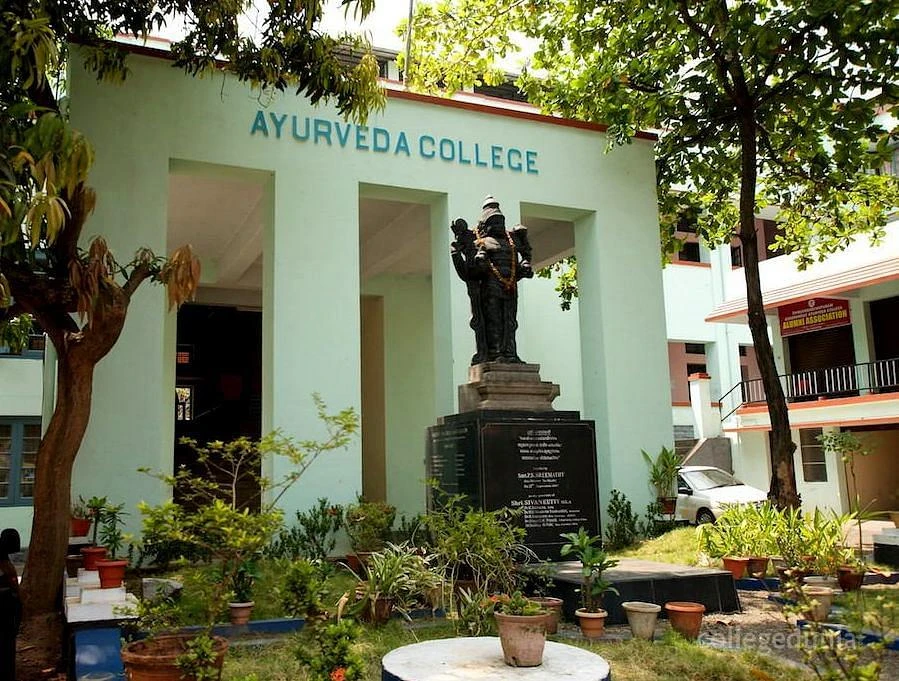
In this preview: 1 photo · 0 videos
Government Ayurveda College (GAC) Thiruvananthapuram is often noted for its superior clinical exposure due to its location in the state capital and its attached government hospital. VPSV Ayurveda College in Kottakkal is frequently highlighted for its strong research output and deep traditional heritage. The "better" choice depends on a student's priority between hands-on clinical training and research-focused, traditional learning.
For admission to the BAMS program at Government Ayurveda College, Thiruvananthapuram, candidates aiming for the All India Quota (AIQ) should typically secure a NEET rank under 50,000. For the State Quota via KEAM, a rank under 10,000 is usually required.
Yes, the Men's hostel for Government Ayurveda College, Thiruvananthapuram is located in Poojappura, which is approximately 5 kilometers away from the main college campus. Students commonly use the college bus service or public transport for commuting.
Yes, the BAMS curriculum at Government Ayurveda College is integrated. This means students are taught modern medical subjects such as Anatomy, Physiology, and Pathology alongside the core principles and practices of Ayurveda.
The current monthly stipend for BAMS interns at Government Ayurveda College, Thiruvananthapuram ranges from ₹23,000 to ₹25,000. This is considered among the highest internship stipends for BAMS students in India.
Share what future students should know about Government Ayurveda College.
Student voices are not rewritten by colleges. We remove spam and abuse.
Wider admission question? Community PulseWhat should future students know?
Tell us which course you're considering. We'll help you work out the next step.
Get instant Partner access after mobile verification. Your public edits are reviewed before they go live.
Claim this college
 Auditorium
 Cafeteria
 Computer Labs
 Gym
Gym Hostel
 Medical
 Science Labs
 Sports Complex
 Study Library