Loading Admission Guardian content
Loading Admission Guardian content
Provisional score based on available data. It may change as more information is verified.
Selected ranking categories, with the recorded year beside each result. Open all records for the complete history.
2 published records · Lower numeric ranks are stronger
IIRF
Nursing
#452023
Find a program, read its fee details and explore the admission requirements.
Summary of the programs shown below. First-year fee. Check the note beside each amount for inclusions and exclusions.
| Course | Stream | Fees |
|---|---|---|
| Bachelor of Science [B.Sc] (Nursing) | Paramedical | 90500 |
| Post Basic Bachelor of Science [P.B.B.Sc] (Nursing) | Paramedical | 90500 |
| Master of Science [M.Sc] | Paramedical | 161000 |
| Post Basic Diploma | Medical |
Specializations
Eligibility: 10+2
Specializations
Eligibility: 10+2
Specializations
Eligibility: Graduation
Specializations
Holy Cross College of Nursing in Kottiyam isn't trying to win any awards for campus life. It's built for a single, serious purpose: turning out clinically competent, disciplined nurses who can work anywhere. Established in 2003 and run by the Sisters of the Holy Cross, this private institution leverages its deep integration with a 550-bed multi-specialty hospital to provide training that alumni consistently describe as "rigorous" and "export-quality." If your priority is a vibrant social scene, look elsewhere. But if your goal is to be exceptionally prepared for a nursing career, especially with an eye on international opportunities, this college's reputation is hard to ignore. It's a trade-off students knowingly make.
The academic portfolio is focused and traditional, covering the core nursing pathways. Everything revolves around the schedule set by the Kerala University of Health Sciences (KUHS). The grading system is credit-based, with internal marks heavily weighted on attendance—100% is mandatory for clinicals—and performance in monthly tests. You don't just learn theory here; you're assessed on how you handle patients from early on.
The undergraduate B.Sc Nursing program takes in 65 students annually for its four-year duration. There's also a two-year Post Basic B.Sc Nursing course for working diploma holders, with an intake of 20. At the postgraduate level, the M.Sc Nursing program offers about 20 seats split across five specializations: Medical-Surgical, Community Health, Paediatric, OBG, and Psychiatric Nursing.
Faculty strength sits between 19 and 25, led by Principal Dr. Sr. Bertha Pereppadan. The consensus from student reviews is that the teachers are dedicated, often described as "motherly but firm," and known to hold extra classes for those struggling. The academic culture isn't about collaboration or open debate; it's about mastering a prescribed, practice-heavy curriculum under close supervision.
Let's be clear: nursing colleges don't have placement drives like engineering schools. Career outcomes here are a mix of direct absorption, domestic recruitment, and—most notably—preparation for international migration. The college's official placement stats aren't loudly advertised, but the trajectory of its alumni tells the real story.
For domestic roles straight out of college, realistic starting packages for freshers range from ₹2.4 to ₹3.6 LPA. Some educational portals might list a "highest package" of 12.5 LPA, but that's almost certainly a template error or refers to a highly experienced alumna working abroad. The more credible high end for a new graduate in a premium Indian hospital like Apollo or Max is around ₹4.8 LPA. A significant number of graduates are directly absorbed by the parent Holy Cross Hospital, Kottiyam, which is a stable, if not high-paying, starting point.
The college's true placement strength lies in its reputation. It's known for producing nurses whose clinical skills meet international standards. After gaining a year or two of experience, a substantial number of alumni successfully migrate to the UK (NHS), Germany, Ireland, and the Middle East. Recruiters from hospitals in the UAE and Oman are familiar with the college's name. Top domestic recruiters include Holy Cross Hospital, Baby Memorial Hospital (Kozhikode), and Aster Medcity. The 100% mandatory internship, conducted at the parent hospital, is where this employable skill set is forged.
Fees are regulated by the state's Admission and Fee Regulatory Committee (AFRC), which keeps them relatively reasonable for a private institution. For the B.Sc Nursing program, the annual tuition fee hovers between ₹73,025 and ₹90,500. Add in other fees like special and exam fees (₹23,300 - ₹27,000), and the total four-year academic cost lands in the ₹4.5 to ₹5.5 lakh range.
That's just tuition. Living expenses are separate. Hostel and mess fees run between ₹50,000 and ₹80,000 per annum. The mess operates on a "dividing system," meaning the monthly bill fluctuates based on actual consumption. There's also a one-time, refundable caution deposit of ₹10,000. All in, the total cost for a B.Sc Nursing degree, including hostel, is typically ₹5.5 to ₹6.5 lakhs over four years. For the M.Sc program, expect to pay over ₹1 lakh annually in tuition, leading to a total two-year cost of ₹2.8 to ₹3.2 lakhs.
Financial aid is available primarily through government channels. SC/ST/OBC students can apply for the E-Grantz scholarship, and minority scholarships are offered by the Kerala Government. The college itself doesn't prominently advertise major institutional scholarships.
Admission is a centralized process in Kerala. For merit seats, everything depends on your rank in the KEAM (Kerala Engineering Architecture Medical) entrance exam or the subsequent LBS Centre counseling rank list. For B.Sc Nursing, the 2024 cutoff indicated that candidates generally needed to be within the top 15,000 to 20,000 ranks on the LBS list to have a serious shot. It's competitive.
For management or minority quota seats, the process is handled by the Association of Management of Christian Self Financing Nursing Colleges of Kerala (AMCSFNCK), which conducts its own entrance exam and counseling. There's also an NRI quota, which requires a minimum of 78% aggregate in Physics, Chemistry, and Biology (PCB) at the 10+2 level, with fees around ₹1.04 lakh per annum for tuition.
The selection process follows a standard chain: entrance exam, merit list generation, online counseling, document verification, and finally, physical reporting to the allotted college. There are no personal interviews or group discussions. Your rank and your choices decide your fate.
Think of the campus as a functional annex to the hospital. It's compact, spanning 1-2 acres within the Holy Cross Hospital complex in Kottiyam. The infrastructure is adequate for its purpose: specialized nursing labs for fundamentals, nutrition, OBG, and paediatrics, plus an extensive library with nursing journals and access to the KUHS digital library. The canteen serves standard Kerala-style vegetarian and non-vegetarian food.
The 400-capacity hostel is for girls only. Male students must arrange private accommodation nearby. Descriptions of hostel life are uniform: it's strict. Reviews consistently mention a 3.5/5 rating for quality, with mandatory prayer sessions, a strict warden, and firm curfews. Outings are typically permitted only with parental or guardian permission. The rules extend to personal appearance—hair must be tied in a bun, uniforms perfectly pressed.
This isn't a campus buzzing with festivals. Student life is subdued and regimented. Events are mostly professional or religious: Nurses Day celebrations, health awareness weeks, and church-related activities. If you're looking for a typical college social scene with big fests and freedom, you will be disappointed. The trade-off, as students note, is an environment where safety and focus are paramount.
Synthesizing feedback from platforms like Justdial, Shiksha, and local forums paints a very consistent picture. The overall rating is high (4.4/5 on Justdial), but the praise comes with significant caveats that define the experience.
The positives are powerful and career-focused. Alumni overwhelmingly praise the clinical exposure. "The hospital is huge and we see a lot of cases. By the third year, you feel like a real nurse," is a common sentiment. They value the dedicated, "motherly" faculty who invest in student success. Parents are reported to be hugely relieved by the secure, monitored environment.
But the negatives are just as defining. The word "strict" appears in nearly every critical review. The regime of 80% theory and 100% clinical attendance is non-negotiable; missing clinicals often means making up the time with double shifts. The rules on appearance, mobile use, and movement feel "like a boarding school" to many. Social life is minimal. As one paraphrase put it: "Fests are small and mostly religious or health-themed."
The most telling reviews often conclude with a pragmatic endorsement. Verbatim quotes like, "If you want to go to the UK or Canada, this is the best place because the training is very hard and prepares you for anything," capture the essence. Students accept the discipline as the price for exceptional professional preparation.
Holy Cross College of Nursing is a specialist institution with a very clear identity. It's not for everyone. If you prioritize personal freedom, a vibrant social life, or a liberal academic atmosphere, you will likely find its environment stifling. The strict rules and monastic campus life are real sacrifices.
However, for a student single-mindedly focused on building a rock-solid nursing career—particularly with ambitions to work internationally—this college offers compelling value. The direct access to a 550-bed hospital for clinical training is a massive advantage that few private colleges can match. The discipline, while harsh, produces nurses who are known for their competence and resilience, a reputation that opens doors abroad. At a total cost of around ₹6 lakhs for a B.Sc degree, the return on investment, in terms of skill acquisition and career launchpad, can be very strong.
Choose Holy Cross if you are choosing the profession of nursing above the experience of college. Go in with your eyes open to the trade-off, and you can graduate exceptionally well-prepared. Look for a holistic college experience, and you'll probably regret it.

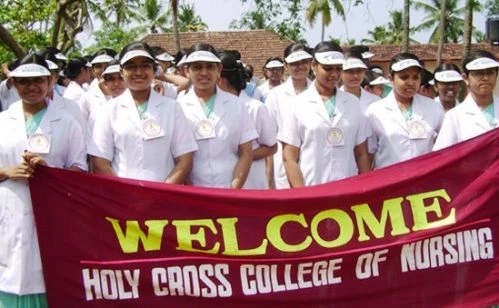


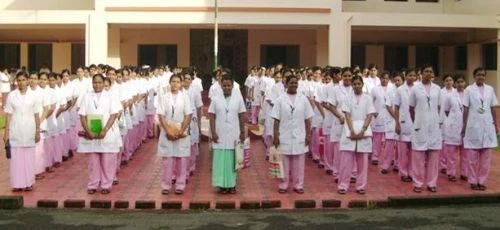
In this preview: 5 photos · 0 videos
Yes, Holy Cross College of Nursing is a co-educational college. However, it is important to note that while both male and female students are admitted, on-campus hostel facilities are provided exclusively for female students.
The total cost for the four-year B.Sc Nursing program, including hostel and mess charges, is estimated to range between ₹5.5 Lakhs and ₹6.5 Lakhs. Please note that fee structures are subject to change as per university and regulatory body guidelines.
The college itself does not function as a recruitment agency for placements abroad. However, the certification and extensive clinical training provided by the college are highly regarded and valued by international healthcare recruiters, which can significantly benefit graduates seeking opportunities overseas.
The hostel discipline is reported to be very strict. It enforces fixed daily schedules for study, prayer, and sleep. Student outings are typically restricted and are usually permitted only when accompanied by parents or authorized guardians.
Yes, admission to management quota seats typically requires candidates to appear for an entrance examination. This exam is usually conducted by the AMCSFNCK (Allied Management Colleges of Self Financing Nursing Colleges of Kerala) association.
Share what future students should know about Holy Cross College of Nursing.
Student voices are not rewritten by colleges. We remove spam and abuse.
Wider admission question? Community PulseWhat should future students know?
Tell us which course you're considering. We'll help you work out the next step.
Get instant Partner access after mobile verification. Your public edits are reviewed before they go live.
Claim this college

 Auditorium
 Cafeteria
 Computer Labs
 Hostel
 Medical
 Science Labs
 Sports Complex
 Study Library