Loading Admission Guardian content
Loading Admission Guardian content

Explore the available options or ask for admission guidance.
Explore the available options or ask for admission guidance.
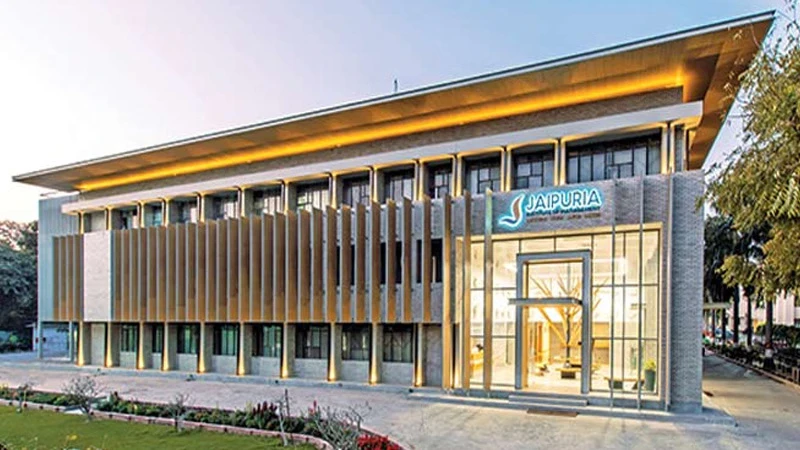
Jaipuria Institute of Management’s Lucknow campus is a residential business school established in 1995. Its current public information is easiest to read in layers: the institute publishes a Lucknow-specific 2027-29 admissions and fee schedule, its NIRF 2026 submission gives campus-specific placement outcomes for completed cohorts, and a separate placement page reports live results across all four Jaipuria campuses. Those sources answer different questions and should not be merged into one headline package figure.
The campus is in Lucknow, Uttar Pradesh, and describes itself as residential. The institute says it was established in 1995. Its main full-time management offering is the two-year Post Graduate Diploma in Management (PGDM), alongside a Financial Services variant and a Fellow Programme in Management (FPM). The Lucknow programme list and campus overview do not use identical labels for every programme: the overview mentions Retail Management, while the current 2027-29 fee schedule names PGDM and PGDM (Financial Services). Applicants should confirm which specialisations appear in the live application form for their intended intake rather than assuming every historically listed programme is open each year.
Jaipuria is one campus within a four-campus institute group that also operates in Noida, Jaipur and Indore. This matters most when you compare placements and group-wide claims. The NIRF submission and the campus admissions pages identify Lucknow separately; the current group placement page combines activity across all four locations. A recruiter list or a headline for the group should not be treated as a Lucknow-only outcome unless the report breaks the number down by campus.
The campus page identifies a residential format. That can simplify access to classes and campus activities, but it also adds accommodation and food costs to tuition. The available hostel rates on the admissions page are for 2026-27, not for the 2027-29 PGDM batch. Treat those rates as a previous-year planning reference and get the current allotment and payment terms before building a full two-year budget.
The general PGDM is the broad management option. Jaipuria describes its programmes as full-time and two years long, with core management study and opportunities for specialisation. The official course pages refer to case work, live projects and internships, but the public overview does not provide enough detail to compare contact hours, elective availability or internship outcomes by specialization. Ask for the curriculum applicable to the 2027-29 batch if those details are central to your decision.
The PGDM (Financial Services) is also listed as a two-year, full-time programme. Its official description focuses on banking, insurance, investments, financial planning, mortgage lending and mutual funds. That subject orientation can help a student decide whether a specialised finance curriculum fits their goals, but the course label alone does not guarantee a role in investment banking or any particular employer. Review the current course structure and placement evidence for roles and cohorts before paying an admission fee.
The campus and programme pages also mention a Fellow Programme in Management. It is presented as a doctoral-level, research-oriented programme for candidates interested in academic or research careers, which is a different decision from choosing a two-year PGDM. The current PGDM fee and admission schedule should not be applied to the FPM. The Lucknow admissions page for the 2027-29 PGDM batch names PGDM and PGDM (Financial Services); it does not establish that every other programme listed elsewhere is accepting applications in that cycle.
Jaipuria’s pages describe the PGDM as AICTE-approved, NBA-accredited and recognised by the Association of Indian Universities as equivalent to an MBA. That equivalence is a recognition of the PGDM credential; it does not turn the award into a university-issued MBA degree. The programme page also notes a dual-specialisation opportunity, but applicants should verify the available combinations and rules for their batch rather than relying on a general description.
The Lucknow admissions page identifies the 2027-29 PGDM batch and says applicants need a bachelor’s degree from a recognised university with at least 50% marks or an equivalent CGPA. Final-year candidates may apply provisionally if they are expected to complete the degree by 30 June 2027. They must submit proof of graduation by 1 October 2027; the page says admission may be withdrawn if the proof is not supplied by then.
The page lists CAT 2026, XAT 2027, CMAT, MAT and GMAT as accepted tests. It gives editions for CAT and XAT but does not specify the CMAT, MAT or GMAT score window in that list. It also does not publish a minimum percentile. Confirm the score validity with the Lucknow admissions team before applying if you plan to use one of the three tests without an edition shown.
The published selection weights allocate 45% to the entrance-test score, 10% to case analysis and 25% to the personal interview. Academic performance accounts for 15%, work experience, sports and extracurricular activities for 3%, and diversity for 2%. The categories sum to 100%, but the page does not explain the conversion method or scoring rubric. Use the weights to understand the stated selection mix, not to calculate a predicted score or infer a cutoff.
Jaipuria describes a three-phase application: register and choose campus/programme, pay the ₹1,000 non-refundable admission-process fee, then complete the form with academic and other requested details. Applicants should keep score information, correspondence details and supporting academic documents ready. The page does not state a closing date as checked on 6 November 2026. The common application portal serves multiple campuses, so select Lucknow explicitly and check for any updated date before paying.
The Lucknow fee table lists tuition of ₹15.25 lakh for the 2027-29 PGDM and the same ₹15.25 lakh total for PGDM (Financial Services). It splits the amount into ₹7.70 lakh in year one and ₹7.55 lakh in year two, payable through six instalments:
The instalments total ₹15.25 lakh. A refundable course security deposit of ₹15,000 is listed with the first instalment. The admissions page says taxes may be added if required by government notification, so the table is a published schedule rather than a guarantee of every amount due in an individual offer. Check the offer letter and current fee portal for any revised charges, refund rules and payment dates.
Hostel charges are separate. For 2026-27, the page lists ₹2.10 lakh per year for a girls’ AC single room and ₹1.35 lakh per year for an AC double room for girls or boys, plus a refundable ₹10,000 hostel deposit. Mess charges are extra and the institute says hostel fees can change annually. These are not confirmed 2027-29 rates. The cost comparison should therefore include tuition, accommodation, food, travel, personal expenses and any taxes, with the next-cycle hostel quotation left open until Jaipuria provides it.
The scholarship table on the same admissions page is labelled for the 2026-28 batch. Do not subtract an older award from the 2027-29 tuition without confirmation of eligibility, amount and timing for the new batch. Ask whether a scholarship is applied before or after instalment payments, whether it is renewable, and whether a student must maintain academic or conduct conditions. A headline award amount is not the same as a guaranteed reduction in the fee payable at admission.
The most comparable campus-specific figures in the official material are in Jaipuria Lucknow’s NIRF 2026 management submission. For the two-year postgraduate programme, the submission reports graduating and placed counts, along with median salary, for three completed cohorts. In 2022-23, 260 students graduated in the minimum stipulated time and 256 were placed; the reported median salary was ₹8.64 lakh. In 2023-24, the counts were 347 and 337, with a ₹8.79 lakh median. In 2024-25, 351 graduated and 341 were placed, with a ₹9 lakh median.
A simple placed-to-graduate calculation gives about 98.5% for 2022-23, 97.1% for 2023-24 and 97.2% for 2024-25. The calculation uses the submission’s “graduating in minimum stipulated time” count as the denominator. It does not describe every admitted student, students who did not graduate in that time, or offer quality. The reported median also does not show the full salary distribution or programme-level differences between general PGDM and Financial Services. It is a more cautious comparison point than a highest package, but still needs its cohort and reporting basis attached.
The institution’s separate placement page reports the PGDM Class of 2024-26 across Lucknow, Noida, Jaipur and Indore. It says placements are still underway and shows a current 97% status, more than 1,100 students placed, 300-plus participating companies, a ₹24.11 lakh highest package and average CTC figures for top slices of the group. These figures are useful as a current group update, but they are not a final Lucknow-only placement report. Do not compare its live 97% status directly with a completed campus-specific NIRF cohort or present the group’s highest package as a typical Lucknow outcome.
For a personal estimate, ask for the latest final placement report with campus, programme, graduating cohort, number eligible, number placed, median salary and role mix. Also ask how internships, pre-placement offers and students seeking further study are counted. Neither the official NIRF table nor the group page gives enough detail to infer the likelihood of a particular role or salary for an individual student.
Jaipuria Lucknow’s campus page lists 67th among management institutes in NIRF 2025. The NIRF page links certificates and reports by campus. The separate NIRF 2026 PDF is a data submission, not evidence of a 2026 rank. Keep those two items distinct when comparing institutions: a published ranking position has a ranking year and category, while a submitted data table is an institution’s reported inputs and outcomes for the framework.
The campus overview states that its PGDM programmes are AICTE-approved, NBA-accredited and AIU-recognised as equivalent to an MBA. The institution also announces AACSB accreditation and describes it as applying to Jaipuria Institute of Management. These are different forms of recognition and should not be collapsed into one claim that the institute awards an MBA degree. Prospective students should check the current accreditation scope and programme name in the official approval documents, especially when comparing PGDMs with university MBA programmes.
The campus page also displays NAAC accreditation, but the source opened for this profile does not establish a current grade and CGPA. The previous article’s specific “A+ (3.32/4.0)” detail is therefore not repeated here. Similarly, third-party rankings shown on the institute’s campus page use different publishers, years and categories. A number without those qualifiers is not a sound way to rank Lucknow against another management programme.
Jaipuria describes Lucknow as a residential campus and identifies the programme environment as full-time. Those features may suit students who want to live near classes and participate in campus activities. They also make the accommodation budget and the exact hostel rules important. Confirm room type availability, mess costs, deposits, refund terms, vacation periods and whether a room is guaranteed before treating the campus as an all-inclusive option.
The location is in Lucknow, while the group has campuses in three other cities. If the campus is your preferred site, confirm that it remains your chosen location through the common application and admission process. The current public placement page aggregates all four campuses, so ask whether central placement processes require travel or whether interviews and role allocation differ by location. The sources reviewed here do not quantify a location advantage or disadvantage, and the old article’s claim that Lucknow students compete against Noida for the same jobs is not supported by a campus-specific report.
The general PGDM may fit a student seeking broad management study with the chance to specialise later. Financial Services is more directly aligned to finance-related subjects. Neither description establishes a guaranteed job track. Compare the actual curriculum, faculty responsible for the subjects, internship process, employer roles and recent placement outcomes. For an academic career, examine the FPM’s research requirements separately rather than treating it as another PGDM pathway.
Before submitting the application, confirm the 2027-29 programme options at Lucknow, the score edition accepted for your test, the deadline and whether your final-year timeline meets the June and October 2027 document dates. Keep a copy of the application, score details and payment receipt. The published page gives a ₹1,000 non-refundable admission-process fee; verify whether any other payment is due at a later selection stage.
Before accepting an offer, reconcile the ₹15.25 lakh tuition schedule with the offer letter, including the ₹15,000 refundable deposit and any government-notified taxes. Get the 2027-29 hostel quote and meal charges in writing. Ask for scholarship terms for the same batch instead of relying on the 2026-28 table. For outcomes, request a Lucknow-specific final report for the most recent graduating cohort and clarify who is included in each denominator.
The available evidence supports a clear but limited picture: Jaipuria Lucknow is a residential, two-year PGDM campus with a published 2027-29 tuition schedule, a current selection structure and several years of campus-specific NIRF outcomes. The evidence does not establish the next application deadline, next-cycle hostel cost, every programme’s current intake status, a current NAAC grade, or an individual student’s placement outcome. Those are the questions to resolve directly with the institution before making a final decision.
Loading programmes and admission routes.
Selected ranking categories, with the recorded year beside each result. Open all records for the complete history.
22 published records · Lower numeric ranks are stronger
IIRF
Management · private
#632024
IIRF
MBA · private
#662024
Indiatoday
MBA
#462021
Find a program, read its fee details and explore the admission requirements.
Summary of the programs shown below. First-year fee
Eligibility: Post Graduation
Specializations
Listed entrance exams
Eligibility: Graduation with 50%
4 exams with cutoff data available - showing recent entries
 99Acres
 Aditya Birla Capital
 Aditya Birla Fashion and Retail (ABFRL)
 Airtel
 Amazon


In this preview: 1 photo · 0 videos
Yes, the PGDM (Post Graduate Diploma in Management) from Jaipuria Institute of Management is recognized as equivalent to an MBA by the Association of Indian Universities (AIU). This recognition makes graduates eligible for government jobs and further academic pursuits like PhD programs.
While the official average placement package is approximately 9.5 LPA, the median package is a more realistic indicator, typically closer to 8 LPA. Students, especially in marketing, should be prepared for initial roles that are often sales-oriented.
Yes, the institute widely accepts MAT (Management Aptitude Test) scores for admission into its PGDM programs. However, the required cutoff for MAT is generally higher, typically in the range of 75 to 80 percentile, compared to the cutoff for CAT scores.
Each campus has distinct strengths. The Noida campus has a slight edge due to its location and proximity to industries. The Lucknow campus is the oldest and is known for having the strongest alumni network. Placements are largely comparable as the process is centralized across campuses.
The girls' hostel is located on-campus and is described as highly secure and well-maintained. A common feedback from residents is that the food, while adequate, can become monotonous after a few months.
About Jaipuria Institute of Management.
Colleges cannot rewrite published reviews. We remove spam and abuse.
Ask the communityWhat should future students know?
 Amul
 Amway India
 Apollo Pharmacy
 Asian Paints
 AU Small Finance Bank
 Axis Bank
 Bajaj Allianz
 Bajaj Corp Ltd
 Bandhan Bank
 Barclays Bank
 Berger
 Bharti Airtel
 Blackstone Group
 Blue Star
 Bose
 Cafe Coffee Day
 CavinKare
 Cleartax
 Coca-Cola
 Colgate Palmolive India Ltd.
 Crompton
 Dabur India Ltd.
 Daimler
 Dalmia Bharat
 Delhivery
 Deloitte
 DHL
 Edelweiss
 Ernst & Young
 ESAF
 Eureka Forbes
 Exide Industries
 Federal bank
 Fincare Business Services
 Force Motors Ltd.
 Gartner Inc
 Genpact
 Glaxo Smithkline Consumer Ltd (GSK)
 Godrej & Boyce
 Gyan Solutions
 Havells
 HDB Financial Services
 HDFC Bank
 HDFC Mutual Fund
 Hexaware Technologies
 Hind Terminals
 Hindustan Unilever Limited
 Honda
 ICICI Bank
 IDFC First Bank
 Indigo
 IndusInd Bank
 JK Paper
 Johnson & Johnson
 Kotak Mahindra Bank
 KPMG Global Services
 Landmark Group
 Luminoguru
 Mahindra & Mahindra
 MakeMyTrip India Pvt. Ltd.
 Mars Wrigley
 Motherson Infotech
 Naukri.com
 Nestle India
 Orient Cables (India) Pvt. Ltd., Bhiwadi
 PhonePe
 Prestige Group
 Prism Johnson
 PWC
 RBL Bank
 Reckitt Benckiser (I) Pvt. Ltd
 Reliance General Insurance
 Reliance Retail
 Saint Gobain Glass
 SBI Card
 South Indian Bank
 Tata Power
 Tech Mahindra
 Times Internet
 TVS Motors
 Ujjivan
 UNICHARM
 Vodafone
 Whirlpool
 Wipro
 Yes Bank
92 named recruiters in the recorded data. Company names are deduplicated.
Tell us which course you're considering. We'll help you work out the next step.
Get instant Partner access after mobile verification. Your public edits are reviewed before they go live.
Claim this college
 Auditorium
 Cafeteria
 Campus Wi-Fi
 Computer Labs
 Hostel
 Science Labs

 Study Library