Loading Admission Guardian content
Loading Admission Guardian content

Provisional score based on available data. It may change as more information is verified.
Find a program, read its fee details and explore the admission requirements.
Summary of the programs shown below. First-year fee. Check the note beside each amount for inclusions and exclusions.
| Course | Stream | Fees |
|---|---|---|
| General Nursing and Midwifery [GNM] | Paramedical | 35000 |
Karnataka School of Nursing, and its sister College of Nursing, have been training healthcare professionals in North Bangalore for over three decades. That's a long time to build a reputation. And in the world of private nursing education, where recognition is everything, this institution has secured its place. It’s recognized by the Indian Nursing Council and affiliated with Rajiv Gandhi University of Health Sciences—two non-negotiable stamps of approval for any serious nursing student. The campus, shared between the diploma school (established 1992) and the degree college (2003), is a hub for students from across India and abroad, all drawn by Bangalore's hospital network and the promise of a stable career path. But as with any institution that's been around this long, the reality is a mix of solid fundamentals and the everyday friction of student life.
The institution offers a clear ladder of nursing qualifications, from diploma to doctorate. That vertical integration is a plus—a student can theoretically start with a GNM diploma and climb all the way to a Ph.D. on the same campus. The B.Sc Nursing program is the main draw, with an intake of up to 100 students per year. The Post Basic B.Sc Nursing (2 years) serves working diploma holders looking to upgrade. At the postgraduate level, the M.Sc Nursing program offers five specializations—Medical-Surgical, Pediatric, Psychiatric, OBG, and Community Health Nursing—with a modest intake of about 5 students per specialization.
Faculty qualifications are standard for the sector. Senior staff hold M.Sc or Ph.D. degrees, while junior lecturers are typically M.Sc holders. The academic rhythm is dictated entirely by the schedules of RGUHS and the state diploma board, meaning annual exams and a curriculum that doesn't deviate from the norm. Where the college leverages its Bangalore location is in clinical rotations. Students get posted to a variety of government and private multi-specialty hospitals for hands-on training, which is the most critical part of any nursing education. It's a decent, structured academic setup, though some student reviews hint that high intakes can sometimes strain classroom space.
Let's be clear: nursing placements don't work like engineering placements. There's no campus drive with signing bonuses. Placement here means the college facilitates your entry into the job market, often through the hospital networks used for clinical rotations. The official claim is 100% placement, which in this context likely means nearly every graduate who wants a job can get one. Student reviews suggest a more nuanced 80-90% for those seeking immediate employment, which is still a strong figure.
The numbers are modest but reflect the stark reality of starting salaries for staff nurses in Indian private hospitals. The average starting package is reported between ₹1.2 LPA to ₹1.5 LPA. The highest figures you might see bandied about reach ₹1.8 LPA to ₹2.4 LPA for freshers. Top recruiters are a who's who of Bangalore's healthcare scene: Aster CMI, Vikram Hospital, Columbia Asia (now part of Manipal), Apollo, and Fortis. The real financial upside, which the college highlights through its alumni network, comes with international migration. A significant chunk of graduates—estimates suggest 20-30%—head to the UK, Ireland, or the Middle East after gaining a couple of years of experience. Those salaries are a different story altogether, but require external exams like IELTS/OET that the college doesn't administer.
Costs here are heavily influenced by your quota. For Karnataka students entering via KCET, the B.Sc Nursing tuition can be as low as ₹40,000-₹60,000 per year. Management quota seats, often taken by non-Karnataka or international students, can run up to ₹1.5-2 lakhs per year. Add to that hostel and mess charges, which are a significant line item at ₹60,000-₹80,000 annually. Over four years, the total outlay for a B.Sc student lands somewhere between ₹5.5 and ₹7.5 lakhs all-in.
Financial aid primarily flows through government channels. SC/ST/OBC students can access state scholarships via the SSP/NSP portals. The Karnataka Education Trust itself occasionally offers merit-based scholarships, but these aren't guaranteed or widely advertised. It's a good idea to budget for the full management quota fee if you're from outside Karnataka and to factor in occasional student mentions of "hidden costs" for practicals or uniforms, though these are unverified.
The gateway depends on the program. For the flagship B.Sc Nursing, Karnataka domicile students must take the KCET (Karnataka Common Entrance Test). Admission then goes through the centralized counseling process run by the Karnataka Examination Authority (KEA). Cutoffs vary yearly but are generally accessible for a mid-tier private college. For the GNM diploma, admission is usually merit-based on 10+2 marks.
The basic eligibility is consistent: 10+2 with Physics, Chemistry, Biology, and English, with a minimum aggregate of 45% for B.Sc and 40% for GNM. The application window typically runs from May to August. A key feature of the admissions landscape here is the management quota. A substantial number of seats are reserved for this category, catering to students from other Indian states and a notable international cohort from countries like Nigeria and Nepal. This quota is where the fee jumps significantly.
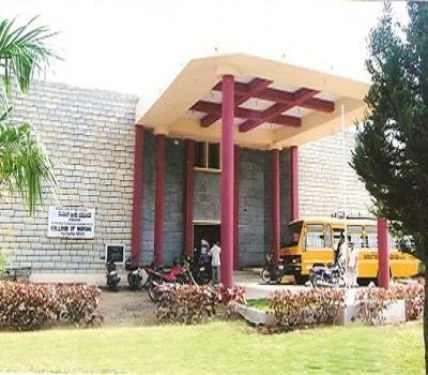
The campus infrastructure gets mixed reviews, but the positives often start with the main academic building, which multiple students have described as "magnificent." Labs for Anatomy, Nutrition, and Nursing fundamentals are well-equipped with simulation manikins, and the library provides access to the RGUHS digital network (HELINET). Wi-Fi is available but, in a very common student refrain, speeds are just "average."
Hostel life is a major part of the experience, with separate buildings for boys and girls housing over 300 students. Rooms are usually 4-6 sharing. The biggest and most consistent complaint across review platforms isn't the rooms—it's the mess food. Students, particularly from North India, frequently cite repetitive and subpar quality. The other defining aspect of hostel life is discipline. Reviews consistently mention "school-like" strictness, with firm attendance rules and limited freedom. It's an environment that prioritizes structure, which some appreciate and others find stifling. The campus location in Yelahanka is decently connected to the city but isn't in the heart of Bangalore's social scene.
Synthesizing feedback from platforms like Shiksha and CollegeDunia paints a realistic picture. On the positive side, students consistently value the clinical exposure. Being in Bangalore means rotations in high-volume, multi-specialty hospitals, which is irreplaceable for building competency. Many also praise the teaching faculty as being supportive and helpful with university exam preparation. The student body is notably diverse, with strong representation from Kerala, West Bengal, the Northeast, and abroad, which can be a great cultural experience.
But the negatives are just as consistent. The strict disciplinary environment tops the list for many. The food quality in the mess is a perennial grievance. Some students also mention that the high intake can lead to crowded classrooms, with some batches tucked into older spaces. There are occasional whispers about fines for minor infractions, though these are hard to verify. The consensus? It's a place that will give you the education and the badge of INC recognition, but don't expect a liberal arts college atmosphere.
Karnataka School of Nursing is a pragmatic choice. It's best for students who are clear-eyed about a career in nursing and want a straightforward, recognized program in a major healthcare hub. If your primary goals are INC recognition, access to Bangalore's hospital network for clinicals, and a clear path to a staff nurse job, this college delivers that at a relatively manageable cost (especially for KCET quota students). The strict, disciplined environment might even be a plus for some families.
However, if you're looking for a vibrant campus social life, premium hostel amenities, or gourmet food, you'll likely be disappointed. The starting salaries are also a reality check—this is a profession where financial rewards grow with experience and, often, international mobility. You should probably look elsewhere if you're not prepared for the rigors and modest starting conditions of hospital nursing. For the student who sees nursing as a vocation and a passport to a stable career, locally or abroad, KSN is a competent, established launchpad.
Yes, Karnataka School of Nursing is officially approved and recognized by the Indian Nursing Council (INC) as well as the Karnataka Nursing Council (KNC).
For students from outside Karnataka, the total fee package for the 4-year B.Sc Nursing program, which typically includes hostel charges, generally ranges between ₹6 lakhs and ₹7.5 lakhs.
Yes, the college provides separate hostel accommodations for both male and female students.
Admission to the General Nursing and Midwifery (GNM) program is generally based on merit from the 10+2 qualifying examination, and there is no separate entrance exam. However, candidates must register with the relevant state nursing board.
The college reports a nearly 100% placement rate in terms of job availability for fresh graduates. However, starting salaries in private hospitals are typically modest, ranging from ₹12,000 to ₹18,000 per month.
Share what future students should know about Karnataka School of Nursing.
Student voices are not rewritten by colleges. We remove spam and abuse.
Wider admission question? Community PulseWhat should future students know?
Tell us which course you're considering. We'll help you work out the next step.
Get instant Partner access after mobile verification. Your public edits are reviewed before they go live.
Claim this college Auditorium
 Cafeteria
 Computer Labs
 Science Labs
 Sports Complex
 Study Library