Loading Admission Guardian content
Loading Admission Guardian content
Provisional score based on available data. It may change as more information is verified.
Find a program, read its fee details and explore the admission requirements.
Summary of the programs shown below. First-year fee. Check the note beside each amount for inclusions and exclusions.
| Course | Stream | Fees |
|---|---|---|
| Master of Business Administration [MBA] | Management | 55000 |
| Bachelor of Technology [B.Tech] | Engineering | 70000 |
| Bachelor of Technology [B.Tech] {Lateral} (Information Technology) | Engineering | 70000 |
| Master of Technology [M.Tech] | Engineering | 70000 |
| Bachelor of Pharmacy [B.Pharma] | Pharmacy |
Specializations
Eligibility: Graduation with 50% + RMAT
Specializations
All accepted exams
Eligibility: 10+2 with 45% + JEE Main
Specializations
All accepted exams
Eligibility: 10+3 with 45% + RPET
Specializations
Eligibility: Graduation
Eligibility: 10+2
 ABN AMRO Group
 ACC Limited
 Accenture
 Airtel
 Apollo Tyres
 Asian Paints
 Bajaj Auto
 Cipla Limited
 Citi Bank
 Coca-Cola (HR)
 Deutsche Bank
 Eicher Tractor Ltd.
 Genpact
 Glaxo Smithkline Consumer Ltd (GSK)
 Hindustan Times
 ICICI Bank
 ICICI Prudential
 Jindal
 Kotak Group
 Larsen & Toubro Ltd.
 NIIT Ltd
 Oberois Group
 Ranbaxy Laboratories
 Religare
 Standard Chartered Bank
 TCIL
TCIL Usha International
 Vodafone
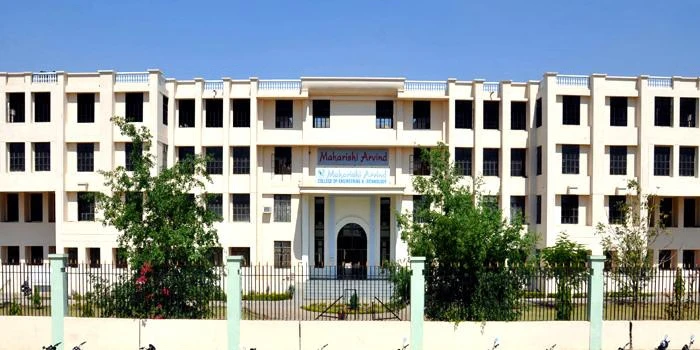
Maharishi Arvind Institute of Engineering & Technology (MAIET) in Jaipur is a private college that’s been around since 1999, and it presents a classic case of a college with a decent physical setup but a significant gap between its official claims and the on-ground student experience. It’s affiliated with Rajasthan Technical University (RTU) and approved by AICTE, which is the basic requirement to operate. The college touts a #1 ranking among private engineering colleges in Rajasthan in a GHRDC survey and sits in the 151-200 band in the broader NIRF Rankings. But talk to students, and you’ll hear a different story—one where placement promises often fall flat, and you’re largely on your own after paying the fees. It’s a place where your mileage will vary dramatically depending on your branch, your proactivity, and your expectations.
MAIET offers a standard spread of programs you’d expect from a mid-sized private institute in Rajasthan. The B.Tech intake is 60 students per branch across Computer Science, Mechanical, Civil, Electronics & Communication, Information Technology, and Electrical Engineering. They also run B.Pharm, BBA, BCA, and B.Sc at the undergraduate level. For postgraduates, there are M.Tech specializations (like Machine Design and VLSI), MBA, MCA, and M.Pharm. The total student strength is noted as 539, which suggests a moderately sized campus community.
Academically, the curriculum follows the RTU syllabus but includes add-ons like industrial internships, live projects, and certification courses in Python or Data Science. They organize hackathons and entrepreneurship programs. The faculty gets mixed reviews. Some students call them good and knowledgeable, while others are far less complimentary. A telling student comment notes that "good faculty left the college for their own good because they were not getting enough support from management." That’s a red flag about institutional stability and support. The official faculty count listed as 5 for 539 students seems implausibly low and is likely an error in reporting, but it underscores a lack of clear, authoritative data.
This is where the narrative splits. Officially, the college claims over 80% placement for 2025 with a highest package of ₹12 LPA and an average of ₹3-4 LPA. Their recruiter list is long and impressive on paper—TCS, Wipro, Infosys, Accenture, L&T, Tata Motors, and many big names in pharma and finance.
But the student consensus, pieced together from reviews on platforms like CollegeDunia and Shiksha, paints a starkly different picture. Alumni consistently report a placement rate of just 20-30%. The average package they cite is closer to ₹2-3 LPA, with the highest maybe touching ₹5 LPA for a lucky few. One review sums it up: "companies used to came but when I graduated only 3,4 companies visited which were belong to cs and IT branch... hiring was only 20-30 students."
The gap between the official placement claim and what alumni say on Reddit and review sites is notable. It suggests bulk of the hiring is concentrated in IT services, with core engineering branches (Mechanical, Civil, Electrical) struggling. Many students end up preparing for government exams or finding jobs off-campus. Internship support is also reportedly minimal; the college makes it compulsory, but students say they have to find those opportunities through their own efforts.
The fee structure is one of MAIET’s more straightforward aspects. For B.Tech, annual tuition ranges from ₹20,000 to ₹70,000, making the total four-year program cost about ₹2.8 lakhs. That’s relatively affordable for a private engineering college. Hostel and mess fees are an additional ₹45,000 per year, which includes Wi-Fi. So, a rough total cost for a B.Tech with hostel comes to around ₹4.6 lakhs over four years.
They do offer scholarships. There’s a merit-based waiver of up to 10% for students with 75%+ in their qualifying exams. Need-based aid can cover up to 50% of tuition for students with family income under ₹2.5 lakhs annually. Government post-matric scholarships for SC/ST/OBC students from Rajasthan are also applicable, offering full tuition reimbursement. They also have scholarships for the top three rankers in each branch.
Admissions primarily go through state counseling. For B.Tech, you need a JEE Main or REAP score. M.Tech requires GATE or the RTU CAM score. MBA admissions consider CMAT, RMAT, MAT, or XAT. The application window typically opens in April, with counseling in July and classes starting in August.
Specific cutoff ranks aren’t publicly detailed, which is common for colleges that fill seats through REAP counseling. The competition isn’t for the highest JEE Main ranks; it’s more about having a valid score and navigating the counseling process. There’s a 15% management quota for B.Tech and MBA, which operates outside the counseling system.
The campus is spread over 6-10 acres in Mansarovar, a decent location about 10-15 km from Jaipur’s main railway station and airport. Infrastructure is a mixed bag. On the positive side, they have well-equipped engineering labs for practical work, a library with 50,000 books and digital journal access, and a sporting complex with both indoor and outdoor facilities. Campus-wide Wi-Fi is available.
The hostels, however, are a common pain point. They’re separate for boys and girls with gated entry and wardens, but students describe them as "not that good." The food in the mess gets particularly poor reviews, called "not that great" and having a "fixed menu for whole life." College transportation services also get criticized for being limited and unreliable.
Student life includes fests like the techno-cultural festival "Aura," which provides a break from academics. But the social experience seems heavily dependent on making your own friend group, as institutional support for a vibrant campus culture appears limited.
Synthesizing the student sentiment is crucial for an honest picture. The positives are consistent: a good-looking campus, decent lab equipment for hands-on learning, and some faculty who are genuinely helpful. For a student who is self-driven and not solely reliant on the college for placements, the experience can be "amazing" from a purely academic and campus-life perspective.
But the negatives are loud and recurring. Placement disillusionment is the biggest theme. The 20-30% placement figure comes up repeatedly. Internship support is virtually nonexistent. Hostel food is a complaint. There are grumblings about management not supporting good faculty, leading to attrition. One vitriolic review even claimed the college was "shut down," which is clearly false but speaks to the depth of frustration some alumni feel.
The takeaway? Go in with eyes wide open. The college provides a platform and a degree. The effort to convert that into a job or a quality learning experience falls largely on you.
MAIET is a budget-friendly private option for engineering and pharmacy in Jaipur. Its low fees are its primary draw. If you have a moderate entrance score, need an AICTE-approved degree, and are capable of being entirely self-directed in your skill development and job search, it can serve as a functional base. The infrastructure is adequate for learning, and some faculty are good.
However, if you are counting on the college’s placement cell to secure you a job, you are likely to be disappointed. The chasm between official placement brochures and graduate outcomes is too wide to ignore. It’s not the college for someone seeking a guaranteed career launchpad, a vibrant residential life, or strong industry connectivity.
It’s best for: Cost-conscious students from Rajasthan who can commute, those planning to prepare for government exams alongside their degree, or extremely proactive learners who will use the college’s labs and library while building their own portfolio and network for off-campus placements.
Look elsewhere if: Your primary goal is a robust, college-facilitated placement into a core engineering role or a high-paying IT job. The data, especially from students themselves, suggests that’s not MAIET’s strength.
MAIET Jaipur is affiliated with Rajasthan Technical University (RTU), Kota, and Rajasthan University of Health and Science (RUHS), Jaipur. It is approved by the All India Council for Technical Education (AICTE) and the Pharmacy Council of India (PCI), which are mandatory for operation. It is important to note that the institute is not independently accredited by NAAC.
There is a significant discrepancy between official claims and student-reported data. The college's 2025 placement report claims over 80% placement with a highest package of INR 12 LPA. However, consistent student reviews across forums indicate a much lower placement rate of 20-30%, with an average package of INR 3-4 LPA and a highest package around INR 5 LPA. Top recruiting companies listed include TCS, Wipro, Infosys, HCL, Accenture, and Cognizant, but student accounts suggest visits from these major firms are infrequent and hiring is limited.
The annual tuition fee for B.Tech programs at MAIET ranges from INR 20,000 to INR 70,000. The total estimated cost for the four-year B.Tech program is approximately INR 2.8 Lakhs. Separate hostel and mess fees are INR 45,000 per year, which includes Wi-Fi access. This brings the total estimated cost for a B.Tech student staying in the hostel to around INR 4.6 Lakhs over four years.
Admissions are primarily through state-level counseling. For the B.Tech program, MAIET accepts scores from JEE Main and the Rajasthan Engineering Admission Process (REAP). For the M.Tech program, GATE and the RTU Combined Admission for M.Tech (RTU CAM) scores are considered. For the MBA program, scores from exams like CMAT, RMAT, MAT, and XAT are accepted.
Student sentiment is mixed. Positives often highlight the decent campus infrastructure, practical lab equipment, and the presence of some knowledgeable faculty. The major negatives consistently focus on poor placement support, the need for students to self-manage internships, dissatisfaction with the quality of hostel food, and criticism of the college's transportation services. The overall life experience is seen as acceptable for a low-fee college, but not one with strong institutional support for careers.
Share what future students should know about MAIET.
Student voices are not rewritten by colleges. We remove spam and abuse.
Wider admission question? Community PulseWhat should future students know?
Tell us which course you're considering. We'll help you work out the next step.
Get instant Partner access after mobile verification. Your public edits are reviewed before they go live.
Claim this college Auditorium
 Cafeteria
 Computer Labs
 Hostel
 Medical
 Science Labs
 Sports Complex
 Study Library