Loading Admission Guardian content
Loading Admission Guardian content

Provisional score based on available data. It may change as more information is verified.
Selected ranking categories, with the recorded year beside each result. Open all records for the complete history.
24 published records · Lower numeric ranks are stronger
IIRF
Management · public
#242023
Indiatoday
MBA
#182021
The Week
Management · public
#112022
Find a program, read its fee details and explore the admission requirements.
Summary of the programs shown below. First-year fee. Check the note beside each amount for inclusions and exclusions.
| Course | Stream | Fees |
|---|---|---|
| Ph.D. (Management Studies) | Management | 16000 |
| Master in Management [M.M.] | Management | 51000 |
| Master in Management Studies [MMS] | Management | 67000 |
Specializations
Eligibility: Post Graduation
Specializations
All accepted exams
Eligibility: Graduation
All accepted exams
Eligibility: Graduation + MAHCET
1 exam with cutoff data available
 Abbott Healthcare Pvt. Ltd.
 Accenture
 Aditya Birla Capital
 Aditya Birla Group
 Amway India
 Anand Rathi Securities
 AO Smith
 Aranca
 ASK Wealth
 Avalon Global Research
 Axis Bank
 Bajaj Allianz
 Bank of America
 Barclays Bank
 Barclays Capital
 Blue Star
 Capgemini
 CARE Ratings
 CBRE
CBRE Citi Bank
 Cognizant
 Colliers International
 Crisil
 Dabur India Ltd.
 Darashaw
 DBS Bank
 Decore Home
 Deloitte
 Deutsche Bank
 Digital India
 Donear Industries Ltd.
 Edelweiss
 EMERSON
 Equifax
 Ernst & Young
 Eureka Forbes
 Fullerton
 Future Generali
 GEP
GEP GEP Worldwide
 Godrej & Boyce
 GODREJ Pvt. Ltd
 Goldman Sachs
 Google
 Gozoop
 HDFC Bank
 HDFC Life
 ICICI Bank
 ICICI Prudential
 ICICI Securities
 IDFC First Bank
 IIFL
IIFL IndusInd Bank
 Infosys
 ITC Hotels
 Jio Creative Labs
 JP Morgan
 Kansai Nerolac Paints Ltd
 KANTAR
 Kotak Mahindra Bank
 KPMG
KPMG Lodha Group
 Madison
 Maersk GSK
 Mahindra Comviva
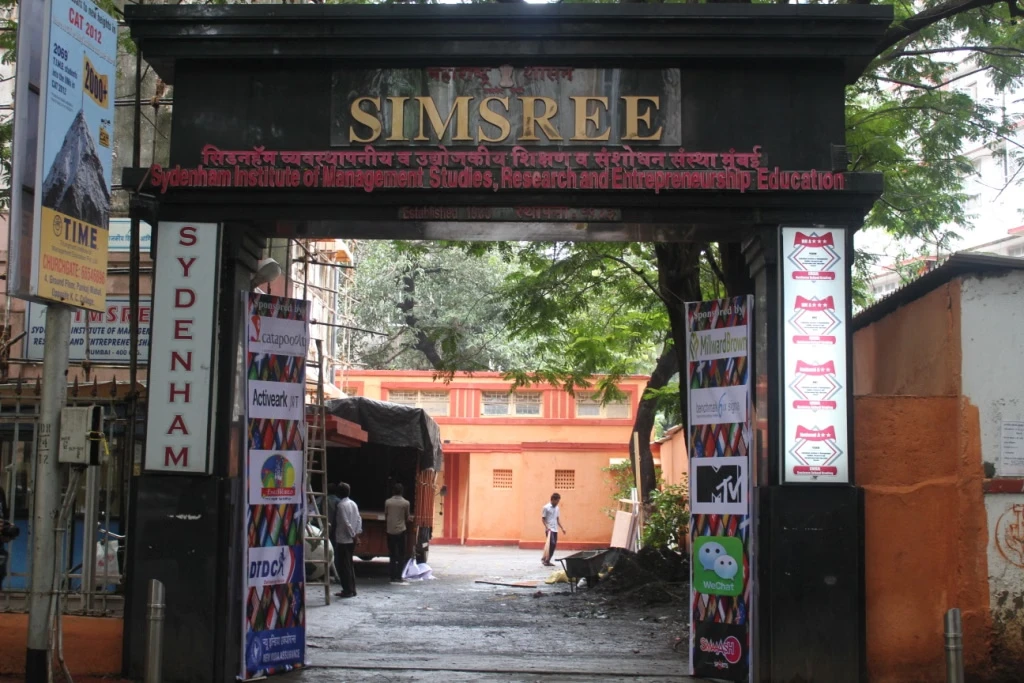
If you're looking for a business school where the return on investment is so sharp it feels like a financial hack, Sydenham Institute of Management Studies, Research and Entrepreneurship Education (SIMSREE) in Mumbai is the place. Forget sprawling campuses and luxury hostels. This government institute, operating from the third floor of a heritage building in Churchgate, delivers one of the most compelling value propositions in Indian management education. For a total two-year fee of around ₹1.4 lakhs, its students land average salaries north of ₹15 lakhs per annum. It’s a trade-off students have been making since 1983: you swap traditional college life for a hyper-practical, student-run bootcamp in the heart of India’s financial capital. The institute’s recent inclusion as a constituent college of Dr. Homi Bhabha State University (HBSU) marks its latest evolution, but its core identity—rigorous, accessible, and fiercely ROI-focused—remains unchanged.
Don’t let the compact footprint fool you. The academic offering here is focused and intense. The flagship is the two-year, full-time MMS (Master of Management Studies) with an intake of about 180, followed by the PGDBM (Post Graduate Diploma) with 60 seats. Here’s the critical detail everyone asks about: there is zero functional difference between the MMS and PGDBM programs. The curriculum, faculty, and placement access are identical. The MMS is a university degree, while the PGDBM is an autonomous diploma—that’s the only distinction. For those seeking specialization, the M.Sc. Finance is a rigorous, quantitative program with a batch size of just 30.
The academic culture is famously student-driven, with committees handling major operations. But the real academic firepower comes from the faculty model. There’s a core of about 15 permanent professors, but the institute leverages its prime location to bring in over 200 visiting faculty members—often CXOs, VPs, and senior practitioners from the banks and corporate houses a short walk away. Learning derivatives from someone who trades them on Dalal Street isn’t a metaphor here; it’s the standard. Specializations follow the typical tracks: Finance (the most sought-after), Marketing, Operations, HR, and Systems, all graded on the University of Mumbai’s 10-point CBCS scale.
This is the headline act. SIMSREE’s placement report is the reason for its ‘ROI King’ moniker. The official numbers for the 2022-2024 batch are strong: a highest package of ₹26.30 LPA, an average of ₹15.24 LPA, and a median of ₹14.95 LPA. Preliminary data for 2024 suggests consistency, with an average around ₹15.10 LPA. The institute claims 100% placement, though student reviews suggest a more realistic 95-98%, with a handful opting for entrepreneurship or family business.
The recruiter list reads like a who’s who of Mumbai’s corporate landscape. Finance is the dominant domain, claiming 42% of offers, with top banks like Barclays, JP Morgan Chase, Goldman Sachs, Citi, HDFC, and ICICI regularly hiring. Consulting and IT giants like Deloitte, Accenture, and Capgemini are also mainstays, alongside majors like Godrej, Amul, and Reliance.
Now, the reality check students talk about. That average package is a solid number, but it’s wise to look at the median (₹14.95 LPA) as a more reliable center point. There’s a persistent sentiment on forums like Reddit that the average can be skewed by a few stellar finance offers, and that the reality for the bottom quartile might be closer to ₹10-11 LPA. That’s still a phenomenal outcome for the fee, but it’s a nuance worth holding. The placement process itself is student-run, which is praised as excellent real-world training but also described as intensely high-pressure.
The fee structure is SIMSREE’s ultimate competitive advantage. For the MMS/PGDBM programs, you’re looking at an annual tuition of roughly ₹67,000 to ₹69,000. Over two years, with additional charges like a library deposit and development fee, the total cost typically lands between ₹1.36 and ₹1.45 lakhs. Hostel fees, for the lucky few who get them, are heavily subsidized by the government, ranging from ₹6,000 to ₹10,000 per year.
Financial aid is robust, as expected from a state institute. Students from SC/ST/OBC categories receive significant concessions, potentially bringing annual fees down to ₹5,000 - ₹15,000. There’s also an EBC (Economically Backward Class) scholarship that offers a 50% tuition waiver for eligible students. The math is simple and compelling: even at full fee, the entire investment can be recouped within months of starting a job.
Getting in is where the difficulty spikes. Admission is fiercely competitive and 100% merit-based—there is no management quota. The primary gateway is the MAH-MBA-CET, which governs 85% of the seats reserved for Maharashtra state candidates. The All India quota (15% of seats) accepts CAT and CMAT scores. The cutoffs are notoriously high, reflecting the institute’s value proposition.
For the 2024 cycle, the MAH-CET cutoff for the Open State category hovered between 99.75 and 99.85 percentile. For the All India seats using CAT scores, the bar was even higher, at a staggering 99.95 to 99.97 percentile. Selection is conducted through the state’s Centralized Admission Process (CAP) by the DTE Maharashtra. Notably, for the CAP rounds, there is no separate Group Discussion or Personal Interview; admission is purely merit-based on your entrance exam score and academic profile.
This is the trade-off. If you dream of a sprawling, residential campus with sports fields and modern amenities, SIMSREE will be a shock. The ‘campus’ is essentially the third floor of the historic Sydenham College building. It’s functional, with a well-stocked library, a computer lab, and classrooms, but it feels more like a corporate office. The canteen is shared with the commerce college, and most students quickly migrate to the countless eateries around Churchgate station.
Hostels are the other major constraint. Availability is extremely limited and allotted strictly on merit and distance. Boys may get a place in the basic Sydenham Hostel behind the college. Girls are often accommodated in government hostels like Savitribai Phule at Marine Drive. The quality is universally described as basic (think old buildings, shared facilities), but the location in South Mumbai is unbeatable. Many outstation students, especially women, end up finding PGs in slightly more affordable suburbs like Dadar and commuting.
Student life, however, is vibrant in its own way. The culture is intensely self-driven, with students organizing everything from the prestigious management fest ‘Sphinx’ to the entire placement process. Your social and professional network is the city of Mumbai itself.
The consensus from platforms like Quora, Reddit, and Shiksha is remarkably consistent, framing the classic SIMSREE dilemma.
The Positives:
The Negatives:
One popular Quora quote sums it up: “If you want a fancy campus and a swimming pool, go to NMIMS. If you want a 15 LPA job for a a 1.4L investment, come to Sydenham.”
SIMSREE is an exceptionally clear-cut proposition. It is unequivocally worth it for the pragmatic, career-focused student who views an MBA as a direct investment in their earning potential. If your primary goal is to maximize salary output against minimal educational input, there is arguably no better option in India. The access to industry, the quality of practical teaching, and the powerful alumni network in Mumbai's finance hub are immense benefits.
However, you should probably look elsewhere if you value the traditional “campus experience”—the dorm life, the sprawling greens, the insulated college community. SIMSREE offers an urban, professional immersion. It’s best for self-starters who are comfortable with ambiguity, can navigate Mumbai’s housing market, and thrive in a high-pressure, student-led environment. It’s not a cozy business school; it’s a bootcamp for the real world, with a payoff that’s very hard to argue with. For the right candidate, it’s not just a good choice; it’s a brilliantly strategic one.
JBIMS is generally considered a "Tier 1" B-school with stronger brand equity, while SIMSREE is often placed in "Tier 1.5/2." However, SIMSREE is noted for offering a similar return on investment (ROI) as JBIMS.
The MMS is a university degree, while the PGDBM is an autonomous diploma. However, there is zero difference between the two programs in terms of curriculum, faculty, and final placement opportunities.
Yes, SIMSREE accepts CAT scores, but only for filling the 15% All India quota seats. The CAT percentile cutoff for this quota is typically extremely high, usually 99.9 or above.
On-campus hostel facilities for girls are limited. The institute provides accommodation through government hostels in South Mumbai. Consequently, many female students opt for private paying guest (PG) accommodations in areas like Dadar or Vile Parle and commute to the college.
No, SIMSREE does not have a management quota. As a government institute, 100% of its seats are filled strictly through merit via the Directorate of Technical Education (DTE) Centralized Admission Process (CAP) rounds.
Share what future students should know about SIMSREE.
Student voices are not rewritten by colleges. We remove spam and abuse.
Wider admission question? Community PulseWhat should future students know?
Tell us which course you're considering. We'll help you work out the next step.
Get instant Partner access after mobile verification. Your public edits are reviewed before they go live.
Claim this college Marsh India Insurance Brokers Pvt. Ltd.
 Matrix
 Mercer Human Resource Consulting
 Metrix Lab
 MG Motor India Pvt. Ltd.
 Morgan Stanley
 Motilal Oswal
 Nomura Research Institute Ltd.
 Ogilvy & Mather
 Omniscient
 Outlook
 Piramal
 PWC
PWC Reliance
 Schneider Electric
 Star Union Dai-ichi
 Swiggy
 Tata AIA
 TATA Communications
 Tata Consultancy Services
 Tata Motors
 TCS
TCS Tech Mahindra
 Tresvista Financial Services
 Trinity Globaltech
 UBS
UBS Ujjivan
 Unison International
 UpGrad
 Vodafone
 Welspun
 Wipro
Wipro Yes Bank
 Zycus
Zycus100 named recruiters in the recorded data. Company names are deduplicated.
 Auditorium
 Cafeteria
 Computer Labs
 Hostel
 Medical
 Science Labs
 Sports Complex
 Study Library