Loading Admission Guardian content
Loading Admission Guardian content

Provisional score based on available data. It may change as more information is verified.
Find a program, read its fee details and explore the admission requirements.
Summary of the programs shown below. Total course fee. Check the note beside each amount for inclusions and exclusions.
| Course | Stream | Fees |
|---|---|---|
| Master of Science [M.Sc] (Nursing) | Paramedical | 200000 |
| Diploma | Paramedical | 310000 |
| General Nursing and Midwifery [GNM] | Paramedical | 380000 |
| Bachelor of Science [B.Sc] | Paramedical | 500000 |
Specializations
Eligibility: Graduation
Specializations
Eligibility: 10+2
Eligibility: 10+2 with 45%
Specializations
Eligibility: 10+2
1 exam with cutoff data available
 Apollo Hospitals
 Columbia Asia
 fortis hospitals
 Global Hospitals India
 Manipal Hospitals
If you're looking at nursing and allied health colleges in Bangalore, the Abhaya Group of Institutions comes up for one reason above all: its hospital. This isn't a simulated lab or a distant affiliate. The Abhaya Multi-Speciality Hospital is right there on the 5-acre campus, owned by the same trust that runs the college. For students in scrubs, that means daily, hands-on clinical exposure from year one—a tangible advantage in a field where textbook learning isn't enough. Established in 2000 (with the nursing college starting in 2008), it's a private institution affiliated with the Rajiv Gandhi University of Health Sciences (RGUHS). It’s recognized by the Indian Nursing Council and the Karnataka Nursing Council, which is non-negotiable for your degree to be valid. The vibe here is intensely professional, almost monastic. Don't expect a typical college social scene. You're here to train, and the structure reflects that. It's a trade-off, but for the right student, it's a clear path into the healthcare system.
This is a specialized health sciences campus. Everything revolves around RGUHS's prescribed curriculum, and the academic calendar follows that university's strict exam schedule. The faculty is a mix of core professors and visiting doctors from the parental hospital. Dr. Laxmi Goudar, the Principal with a PhD and 20+ years in nursing, sets a serious academic tone. The teaching is described as dedicated but rigid—they drill the RGUHS syllabus because you need to pass those exams. The grading system requires a minimum of 50% separately in theory and practicals, which keeps the pressure on.
The undergraduate lineup is solid. The B.Sc Nursing program, with an estimated intake of 60-100, is the anchor. Then you have a suite of B.Sc Allied Health Sciences programs: Optometry, Medical Lab Technology (MLT), Medical Imaging Technology (MIT), Operation Theatre & Anesthesia Technology, and Renal Dialysis Technology. Each runs for 3-4 years with intakes around 30. For those already in the field, there's a 2-year Post Basic B.Sc Nursing course. At the diploma level, GNM (General Nursing and Midwifery) is a 3.5-year commitment. They also offer shorter 2-year diplomas in Dialysis, OT Tech, and others.
The postgraduate offering is an M.Sc in Nursing with specializations in Medical-Surgical, Paediatric, OBG, Community Health, and Psychiatry. The academic differentiator isn't a fancy library—it's the hospital next door. Your "lab" is a working ward.
The placement story here is straightforward and, for nursing, relatively reliable. The college claims 100% placement assistance, and reviews suggest an on-campus placement rate of 85-90% for nursing graduates. That's a decent outcome. The demand for trained nurses and paramedics in Bangalore's vast hospital network is real and insatiable.
Packages are modest but realistic for entry-level clinical roles. The highest package cited for 2022 was 8 LPA for an international or specialized nursing position. That's an outlier. The average package for a fresh B.Sc Nursing or Allied Health graduate sits between 3.5 and 4.5 LPA. You're not getting tech company salaries, but it's a stable start in a recession-proof sector.
Recruiters are the who's who of South Indian healthcare: Apollo Hospitals, Fortis, Manipal Hospitals, Narayana Health, and Columbia Asia (now part of Manipal). A significant number of graduates are absorbed directly into the Abhaya Multi-Speciality Hospital itself. The placement cell also provides guidance for students aiming for international roles, particularly in the UK and Middle East, covering exams like IELTS and OET. The 6-month mandatory internship, often at major government hospitals like Kidwai or Victoria, frequently turns into a pre-placement offer. It's a functional, no-nonsense system that works because the industry need is concrete.
Let's talk total cost, because the tuition is just part of the story. For the flagship B.Sc Nursing program, annual tuition fees range from ₹1.2 lakh to ₹1.5 lakh, depending on whether you secure a seat through the KCET government quota or the management quota. Over four years, tuition alone will run you ₹4.8 lakh to ₹6 lakh.
But you'll likely need the hostel. Hostel and mess fees add another ₹60,000 to ₹80,000 per year. Then factor in one-time admission fees (around ₹5,000), semester exam fees (₹3,000 each), and annual lab/library charges (₹10,000). A realistic total cost for a B.Sc Nursing degree with hostel for four years is in the ballpark of ₹8.5 lakh to ₹9.5 lakh. For B.Sc Allied Health courses (3-4 years), the total cost is slightly lower, around ₹4.5-5 lakh for tuition, plus hostel.
Financial aid primarily comes through government schemes. SC/ST/OBC students from Karnataka can apply for scholarships via the Karnataka State Scholarship Portal (SSP). The college itself doesn't prominently advertise extensive merit-based scholarships, so planning your finances around the full fee structure is wise.
Getting in hinges on the Karnataka Common Entrance Test (KCET). For B.Sc Nursing and the Allied Health programs, KCET is mandatory for the government quota seats, which make up a portion of the intake. The selection is then done through centralized counseling by the Karnataka Examinations Authority (KEA).
The KCET cutoffs give you a sense of the competition. In the 2025 counseling rounds, the closing rank for B.Sc Nursing for General/OBC candidates was between 1.39 lakh and 2.03 lakh. For B.Sc MLT, the SCG category closed around 1.80 lakh. These are not ultra-competitive ranks compared to engineering, but they show a consistent demand.
For seats not filled through KCET (the management quota), the college may consider NEET scores or conduct its own merit-based assessment, though this is less formalized. The application process usually involves filling a form with a fee of ₹500, either online or via demand draft. The entire process is bureaucratic and follows the state calendar—patience is required.
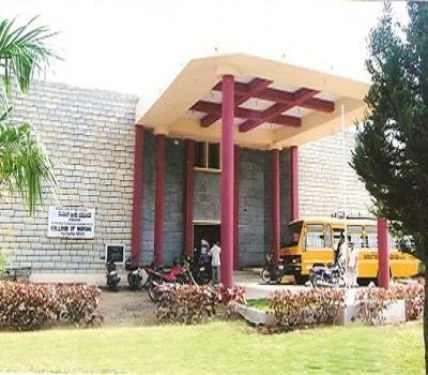
The campus is functional, not luxurious. Spread over 5-6 acres off Kanakapura Road, it's in a quieter zone. You have the essential academic blocks, six specialized nursing and health sciences labs with simulation equipment, and a library stocked with RGUHS materials. The crown jewel, as mentioned, is the on-campus Abhaya Hospital where students do daily clinical rounds.
Hostels are separate for boys and girls, with a total capacity of about 400. Reviews are mixed. The social life within the hostel is often cited as a highlight—"hostel is more fun than college." But the infrastructure is basic. Rooms are typically shared between 4 to 7 students, especially in the newer blocks. Food in the mess is routinely described as "average." The college runs a fleet of buses to ferry students to their external clinical postings at hospitals like Kidwai and Victoria.
And here's the critical point about student life: it's minimal. This is not a "campus life" college. There are very few fests, cultural events, or the kind of socializing you'd find at an engineering college. The focus is deliberately and intensely on your professional training.
Synthesizing opinions from CollegeDunia, Shiksha, and forums paints a consistent picture. The praise is almost always for the clinical exposure and teaching quality. Students feel prepared for the job because they've been in a real hospital setting for years. Faculty are generally seen as knowledgeable and supportive, if strict.
The biggest and most universal critique is about strictness and rules. The atmosphere is frequently called "school-like." Attendance is enforced at 85%. One recurring, specific complaint is the ban on personal vehicles: "Bikes are not permitted for entering the college or hostel; if found, heavy fines are imposed." For students used to more autonomy, this can feel stifling.
Placement claims are largely trusted, given the healthcare sector's demand. The consensus is that if you do your part, you'll get a job, though it might start at the lower end of that 3.5-4.5 LPA band. Social life is acknowledged to be low-key. It's a trade-off students seem to understand—you come for the professional training, not the college experience.
Abhaya Group of Institutions is a specific tool for a specific job. It's best for the student who views their education as professional training first and foremost. If you want to become a nurse or a paramedic and value daily, hands-on hospital experience over a vibrant campus life, this college delivers. The link to Abhaya Hospital is its core strength, providing clinical exposure that many colleges can only promise. The placement track record, while offering modest starting salaries, is solid because it's tied to a sector with genuine need.
But you have to be okay with the environment. The rules are strict, the social scene is quiet, and the infrastructure is adequate, not amazing. If you're looking for a holistic "college experience" with freedom, fests, and a sprawling campus, you'll likely be frustrated here. It’s a pragmatic choice. For the right candidate—one focused squarely on building a clinical career from day one—it’s a direct and effective path into the healthcare workforce of Bangalore and beyond.
Yes, Abhaya Group of Institutions is considered good for B.Sc Nursing, primarily due to its direct access to its parental multi-specialty hospital, which ensures consistent and extensive clinical practice for students.
The total estimated cost for the full 4-year B.Sc Nursing program, including hostel fees, ranges from approximately ₹8.5 lakhs to ₹9.5 lakhs.
The college strictly enforces an attendance requirement of 80-85% for its students, in compliance with the regulations set by the Rajiv Gandhi University of Health Sciences (RGUHS).
While the college does not directly provide international placements, it offers guidance and preparation for key exams like IELTS and OET for students aspiring to work in countries such as the UK or the Middle East.
Nursing students gain clinical experience at several major hospitals, including Abhaya Hospital, Kidwai Institute of Oncology, Indira Gandhi Institute of Child Health, and Vanivilas Hospital.
Share what future students should know about Abhaya Group of Institutions.
Student voices are not rewritten by colleges. We remove spam and abuse.
Wider admission question? Community PulseWhat should future students know?
Tell us which course you're considering. We'll help you work out the next step.
Get instant Partner access after mobile verification. Your public edits are reviewed before they go live.
Claim this college Auditorium
 Cafeteria
 Campus Security
 Computer Labs
 Medical
 Science Labs
 Sports Complex
 Study Library