Loading Admission Guardian content
Loading Admission Guardian content
Provisional score based on available data. It may change as more information is verified.
Find a program, read its fee details and explore the admission requirements.
Summary of the programs shown below. Total course fee. Check the note beside each amount for inclusions and exclusions.
| Course | Stream | Fees |
|---|---|---|
| Diploma | Medical | 144500 |
| Bachelor of Science [B.Sc] | Paramedical | 376900 |
Specializations
Specializations
Eligibility: 10+2
Forget the sprawling campuses and raucous fests. Al Shifa College of Paramedical Sciences in Perinthalmanna, Kerala, is a different kind of institution. It’s a training ground. Established in 2004 and affiliated with the Kerala University of Health Sciences (KUHS), its defining feature isn't a sports complex—it's the 450-650 bed KIMS Al Shifa Super Specialty Hospital right next door. That's the core of its reputation. If you're serious about a hands-on career in allied health, where you learn by doing in a real clinical environment from day one, this is a compelling option. But if you're picturing a typical college experience with endless freedom, you'll be in for a surprise. The culture here is disciplined, focused, and built around professional readiness above all else.
The college sticks to a focused portfolio in allied health. You won't find arts or commerce here. The programs are a mix of four-year undergraduate degrees and shorter, more practical diplomas.
For the degrees, the B.Sc. in Medical Laboratory Technology (MLT) with an intake of 40 is the most popular. The B.Sc. Optometry program, taking in 30 students, includes a mandatory one-year internship. On the diploma side, they offer two-year programs in Medical Lab Tech (DMLT), Radiological Technology (DRT), and Operation Theatre & Anaesthesia Tech (DOTAT). The DOTAT course tacks on a six-month internship.
Academically, it's a structured environment. They follow the KUHS calendar and grading system for degrees and the DME schedule for diplomas. The rules are clear: maintain 80% attendance and score at least 50% in internal exams to be eligible for the university finals. The faculty, around 31 members, gets consistently good marks from students for being knowledgeable and approachable, especially in the core departments. But let's be honest—the real classroom is the hospital. That's the college's biggest academic selling point.
Talking about paramedical placements requires a mindset shift from engineering. You're not chasing 20 LPA packages from tech giants. Recruitment is hospital-based, often starting with the mandatory internship.
The college claims an 85-90% employment rate within six months of graduation. That's a decent figure for the sector. The primary recruiter is, unsurprisingly, the parent KIMS Al Shifa Hospital itself. Other top names include Aster DM Healthcare, Baby Memorial Hospital in Kozhikode, and Moulana Hospital locally.
Now, the numbers. For a fresher starting in Kerala, the average annual salary is modest, typically between ₹1.8 to ₹3.0 lakhs. The real financial upside, which the college heavily promotes, is the Gulf corridor. A significant chunk of alumni—around 30%—find work in the UAE, Saudi Arabia, Qatar, and Oman. There, starting salaries can be equivalent to ₹8-12 lakhs per annum, though you have to clear licensing exams like DHA or PROMETRIC first.
Here's the reality check students talk about. That mandatory internship at the parent hospital? It's almost always unpaid. That's a major point of contention in reviews. The "placement" often means being absorbed after proving yourself during that free labor period. So the path to a job is clear and attached to the hospital, but don't expect a corporate-style placement drive with signing bonuses.
For a private institution with its own hospital, the fees are relatively controlled. For the 2024-25 session, expect to pay between ₹80,000 to ₹95,000 per year for B.Sc. MLT, and ₹90,000 to ₹1,10,000 for B.Sc. Optometry. Over four years, that totals roughly ₹3.76 lakhs and ₹4.5 lakhs for tuition, respectively. Diploma courses are cheaper, ranging from ₹40,000 to ₹50,000 annually.
But that's just tuition. Living on campus adds cost. Hostel rent runs about ₹22,000 per year. Mess fees are extra, typically ₹2,400 to ₹3,500 per month depending on the meal plan. Add exam fees, uniforms, and lab deposits, and the total cost for a degree student living in the hostel can edge toward ₹5.5-6 lakhs over four years.
Financial aid is available, primarily through government schemes. Eligible SC/ST/OBC students can apply for the E-Grantz scholarship from the Kerala government. The managing Shifa Medicare Trust also offers some minority scholarships. It's worth checking the official website or contacting the administration directly for the latest forms and deadlines.
The admission process here is straightforward, with no complex entrance exams to navigate. It's largely merit-based on your 10+2 marks.
Eligibility requires a science background. For B.Sc. programs, you need a minimum of 50% aggregate in Physics, Chemistry, Biology, and English. For the diploma courses, the bar is slightly lower at 45% in PCB.
The selection splits the seats 50/50. Half the seats (Government Quota) are filled through centralized counseling conducted by the LBS Centre for Science & Technology in Kerala. The other half (Management Quota) are filled directly by the college, usually based on merit and sometimes a personal interview. The application window typically opens in May or June, right after the Kerala Plus Two results are out. If you're interested, that's the time to be vigilant and check their official website for notifications.
The 3.49-acre campus is functional. The academic blocks house six well-equipped labs for microbiology, pathology, biochemistry, and optometry. The library has over 1,800 books and is digitized. There's an auditorium for events. But again, the star infrastructure is the hospital—it's an extension of the campus for practical training.
Hostel life is segregated and capacious. The girls' hostel can fit 420, the boys' hostel 200. They're described as adequate, not luxurious. The in-house canteen serves South Indian meals and is considered clean, though some students gripe about the price.
Campus life is where the college's disciplined nature is most apparent. Rules are strict. Students frequently mention needing permission slips for various activities. It can feel restrictive if you're expecting autonomy. That said, they do celebrate Onam and Christmas with genuine enthusiasm, which are highlights of the social calendar. There's a medical facility on hand, but that's almost a joke—you're literally attached to a super-specialty hospital.
Synthesizing feedback from CollegeDunia, Shiksha, and other forums paints a consistent picture. The consensus isn't about luxury or fun; it's about professional preparation.
The praise is laser-focused on clinical exposure. Review after review states that access to the high patient volume at KIMS Al Shifa is invaluable. "We get to see real cases from the first year itself," is a common sentiment. Faculty support, especially in the MLT and Optometry departments, is also a strong positive.
The criticisms are equally consistent. The strict discipline tops the list, with many saying it feels like a school extension. The lack of a stipend during the mandatory internship is a major financial and ethical grievance for many. Food in the canteen gets mixed reviews, often cited as okay but overpriced.
One alumni quote from 2024 sums it up perfectly: "If you want to be a good technician, come here for the hospital exposure. If you want a 'movie-style' college life, you will be disappointed." That's the trade-off, laid bare.
It depends entirely on what you're after. If your primary goal is to become a skilled, job-ready medical lab technologist, optometrist, or theatre technician with hands-on experience that most graduates can only dream of, then Al Shifa is absolutely worth serious consideration. The direct pipeline to a major hospital and the proven track record of placements, especially in the Gulf, are powerful advantages. The fees, while not cheap, are justified by the clinical infrastructure you're paying to access.
However, if you value a liberal campus atmosphere, student autonomy, and a wide range of extracurriculars, you'll likely find it stifling. The strict rules and unpaid internship are real downsides. This college is a vocational training centre with a degree-granting affiliation. It's best for focused, career-oriented students who see college as a step toward a profession, not just an experience. For them, it can be a very effective launchpad.
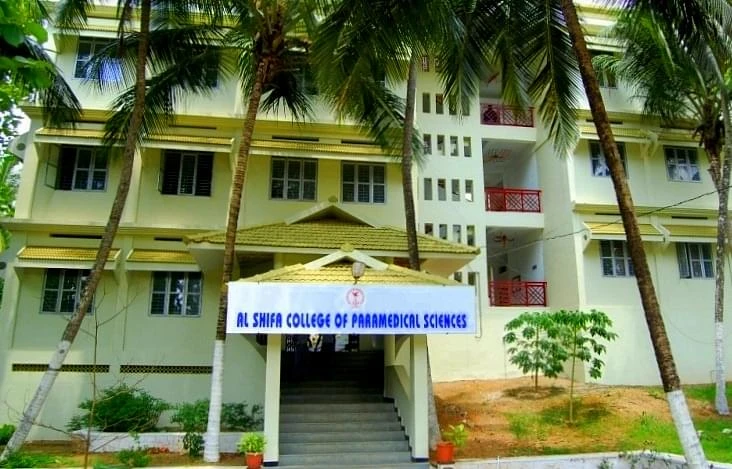
In this preview: 1 photo · 0 videos
Yes, Al Shifa College of Paramedical Sciences is considered one of the best colleges for B.Sc. Medical Laboratory Technology (MLT) in Malappuram. This is largely due to the high volume of clinical samples and cases available for practical training at its attached KIMS hospital.
The total approximate cost for the 4-year B.Sc. Optometry program at Al Shifa College of Paramedical Sciences, including hostel and mess charges, ranges between ₹5.5 lakhs to ₹6 lakhs.
The college has an active placement cell. However, most students secure employment through the clinical experience gained during their internship or by directly applying for jobs in Gulf countries.
Yes, Al Shifa College of Paramedical Sciences provides a separate boys' hostel facility with a capacity to accommodate 200 students.
Yes, the degree is awarded by the Kerala University of Health Sciences (KUHS) and is recognized globally. Graduates can work abroad after clearing the required licensing exams of the destination country, such as DHA, MOH, or PROMETRIC.
Share what future students should know about Al Shifa College of Paramedical Sciences.
Student voices are not rewritten by colleges. We remove spam and abuse.
Wider admission question? Community PulseWhat should future students know?
Tell us which course you're considering. We'll help you work out the next step.
Get instant Partner access after mobile verification. Your public edits are reviewed before they go live.
Claim this college
 Auditorium
 Cafeteria
 Computer Labs
 Medical
 Sports Complex
 Study Library