Loading Admission Guardian content
Loading Admission Guardian content

Selected ranking categories, with the recorded year beside each result. Open all records for the complete history.
2 published records · Lower numeric ranks are stronger
IIRF
Nursing
#1102022
Find a program, read its fee details and explore the admission requirements.
Summary of the programs shown below. Fee amounts are not listed. Contact the college for its current fee schedule.
| Course | Stream | Fees |
|---|---|---|
| Bachelor of Science [B.Sc] (Nursing) | Paramedical |
Specializations
Eligibility: 10+2
If your top priority in a nursing education is a direct, guaranteed pipeline into one of India's largest private hospital networks, Aragonda Apollo College of Nursing (AACN) is a name you'll keep hearing. Located in a quiet village in Chittoor district, this isn't a typical sprawling campus. It's a focused, no-frills training ground owned by the Apollo Hospitals Educational Trust. The trade-off is clear: you exchange a vibrant city life and some personal freedoms for exceptional clinical exposure and near-certain job security with Apollo upon graduation. That's the core bargain here, and for many students, it's a compelling one.
The academic portfolio here is streamlined and practical. You have two core pathways: the four-year B.Sc. Nursing degree and the three-year General Nursing and Midwifery (GNM) diploma. It's important to note that post-graduate options like M.Sc. Nursing or Post Basic B.Sc. are centralized at other Apollo campuses in Chennai or Hyderabad; they aren't offered at Aragonda. The curriculum follows the schedule of the affiliating Dr. YSR University of Health Sciences, with an annual exam pattern still in place for some batches.
Where the college shines is in its faculty-to-student ratio and clinical tie-ups. With about 25 faculty members for an intake of 110 students across both programs, the student-teacher ratio sits around 7.76:1. That's a strong number, well above INC norms, and it translates to more personalized attention in labs and classrooms. Most instructors hold M.Sc. Nursing degrees in specialties like Medical-Surgical, OBG, and Paediatrics. The real academic weight, however, comes from the clinical postings. Rotations happen at the District Head Quarters Hospital in Chittoor, SVRR Government General Hospital in Tirupati, and crucially, within the Apollo network itself, including KH Apollo Hospital in Ranipet and the flagship Apollo Hospitals in Chennai. This access to high-volume, multi-specialty hospitals is the program's defining academic advantage.
Let's separate the official line from the on-ground reality. The college officially claims a 100% placement rate. In practice, this is better understood as a near-guaranteed absorption policy for students who successfully complete their mandatory 6-month internship, which is typically within Apollo-affiliated hospitals. So, you don't have a traditional placement drive with multiple companies vying for you. Your recruiter is essentially your parent organization.
The packages reflect this internal hiring. The average starting salary for a staff nurse role within the Apollo network in India is around ₹3.0 lakhs per annum (LPA), which breaks down to roughly ₹25,000 per month. That's the working number most alumni cite. There are mentions of a highest package ranging between 4.5 to 5.0 LPA, usually linked to international placements in the Gulf or UK, or specialized roles, but these are not the norm and depend on individual performance and additional certifications. The top—and really, the only—recruiters are Apollo Hospitals (Chennai, Hyderabad, Bangalore), Apollo Reach Hospitals, and KH Apollo Hospital, Ranipet. The entire output goes into the healthcare sector.
The verdict? If your goal is a stable nursing job with a renowned brand right after college, this system delivers. But if you're aiming for a high-stakes placement day with competitive bids from various corporate hospital chains, that's not the model here. The security comes with a predefined career starting point.
The cost of studying here is a tale of two quotas, with a staggering difference. For the 2025-2027 period, estimates are as follows:
The hostel fee, which includes mess charges for vegetarian and non-vegetarian food, is generally mandatory, especially for female students, given the rural location. Financial aid is primarily available through state government schemes. Eligible students (SC/ST/BC/EBC, Minority) can apply for the Andhra Pradesh Jagananna Vidya Deevena (Right to Fee Reimbursement) and Vasathi Deevena (Mess Charges) schemes, which can significantly offset costs for those qualifying.
Admission is a two-track process defined by quota. The basic eligibility is consistent: passing 10+2 (or equivalent) with Physics, Chemistry, Biology, and English, and securing a minimum of 45% aggregate (40% for reserved categories).
The pathways diverge from there:
The application window typically opens in May and runs through July, aligning with the state counseling schedule.
This is where the college's remote location and institutional discipline profoundly shape the experience. The campus spans about 3 acres and has the essentials: well-equipped labs for Anatomy, Fundamentals of Nursing, and MCH, plus a library with over 3,000 nursing-specific texts. There's immediate access to a small Apollo Medical Center on-site for health needs.
The hostel is a focal point of student reviews. It has separate wings for boys and girls, with rooms described as dormitory-style and well-ventilated but basic—no modern luxuries. The food in the mess gets a middling 3.5/5 rating, with an open-kitchen system praised for hygiene. The biggest, most consistent complaint across student forums is the complete lack of student Wi-Fi in the hostel. Connectivity is a major pain point.
And that leads to the culture. Life here is structured, some would say severely. The college enforces a strict 75-80% attendance policy, with exam barring for shortfalls. Rules governing dress code (no second stud earrings, limited jewelry), curfews, and requiring permission letters for outings are often described as "school-like." Social life in Aragonda village is minimal. The trade-off, as always presented, is the focus on professional training and safety. Sports and extracurriculars exist but within this disciplined framework.
Synthesizing feedback from platforms like CollegeDunia and Shiksha reveals a clear consensus with very specific pros and cons.
The Positives are powerful and career-centric: Alumni overwhelmingly praise the "exceptional clinical exposure," noting they see complex cases many private college students don't. The "100% job security" with Apollo is the dominant relief, removing post-graduation anxiety. Faculty are frequently called "supportive" and "knowledgeable," with several reviews highlighting their role as mentors who care about students' mental well-being.
The Negatives are about lifestyle and autonomy: The phrase "extreme discipline" comes up constantly. The remote location is called out for offering "zero social life." Hostel rules and the "worst possible" internet connectivity are major grievances. You have to be prepared for an environment where personal freedom is secondary to a regimented training schedule. It's not for everyone.
Aragonda Apollo College of Nursing is a highly specific, utilitarian choice. It's unequivocally worth it for the student whose singular goal is to become a skilled staff nurse and secure a job with the Apollo Hospitals network right out of college. The clinical training is top-tier for a private institution, and the absorption policy is a legitimate safety net. If you can accept the strict discipline, remote setting, and basic hostel amenities as the price for that career launchpad, it's a logical decision.
However, you should probably look elsewhere if you value a traditional college social experience, campus autonomy, or want to keep your options open with multiple hospital chains during placements. The Management Quota fee, nearing ₹12 lakhs, also demands scrutiny—at that price point, you could consider colleges in more urban centers with broader horizons. Ultimately, AACN is a pipeline. It's an excellent one if Apollo is your destination, but it's not a detour-rich journey.
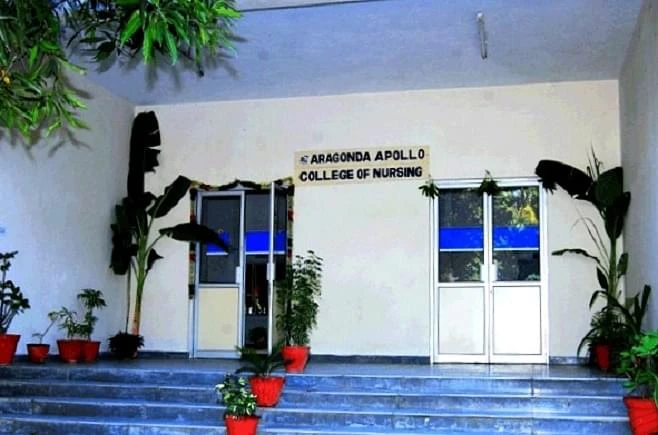

In this preview: 2 photos · 0 videos
Yes, Aragonda Apollo College of Nursing is considered good for its B.Sc. Nursing program, primarily due to its strong clinical training and the benefit of guaranteed placement opportunities within the Apollo Hospitals network.
The approximate fee for the Management Quota at Aragonda Apollo College of Nursing ranges from ₹1.75 Lakhs to ₹2.0 Lakhs per year. It is important to note that this cost does not include hostel fees.
Hostel accommodation is generally mandatory, especially for female students. This policy is in place due to the college's rural location and its commitment to student safety and security protocols.
While formal coaching for exams like NCLEX or IELTS is not part of the core curriculum, the Apollo Group does offer guidance and support for students who are interested in pursuing nursing careers in the UK or USA.
Aragonda Apollo College of Nursing enforces a strict "Zero Tolerance" anti-ragging policy. In recent years, no major ragging incidents have been reported on campus.
Share what future students should know about Aragonda Apollo College of Nursing.
Student voices are not rewritten by colleges. We remove spam and abuse.
Wider admission question? Community PulseWhat should future students know?
Tell us which course you're considering. We'll help you work out the next step.
Get instant Partner access after mobile verification. Your public edits are reviewed before they go live.
Claim this college
 Auditorium
 Cafeteria
 Campus Shuttle
 Communication Centre
 Computer Labs
 Hostel
 Medical
 Science Labs
 Sports Complex
 Study Library