Loading Admission Guardian content
Loading Admission Guardian content
7 programmes · 1 institution. Check the admission year and requirements.
7 programmes · 1 institution. Check the admission year and requirements.
B.M.S. College of Engineering (BMSCE) is a private engineering institution in Basavanagudi, Bengaluru. The college says it was founded in 1946 and now offers 13 undergraduate and 16 postgraduate courses. The current official pages reviewed here describe 2026-27 admissions and management-quota fee schedules; they do not establish next year's deadlines, entrance-score validity or fees. Applicants should use the current counselling and college notices for their own course and route rather than treating historical figures as a 2027-28 offer.
BMSCE's official history describes the institution as founded by B. M. Sreenivasaiah and later nurtured by B. S. Narayan. Its current site describes undergraduate and postgraduate study across conventional and emerging engineering areas. The published undergraduate list includes core engineering and computing branches such as Civil, Mechanical, Electrical and Electronics, Electronics and Communication, Computer Science and Engineering, Artificial Intelligence and Machine Learning, and Computer Science and Engineering (Data Science), alongside other named programmes. The postgraduate page includes M.Tech, MBA and MCA routes. Programme names and seat availability should be checked against the current admission notice and counselling seat matrix.
The college says UGC extended its autonomous status for ten years from the 2022-23 session through 2031-32. Its autonomy supports institution-level academic administration within the applicable university and regulatory framework; applicants should verify the current degree-awarding and affiliation details in the admission-year documents. The institution's rankings page reports a NAAC Cycle III CGPA of 3.56 and grade A++, for a period stated as 30 June 2024 to 29 October 2031.
For undergraduate engineering, BMSCE lists Karnataka Examination Authority (KEA) and COMED-K counselling, along with a separately handled management-quota application route. Its current management page says first-year B.E. applicants must qualify in an entrance examination conducted by CET/COMED-K or JEE Main Paper I. The captured notice is for 2026-27. It is not evidence that the same test year, deadline or process will apply to a later intake.
The official undergraduate page states a 45% aggregate in Physics and Mathematics with the listed optional subjects for general merit candidates and 40% for the specified SC/ST and OBC categories. It also lists a three-year lateral-entry route for diploma or equivalent candidates, with different final-year diploma thresholds. These published conditions do not replace the counselling authority's current category, document or equivalence rules.
For postgraduate study, the 2026-27 page gives distinct MBA and MCA requirements. The MBA requires a recognised bachelor's degree and lists a 50% aggregate, or 45% for the specified Karnataka SC/ST/Category-I candidates, with KEA PGCET, KMAT or another qualifying approved examination. MCA requires a relevant optional subject such as Mathematics, Statistics, Computer Science or Computer Applications and lists KMAT or PGCET. Do not carry the MBA test or marks rule over to another programme.
BMSCE's 2026-27 management-quota schedules publish annual programme amounts rather than one common college-wide price. For example, the B.E. table lists Computer Science and Engineering at ₹15 lakh per year; other branches have different rates. The postgraduate page lists MBA at ₹4 lakh and MCA at ₹3.5 lakh per year. Hostel, food and personal expenses are not established by those tuition amounts. A revised first-year postgraduate circular separately lists management-quota fresh-admission miscellaneous charges of ₹40,840 for Karnataka students and ₹42,640 for non-Karnataka students. That circular is a separate charge, not the total programme fee.
These are historical 2026-27 figures and should not be projected to the next intake. Before paying, ask for the current branch-specific schedule and written component breakdown, including the number of years or semesters covered, category, quota, additional charges and refund terms. The official pages distinguish management quota from the KEA/COMED-K routes; do not apply a management figure to a counselling seat.
The latest outcome table captured for this refresh is BMSCE's NIRF Engineering submission for the 2026 reporting cycle. For undergraduate students graduating in 2024-25, it reports 1,291 graduates, 972 placed, a median salary of ₹10 lakh per year and 79 students continuing to higher studies. For the corresponding postgraduate cohort, it reports 127 graduates, 98 placed, a median salary of ₹6.2 lakh per year and four students continuing higher studies.
These are course-level outcome counts and medians reported in the NIRF submission, not a placement guarantee or an individual salary forecast. The median is not the highest package or an average. The denominator is the graduates reported for that course level and year; the placement count and higher-study count should be read as separate reported outcomes. Students comparing departments should seek the branch-specific placement report and its cohort definition rather than assuming that the college-wide figure applies to every programme.
NIRF's Engineering pages list BMSCE in the 151-200 rank band in 2025. The official NIRF page also lists the institution in the 151-200 band for 2024 and the 101-150 band for 2023. These are rank bands, not exact positions. They provide a year-specific national comparison, but do not measure a particular department, admission outcome or student experience. The NAAC accreditation and UGC autonomous-status dates above are separate institutional measures and should not be conflated with NIRF ranking.
BMSCE's scholarship directory lists the SDEF India Scholarship and the Social Welfare Department's SC/ST SSP scholarship for 2026-27. The SDEF provider page gives a 31 October 2026 deadline, which had passed by the 1 November 2026 review date. Applicants should check the provider and government portals for live eligibility, deadlines, renewals and application status. A directory listing does not guarantee that a student qualifies or will receive support.
The college's first-year hostel page identifies 2026-27 accommodation addresses and says the listed hostels are outside the campus. Its hostel-admission page says room allotment for freshers is by lottery. The wider hostel capacity list is not dated and is not a current vacancy count. The hostel fee page captured here does not publish a fee amount, so applicants should request current room, mess, deposit and commute details before budgeting. BMSCE's library page describes digital and print holdings, but its published collection figures are not dated; confirm access, opening hours and current subscriptions directly.
Start with BMSCE's official undergraduate or postgraduate admissions page and the current notice for your degree and route. For KEA or COMED-K seats, use the counselling authority's instructions for registration, category documents, choice filling and allotment. For management quota, confirm the exact programme, accepted test and score year, current fee schedule, additional charges and refund conditions in writing. For scholarships, verify the provider's current application window. For hostel accommodation, confirm availability and the assigned address rather than treating historic capacity as a reservation.
The 2026-27 notices and 2024-25 outcome cohort are useful dated references. They do not provide a 2027-28 deadline, fee schedule, cutoff, scholarship award or placement promise. Check for the relevant official notice when that cycle opens.
For a clearer comparison, the 2026-27 undergraduate management schedule lists annual figures of ₹6 lakh each for Civil, Electrical and Electronics, Industrial Engineering and Management, and Mechanical Engineering; ₹9 lakh for Electronics and Communication; ₹15 lakh for Computer Science and Engineering; ₹4 lakh for Chemical Engineering; and ₹7 lakh for Biotechnology. The schedule lists Artificial Intelligence and Machine Learning at ₹12.5 lakh, Artificial Intelligence and Data Science at ₹12 lakh, CSE Data Science at ₹12 lakh, CSE IoT and Cyber Security at ₹12 lakh, and Computer Science and Business Systems at ₹10 lakh per year. These are branch-specific management-quota charges. They are not all-in degree totals, and the source states that hostel charges are extra.
For postgraduate management quota, the same cycle's page lists M.Tech Data Science at ₹3 lakh per year, Transportation Engineering at ₹1.5 lakh per year, and VLSI and Embedded Systems at ₹4 lakh per year, alongside MBA and MCA. The revised postgraduate circular adds its fresh-admission miscellaneous fee separately. These figures should be compared only after checking the exact programme, admission category, duration and charge component. A listed yearly amount multiplied by a nominal course duration would still not establish the amount payable, since the official pages do not provide a single consolidated all-years invoice or guarantee that each year's rates remain unchanged.
The NIRF 2026 Engineering submission gives a three-year view by course level. For undergraduate graduates, it reports 1,344 graduates and 952 placed in 2022-23, with a ₹9 lakh median and 125 higher-study students; 1,417 graduates and 924 placed in 2023-24, with an ₹8.5 lakh median and 100 higher-study students; and 1,291 graduates and 972 placed in 2024-25, with a ₹10 lakh median and 79 higher-study students. The median rose between the last two reported cohorts, while the placed count also rose even as the reported graduate count fell. These are descriptive changes in the submission, not proof of a cause or a forecast.
For postgraduate graduates, the same report lists 104 graduates and 63 placed in 2022-23, with a ₹7 lakh median and two higher-study students; 133 graduates and 75 placed in 2023-24, with a ₹7.2 lakh median and none recorded in higher studies; and 127 graduates and 98 placed in 2024-25, with a ₹6.2 lakh median and four higher-study students. The PG median fell in the latest cohort while the placed count rose. As with the UG figures, the report is a submitted institution-level NIRF dataset, not a guarantee for a particular branch or an estimate of an individual offer. Use the separately published department placement information for programme-level comparison and check whether its cohort and salary definitions match.
The college scholarship directory lists two different 2026-27 opportunities: the SDEF India Scholarship and the Social Welfare Department SC/ST SSP Scholarship. The SDEF provider describes renewable scholarships for academically deserving and financially constrained students pursuing approved professional undergraduate education, conditional on continued eligibility and academic performance. Its deadline was 31 October 2026, so that date had passed at the time of this review. A student considering the SSP route should use the government portal and current college notice for category requirements, documents, renewal and disbursement. A directory entry or a provider's general description does not establish individual eligibility or selection.
BMSCE also reports that five named students were selected for a ₹50,000 IEEE India Philanthropy scholarship funded through Quest Global CSR initiatives. This is an institution-reported selection, not a general scholarship amount available to every student. Applicants should distinguish an announced award to selected students from an open scheme and verify the current application process before relying on it in a budget.
For accommodation, the college's first-year 2026-27 hostel listing gives addresses outside the campus. The hostel admission page says fresher room allocation is by lottery, so an applicant should not treat the listing as a room reservation. The broader capacity list includes blocks with different year and gender allocations but does not give a dated vacancy count. Request current availability, room-sharing arrangement, mess terms, deposits and commute details directly from the hostel office.
The library page describes a 4,200-square-metre building and lists 12,499 e-journals, 51,662 e-books and 84 printed journals, alongside online science and technology resources. The page does not state a reporting date for these collection counts. It also describes question-paper access through the campus intranet and NPTEL access online. These details identify the kinds of resources the college lists; they do not establish that a specific title or subscription is currently available or that every resource can be accessed off campus. Confirm current access and library hours before relying on them for daily study.
NIRF lists BMSCE in the 151-200 Engineering rank band in both 2024 and 2025. A band does not disclose an exact rank within its range. The college's NAAC A++ grade and UGC autonomous-status period describe different aspects of institutional status. For a decision about a specific branch, applicants should compare its course structure, current seat matrix, fee category and cohort-level outcomes rather than treating one national band as a substitute for those details.
Loading programmes and admission routes.
Selected ranking categories, with the recorded year beside each result. Open all records for the complete history.
43 published records · Lower numeric ranks are stronger
NIRF
B.Tech
#692019
IIRF
B.Tech · private
#122023
Indiatoday
B.Tech · private
#52021
Indiatoday
MBA
#1972021
Find a program, read its fee details and explore the admission requirements.
Summary of the programs shown below. First-year fee
Showing 5 courses
Specializations
Eligibility: Graduation
Eligibility: Graduation
Specializations
Listed entrance exams
Eligibility: 10+2 with 45% + COMEDK UGET
Specializations
Listed entrance exams
Eligibility: Graduation with 50% + CAT
Specializations
Listed entrance exams
Eligibility: 10+3 with 45%
4 exams with cutoff data available
 ABB Limited
 Accenture
 Adobe
 Amazon
 Atos Origin
 Bosch Limited
 Caterpillar
 Cerner
 Cisco
 Citrix
 Cleartrip.com
 Cognizant
 Deloitte
 DXC Technology
 Ericsson India Pvt Ltd
 Ernst & Young
 EXL Services
 Extreme Data Technologies
 Fidelity
 Flipkart
 Ford India Ltd
 Goldman Sachs
 Google
 Hewlett-Packard (HP)
 IBM
 IBM India Pvt. Ltd.
 IGATE
 Informatica Business Solutions Pvt Ltd.
 Infosys
 InfoTech
 Intel
 JP Morgan
 KEANE India Ltd( NTT DATA)
 KPIT Cummins
 KPMG India
 L&T Infotech
 L&T Valdel Engineering Ltd.
 LSI Logic
 Magic Bricks
 Manhattan Associates
 McKinsey & Co
 Mech Mocha
 Microsoft
 Mu Sigma
 NetApp
 Ninjacart
 Nokia
 NUTANIX
 Oracle
 Qualcomm India Pvt. Ltd.
 Quest Global
 Robert Bosch Engineering & Business Solutions Ltd
 Saint Gobain Glass
 Sandisk
 SAP
 Sap labs
 Schneider Electric
 Shapoorji Pallonji & Co. Ltd.
 Siemens
 Societe Generale Global Solutions
 Tata Consultancy Services
 Tata Consulting Engineers Ltd.
 Tata Elxsi
 TCS
 Tektronix India Ltd
 Thomson Reuters
 ThoughtWorks Technologies
 Titan
 Toyo Engineering Corporation
 Udaan
 Unisys
 VMware
 Wipro
 Wissen Technology
 Yahoo! India R & D
 Zycus
76 named recruiters in the recorded data. Company names are deduplicated.


In this preview: 5 photos · 0 videos
BMSCE and MSRIT are considered almost equal. BMSCE is often noted for its better location and fest culture, while MSRIT is generally seen as slightly more organized for placements.
For the 2024-25 academic year, the management quota fee for Computer Science and Engineering (CSE) is approximately ₹12–15 Lakhs per year, totaling around ₹60 Lakhs for the 4-year program. Please note that management fees are subject to change annually.
There is no formal dress code, but students are expected to dress decently. Lab coats are mandatory for laboratory sessions.
The hostel food is reported to be better than average, with both North and South Indian meal options available for students.
With a COMEDK rank of around 10,000, admission to CSE or Information Science Engineering (ISE) is unlikely. However, this rank may be sufficient for core branches like Mechanical, Civil, or Chemical Engineering.
About BMSCE.
Colleges cannot rewrite published reviews. We remove spam and abuse.
Ask the communityWhat should future students know?
Tell us which course you're considering. We'll help you work out the next step.
Get instant Partner access after mobile verification. Your public edits are reviewed before they go live.
Claim this collegeProgramme information: Official source · Source as of: 2026-11-01
Each route applies only to this named programme and the stated year.
Admission-route evidence: Official source · Source as of: 2026-11-01
KCET: Karnataka Common Entrance Test · 2026-27
Admission-route evidence: Official source · Source as of: 2026-11-01
Programme information: Official source · Source as of: 2026-11-01
Each route applies only to this named programme and the stated year.
Admission-route evidence: Official source
Programme information: Official source · Source as of: 2026-11-01
Each route applies only to this named programme and the stated year.
Admission-route evidence:
Programme information: Official source · Source as of: 2026-11-01
Each route applies only to this named programme and the stated year.
Admission-route evidence:
Programme information: Official source · Source as of: 2026-11-01
Programme information: Official source · Source as of: 2026-11-01
Programme information: Official source · Source as of: 2026-11-01
7 recorded programmes · 1 institution. Admission years and conditions apply to the named programme.
KCET: Karnataka Common Entrance Test · 2026-27
Admission-route evidence: Official source · Source as of: 2026-11-01
KCET: Karnataka Common Entrance Test · 2026-27
Admission-route evidence: Official source · Source as of: 2026-11-01
KCET: Karnataka Common Entrance Test · 2026-27
Admission-route evidence: Official source · Source as of: 2026-11-01
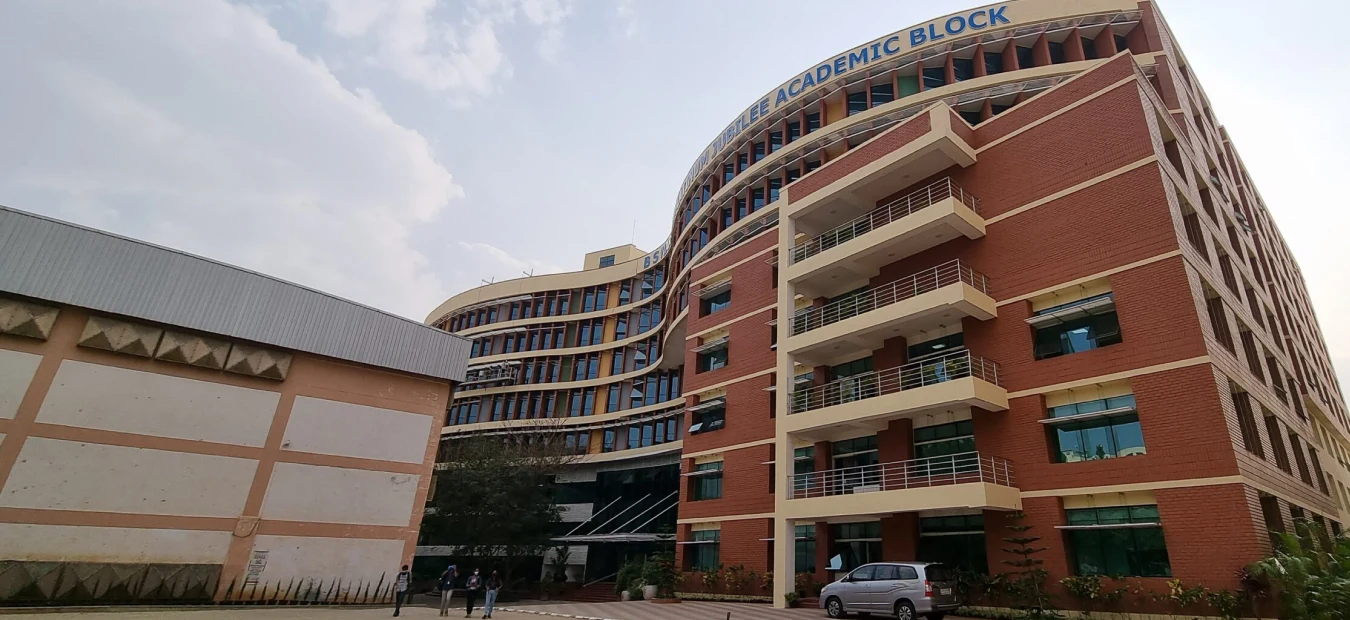
 Auditorium
 Cafeteria
 Campus Shuttle
 Communication Centre
 Computer Labs
 Gym
 Hostel
 Medical
 Science Labs
 Sports Complex
 Study Library