Loading Admission Guardian content
Loading Admission Guardian content
Provisional score based on available data. It may change as more information is verified.
Find a program, read its fee details and explore the admission requirements.
Summary of the programs shown below. Total course fee. Check the note beside each amount for inclusions and exclusions.
| Course | Stream | Fees |
|---|---|---|
| Bachelor of Arts [BA] | Arts | 2600 |
| Bachelor of Commerce [B.Com] | Commerce | |
| Bachelor of Science [B.Sc] | Science |
Specializations
Eligibility: 10+2
Specializations
Eligibility: 10+2
Specializations
Eligibility: 10+2
Dhing College isn't trying to be an IIT. And that's its strength. Established in 1965 in a rural pocket of Assam's Nagaon district, this government-aided institution has carved out a specific, vital role: providing affordable, quality undergraduate education to students who might otherwise be left out. Its recent NAAC B++ grade and DBT Star College status signal a quiet, steady climb in academic rigor, particularly in the sciences. But the real story here is one of context. You don't come here for corporate recruitment drives; you come for a solid foundation, a disciplined environment, and faculty who will know your name. It's a college built for the realities of its region, where success is often measured by a seat in a government office or a spot in a good postgraduate program, not a six-figure salary package. For the right student, that's more than enough.
The academic offering is a straightforward mix of traditional arts, science, and commerce degrees, now transitioning to the Four Year Undergraduate Program (FYUGP) as per NEP 2020. The B.A. and B.Sc. programs have the widest intake, with hundreds of seats each. But the standout feature is the science wing's DBT Star College status. That's not just a badge. It means the Botany and Zoology departments get enhanced funding for equipment and undergraduate research projects—a rare opportunity at this level in a rural college. The B.Voc programs in Medical Lab Tech and Food Processing are newer, self-financed additions aimed at immediate employability.
Faculty accessibility gets consistently high marks in student reviews. With around 50 permanent staff and a decent chunk holding PhDs, the student-teacher ratio isn't overwhelming. The calendar follows Gauhati University, so exams and schedules are predictable. They've also signed a few practical MoUs, like the one with the Assam Pearl Development Co-Operative Society for skill training. It's not a research powerhouse, but for a provincialized college, the academic infrastructure—especially the Kanaklata Baruah Library with its N-LIST digital access—is surprisingly robust. You can check the official course list on the Dhing College website.
Let's be direct: if your primary goal is on-campus placement with a multinational, this is the wrong college. The placement cell exists, but its function is more about career counseling and soft-skills workshops than brokering job offers. The official website doesn't publish LPA (Lakhs Per Annum) figures for a reason.
The real placement story is different. Most graduates either continue their education or dive into the vast ecosystem of government exams. For B.Voc students in Medical Laboratory Technology, local healthcare centers and diagnostic labs are common destinations. Students entering the local private sector might see starting figures in the range of ₹1.8 to ₹3 LPA, but that's an informal estimate, not a college-guaranteed package. The top recruiters here are the Assam Public Service Commission (APSC), various banking sectors, and state government departments. Success is self-driven. The college provides the foundation and a quiet place to study for the SSC CGL or TET; it's up to the student to crack the exam.
Affordability is the cornerstone. For a three-year BA, B.Sc., or B.Com., the total tuition can be as low as ₹15,000 to ₹25,000 for students who don't qualify for waivers. That's almost negligible in today's higher education market. Hostel fees add another ₹12,000-18,000 annually, with mess charges running about ₹2,000-2,500 per month.
The big factor is the Assam government's "Pragyan Bharti" scheme. If your family's annual income is below ₹2 lakhs, you can get full admission fees waived. The process requires an income certificate from a Circle Officer and, in a uniquely Assam twist, a photograph of the student planting a tree. For many in this agrarian region, this scheme is what makes college possible. There's no complex scholarship portal—it's a direct, if bureaucratically involved, financial lifeline.
The process is merit-based and centralized, cutting out a lot of confusion. There's no entrance exam for the standard BA, BSc, or BCom programs. Admission is 100% based on your Class 12 marks. Everything runs through the state's SAMARTH portal for UG admissions. You must register there; the college doesn't typically accept direct applications.
Cutoffs vary by subject and category. In the 2024 cycle, a seat in a B.Sc. (Honours) program like Chemistry or Mathematics likely required 70-80% for general category students. For B.A. (Honours), popular subjects like Assamese and English were competitive, with cutoffs around 60-75%. The application window is short, usually from May to June, right after HS results are declared. Miss the SAMARTH portal deadline, and you're out of luck for that academic year. It's a streamlined, transparent, but rigid system.
The 30-acre campus is repeatedly described as "serene and green" in reviews—a peaceful place to focus. Infrastructure is a mixed bag but leans positive given the context. The girls' hostel is noted as well-maintained and secure, a major plus for families. The boys' hostel exists but has smaller capacity. The science labs, boosted by DBT Star College funds, are legitimately good, especially the Biotech Hub. A partially campus-run solar power plant is a forward-thinking touch.
Social life is low-key. There's a large playground, an indoor stadium, and a gymnasium. But you're in Dhing, not Guwahati. The canteen gets complaints about limited variety. The location, 35 km from Nagaon town, is a double-edged sword. It ensures a distraction-free zone but makes accessing urban coaching centers or amenities a commute. Student culture revolves around academics, sports, and college festivals, not mall outings. It's a disciplined, ragging-free environment that suits some perfectly and feels isolated to others.
The consensus rating floats around a 4.2/5, which is strong. Praise is consistent for the approachable faculty and the surprisingly good science facilities. One recurring sentiment: teachers treat students "like family" and are proactive with scholarship guidance. The library's digital resources are a hidden gem many appreciate.
But the critiques are just as consistent. The lack of corporate placement opportunities is the number one grievance. Students who crave a more cosmopolitan college experience find the rural location limiting. The 35km distance to Nagaon is a real barrier for those needing extra coaching. Some mention the canteen food gets monotonous.
You see comments like, "Best labs in Nagaon for Botany and Zoology. The Biotech hub gives us exposure we didn't expect in a small town." Right alongside, "The college is the pride of Dhing... but don't expect a corporate job offer at the end of your degree." Both are true. The reviews paint a picture of an institution that excels within its defined mission but doesn't pretend to be something it's not.
Dhing College is an excellent, purposeful choice for a specific student. If you are from the region or a similar background, seeking a highly affordable, disciplined, and academically sound government college to complete your undergraduate degree, it's a standout option. This is especially true for science students who can leverage the DBT Star College labs. It's perfect for those whose plan is to use the three years to build a stellar academic record for a top M.Sc. program or to diligently prepare for government service exams without the distractions and high costs of a city college.
However, if your primary goal is direct campus placement into the corporate sector, or you desire a vibrant, urban campus life with endless extracurriculars, you will likely be disappointed. The college doesn't facilitate that path. It's a launchpad for further academic or government careers, not a destination for private sector jobs. For the right candidate—one who understands and aligns with its strengths—Dhing College offers immense value and a solid foundation for the long game. For others, it might feel like a dead end. Know which one you are before you apply.
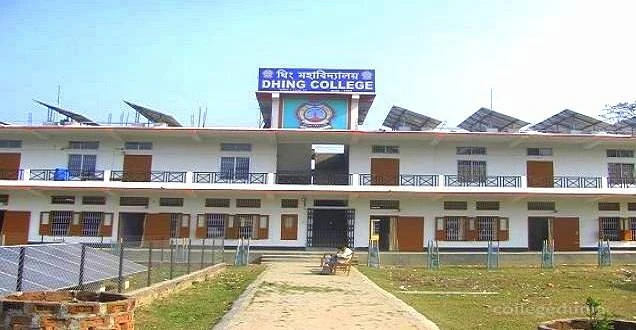
In this preview: 1 photo · 0 videos
Yes, Dhing College is a provincialized college under the Government of Assam. This means it is government-funded and follows official government fee structures.
To apply for a fee waiver, eligible students must submit an Income Certificate showing parental income is less than ₹2 Lakhs, issued by a Circle Officer, along with a photograph of themselves planting a tree as per Assam Government norms.
The college offers limited regular postgraduate courses. However, it is a major study center for distance education PG programs through institutions like KKHSOU and IDOL.
Yes, Dhing College provides a secure on-campus girls' hostel facility, which is highly rated by the student community.
Dhing College is particularly strong in Zoology, Botany, and Assamese. These departments benefit from the college's "Star College" status and have experienced faculty.
Share what future students should know about Dhing College.
Student voices are not rewritten by colleges. We remove spam and abuse.
Wider admission question? Community PulseWhat should future students know?
Tell us which course you're considering. We'll help you work out the next step.
Get instant Partner access after mobile verification. Your public edits are reviewed before they go live.
Claim this college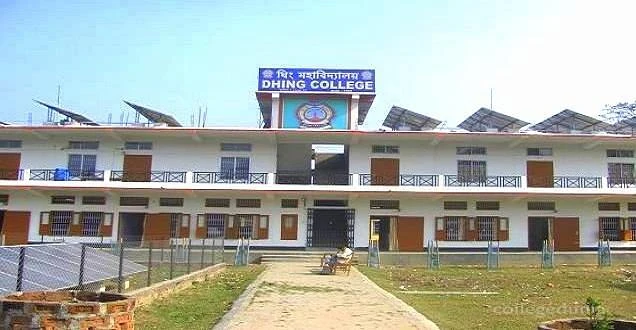
 Auditorium
 Cafeteria
 Computer Labs
 Gym
Gym Hostel
 Medical
 Science Labs
 Sports Complex
 Study Library