Loading Admission Guardian content
Loading Admission Guardian content

Provisional score based on available data. It may change as more information is verified.
Find a program, read its fee details and explore the admission requirements.
Summary of the programs shown below. First-year fee. Check the note beside each amount for inclusions and exclusions.
| Course | Stream | Fees |
|---|---|---|
| Bachelor of Arts [BA] | Arts | 1700 |
| Bachelor of Commerce [B.Com] | Commerce | 1900 |
| Bachelor of Science [B.Sc] | Science | 2100 |
| Bachelor of Arts [BA] {Hons.} | Arts | 2400 |
| Bachelor of Science [B.Sc] {Hons.} | Science | 6400 |
Specializations
Eligibility: 10+2
Specializations
Eligibility: 10+2
Specializations
Eligibility: 10+2
Specializations
Eligibility: 10+2
Specializations
Eligibility: 10+2
Dumkal College exists for a specific, unglamorous purpose: to provide an affordable, government-subsidized degree to students in the rural Dumkal subdivision of Murshidabad. Established in 1999 and affiliated with the University of Kalyani, it's a place where a three-year B.A. can cost less than a mid-range smartphone. You won't find corporate recruiters or sprawling campuses here. What you will find is a functional, no-frills institution where the primary goal is getting a formal undergraduate credential—often as a stepping stone to a B.Ed., government service exams, or further postgraduate study. It's a college defined by its context, serving a community where higher education is a privilege, not a given. And for that role, it's quietly essential.
Dumkal College operates strictly as an undergraduate arts, science, and commerce college under the University of Kalyani's New Education Policy (NEP 2020) framework. The academic calendar starts late, with first-semester classes typically kicking off in October. The intake numbers tell a clear story about local demand: the B.A. programs, especially in Bengali (368 seats) and History (341 seats), are the heart of the institution. Science streams like Mathematics (60 seats) and Physics (40 seats) are smaller, more focused offerings. Commerce, with about 119 seats, rounds out the traditional triad.
The faculty, around 42-45 strong, includes several PhD holders like Dr. Bhabesh Pramanik (Principal) and Dr. Achintya Kumar Gangopadhyay in Bengali. Student reviews consistently highlight faculty accessibility as a major plus—teachers are described as helpful and down-to-earth, a significant asset in a remote setting. Academically, it's a straightforward path: attend lectures, complete internal assessments in January-February, and sit for University of Kalyani semester exams in March-April. The college also hosts study centers for distance learning through IGNOU and NSOU, providing crucial postgraduate and certificate options for those who can't relocate.
Let's be blunt: if you're looking at Dumkal College for on-campus corporate job offers, you're looking at the wrong institution. Formal placement percentages are near zero. You'll see unverified claims of high packages on some education portals—those almost always refer to the separate Dumkal Institute of Engineering & Technology (DIET) nearby, a common source of confusion.
The real career trajectory for a Dumkal College graduate follows a different map. About 60-70% of students proceed to MA or MSc programs, often at the University of Kalyani, Calcutta University, or Aliah University. A significant volume, especially after a B.A., enrolls in B.Ed. programs to enter the teaching profession. The most common career target is government service. Students here are primarily preparing for exams conducted by the West Bengal Public Service Commission (WBPSC), the School Service Commission (SSC), and police recruitment boards. The college's "placement cell" functions more as a career counselling unit, offering guidance for these competitive exams rather than hosting company recruitment drives. That's the reality. It's a launchpad for stable, government-oriented careers, not corporate ones.
Affordability isn't just a feature here; it's the core proposition. Thanks to state government subsidies, annual fees are remarkably low. For the 2024-2025 session, a B.A. (General) student might pay between ₹1,700 and ₹2,200 per year. B.A. (Honours) fees range from ₹2,400 to ₹3,500. B.Sc. (Honours) programs, with lab costs, are the most expensive at ₹3,500 to ₹6,500 annually. Over three years, the total tuition cost typically falls between ₹6,000 and ₹18,000—excluding personal and living expenses.
This low cost makes government scholarships critically important and widely utilized. Female students heavily leverage the Kanyashree scheme (K1 & K2). The Swami Vivekananda Merit-cum-Means Scholarship (SVMCM) supports students scoring above 60%. SC/ST/OBC students access funds through the OASIS portal. The financial model is clear: the state keeps the door to a degree open for economically weaker sections, and scholarships help students walk through it.
The admission process at Dumkal College is transparent and entirely merit-based. There are no entrance exams. Selection is 100% dependent on your Class 12 (or equivalent HS) marks. The application window usually opens in June or July, following the announcement of HS results, and is conducted online through the West Bengal Centralized Admission Portal. The college's own website, dumkalcollege.in, posts the specific notices and links.
Merit lists are prepared based on the aggregate "Best of Five" subjects. Eligibility requires a minimum of 45-50% in aggregate for admission to Honours programs; a simple pass is sufficient for General courses. Cutoffs vary by subject and demand. For instance, getting into a popular Honours program like Geography often requires a merit score of 80% or higher. It's a straightforward system: your past academic performance determines your seat.
The campus spans about 2 acres in a green, quiet, and—as students note—pollution-free rural setting. Infrastructure is basic but functional. The library holds over 20,000 books, with digital access slowly improving as part of the NAAC re-accreditation efforts. Labs for Physics, Chemistry, and Computer Science are described by students as "functional and basic." Wi-Fi is available, but only in specific zones like the office and library, not campus-wide.
Accommodation is a mixed bag. There is a UGC-funded girls' hostel. For boys, there's no official college hostel; most rent private rooms or stay in local "mess" housing in Basantapur. The college canteen receives consistently poor reviews, with many students opting for nearby eateries instead. On the extracurricular side, the college has a large playground and a notable Physical Education department. Participation in inter-college football and athletics is a point of pride. Like many West Bengal colleges, student union activity is present and can occasionally lead to schedule disruptions, which is a noted part of the campus atmosphere.
The consensus from student reviews on platforms like CollegeDunia and Quora paints a coherent, pragmatic picture. The positives are clear and consistent. Faculty accessibility is the top praise—teachers are seen as approachable and dedicated. The extreme affordability is the primary draw, making it the default choice for many in the Dumkal area. The environment is considered peaceful and conducive to studying, away from city distractions.
But the negatives are equally consistent. The remote location, near the Indo-Bangladesh border, is a genuine hurdle for anyone not from the immediate region. Infrastructure, particularly the canteen and some lab equipment, is cited as needing serious upgrade. There's also a universal understanding of the college's purpose, best summed up by a paraphrased student quote: "Don't expect a job after BA here. You have to prepare for SSC or do an MA." Another review highlights its niche: "If you want to study Bengali or History and can't afford a city college, this is the best place in Murshidabad." The reviews aren't flashy, but they're honest.
Dumkal College isn't for everyone. It's not a nationally ranked hub of research or a corporate recruitment feeder. Evaluating it through that lens would be a mistake. Its value is hyper-local and context-specific. This college is absolutely worth it for students from Murshidabad and surrounding rural districts who need a recognized, accredited undergraduate degree at the lowest possible cost, with the goal of entering teaching or government service. If your plan is to complete a B.A. or B.Sc., then pursue a B.Ed. or prepare for the WBPSC/SSC exams, Dumkal College provides a perfectly viable, affordable launchpad with supportive faculty.
However, if you're seeking a vibrant campus life, modern amenities, industry connections, or a direct path to private-sector jobs, you should look elsewhere—likely at colleges in Kolkata or other urban centers. Dumkal College serves its specific community well, fulfilling a critical need for accessible higher education in a region where options are limited. That's its role, and it performs it without pretense.
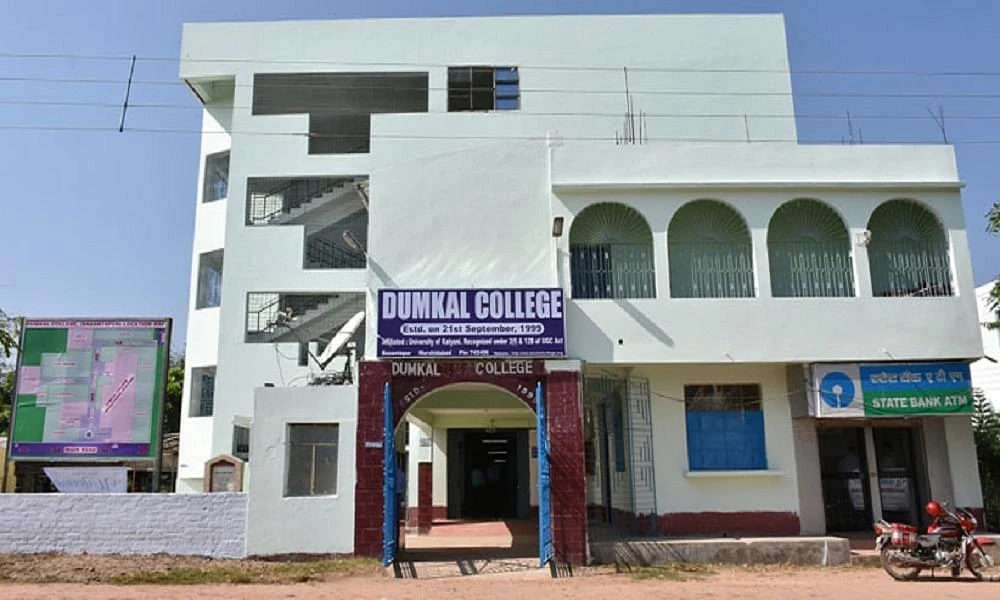
In this preview: 1 photo · 0 videos
Dumkal College is a Government-aided college. This means it receives funding from the state government but is managed by an independent Governing Body.
No, Dumkal College does not offer a B.Tech degree. The Bachelor of Technology (B.Tech) program is offered by the Dumkal Institute of Engineering & Technology (DIET), which is a separate private institution located nearby.
Admission to the Geography Honours program is highly competitive. Typically, a merit score of 80% or higher in the Higher Secondary (HS) examination is required due to the program's high demand.
There is no official boys' hostel provided by the general college. Male students typically arrange accommodation in private rented rooms or messes located in the nearby Basantapur area.
Applications for the 2025 session are submitted online through the official college portal at dumkalcollege.in. The application process typically opens in June, following the declaration of Higher Secondary (HS) results.
Share what future students should know about Dumkal College.
Student voices are not rewritten by colleges. We remove spam and abuse.
Wider admission question? Community PulseWhat should future students know?
Tell us which course you're considering. We'll help you work out the next step.
Get instant Partner access after mobile verification. Your public edits are reviewed before they go live.
Claim this college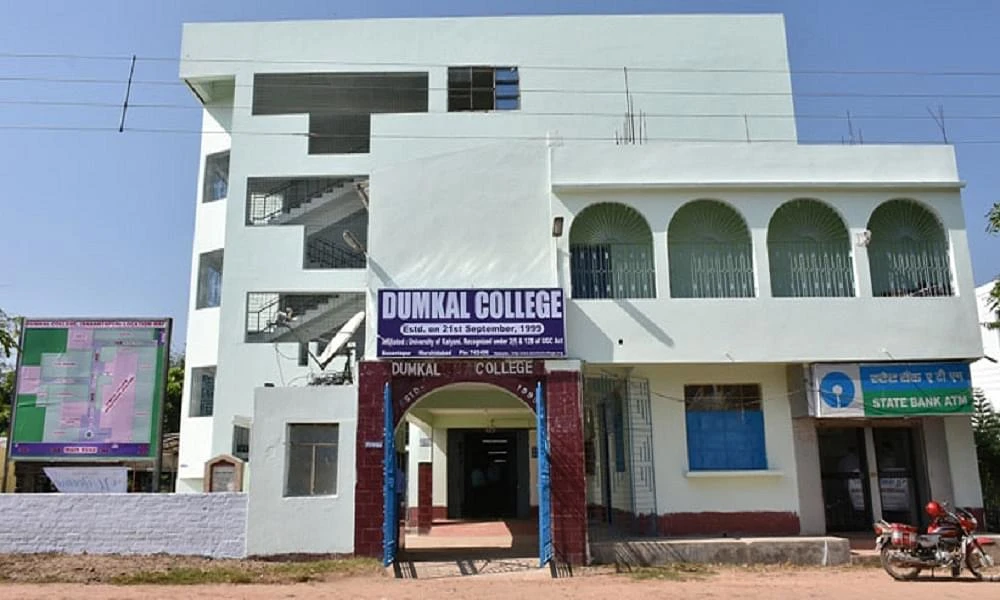
 Auditorium
 Cafeteria
 Computer Labs
 Gym
Gym Medical
 Science Labs
 Sports Complex
 Study Library