Loading Admission Guardian content
Loading Admission Guardian content

Provisional score based on available data. It may change as more information is verified.
Find a program, read its fee details and explore the admission requirements.
Summary of the programs shown below. First-year fee. Check the note beside each amount for inclusions and exclusions.
| Course | Stream | Fees |
|---|---|---|
| Master of Technology [M.Tech] (Computer Engineering) | Engineering | 78150 |
| Bachelor of Technology [B.Tech] | Engineering | 80750 |
| Master of Business Administration [MBA] | Management | 80750 |
| Post Graduate Diploma in Management [PGDM] | Management | 80750 |
Specializations
All accepted exams
Eligibility: Pass in Graduation + GATE
Specializations
Eligibility: 10+2 with 75% + JEE Main
Specializations
All accepted exams
Eligibility: Graduation with 50% + CAT
Specializations
All accepted exams
Eligibility: Graduation with 50% + CAT
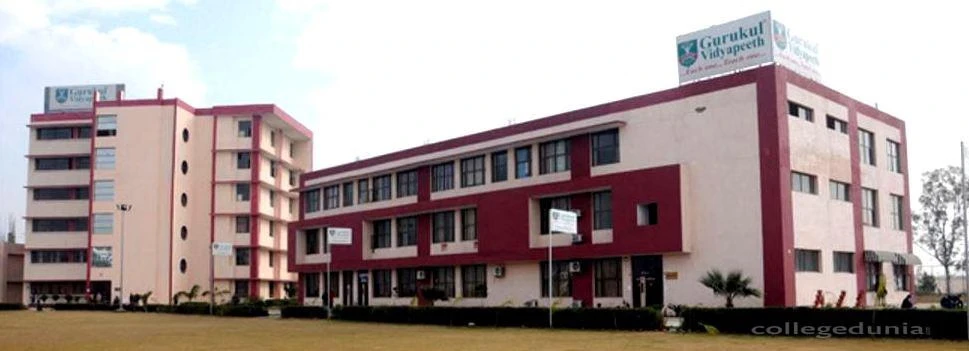
Gurukul Vidyapeeth South Campus sits on the Chandigarh-Patiala Highway, a private engineering and management college that’s been around since 2007. It’s affiliated with I.K. Gujral Punjab Technical University (PTU), and that’s a key detail. The affiliation means your degree is from a recognized state technical university, which carries more weight in certain circles than a private, deemed-to-be-university degree might. The campus is part of a larger group claiming a sprawling 40-acre footprint, though specifics for the South Campus itself are a bit fuzzy. What’s clear is its location—about 20 km from Chandigarh Airport—which makes it accessible but also somewhat isolated from a major city center. The college promotes itself with claims of an ‘A++’ NAAC grade and UGC approval, but a close look suggests these accolades might belong to the broader Gurukul Vidyapeeth group, not necessarily this specific campus. It’s a distinction prospective students should verify directly. You can check the official NAAC portal for accredited institutions. The reality here is a mix of official ambition and the grounded, sometimes stark, feedback from the students who’ve actually lived it.
The academic portfolio is heavily engineering-focused. For B.Tech, the list is extensive: Aeronautical, Aerospace, Chemical, Civil, Computer Science and Engineering (CSE), Electronics and Communication (ECE), Mechanical, Mining, Petrochemical and Petroleum Refinery, and even a niche program in Three D Animation and Graphics Engineering. The intake numbers, sourced from a sister institute for 2025, show Civil Engineering (120 seats) and CSE (90 seats) as the largest programs, with others like Mining and Petrochemical having 30 seats each. That’s a decent spread for a private college in Punjab.
On the management side, they offer an MBA with specializations in Finance, HR, Marketing, and a General track, alongside a PGDM. There’s also an M.Tech in Computer Engineering. A unique claim is being the only institute in North India to offer Marine Engineering, though it’s unclear if that’s active at the South Campus. Academically, they highlight a partnership with SAP Education for certifications and an in-house R&D cell to support projects and internships.
The faculty picture, however, is where official claims and student experience diverge sharply. The college website talks of highly qualified, research-active faculty. Student reviews tell a different story. One alum bluntly stated, "Teachers are the graduates of the same college who didn't get jobs outside, so they teach the students." Another offered a more tempered view: "Teachers are not much qualified as PhD holders, but it is okay. One of the good things is that they are very supportive of the students." That support is something, but the lack of advanced academic credentials among faculty is a notable gap for an institution promoting research and development.
This is the section where you need to read between the lines. The college’s official placement page and brochures list an impressive array of potential recruiters: Infosys, HCL, IBM, Accenture, Mahindra, Flipkart, and many other big names. It’s a standard list you’ll see at many institutions.
The numbers from students paint a far less rosy picture. There are no official, verifiable figures for highest, average, or median packages. What you find in reviews is telling. One student reported a maximum package of 3 LPA for the computer science branch. Others are more stark: "no placements at all" or "only 7 students are placed in our course out of 60." That’s a placement rate in the 10-12% range for that batch, if accurate. The gap between the recruiter list and the student-reported outcomes is significant and can’t be ignored.
On internships, the claim is that over 60% of students secure them, with some landing positions at organizations like DRDO. That’s a positive data point if true, as internship experience is critical. But the overarching placement narrative, based on alumni voices, suggests that securing a final job offer through campus processes is a major challenge. You’re likely looking at a scenario where proactive students who hunt for off-campus opportunities fare better.
The fee structure is relatively clear. For the 2025-2026 cycle, the total tuition fee for a B.Tech degree ranges from about ₹2.64 Lakhs to ₹3.58 Lakhs, with the total program cost hovering around ₹3.66 to ₹3.78 Lakhs. The first-year fee is listed at ₹100,200. That puts the per-year cost in the ₹90,000 - ₹1 Lakh range for tuition after the first year, which is on the lower end for private engineering colleges in North India.
MBA total fees are around ₹1.89 Lakhs, PGDM is ₹1.62 Lakhs, and M.Tech is ₹1.6 Lakhs. Hostel and mess fees aren’t detailed in the available data, so that’s an additional, significant cost to budget for. The college does state that scholarships are available based on merit (Post Merit Scholarships, Merit-cum-Means) and through central government schemes. They also facilitate educational loans. For a student with strong 10+2 or entrance exam scores, the scholarship potential could make the financial outlay more manageable.
Admissions kick off in June and July. The pathways differ by program:
The process follows a standard flow: eligibility check, application submission (with a fee), document verification, and then a merit list or counseling session leading to the final offer. With MAT registrations for May 2026 already noted, it seems the institute aligns its calendar with national entrance exam cycles.
The infrastructure receives the most polarized reviews. Let’s break it down.
On paper, it sounds adequate. A "well-maintained and huge" library gets a positive mention, stocked with books, journals, and digital resources. Workshops for mechanical engineering are listed with eight different shops (machine, fitting, welding, etc.), which is comprehensive for a hands-on curriculum.
Student accounts, however, are full of complaints. One says, "The infrastructure of this college is pathetic. We do not have labs." Another notes, "Labs of my college are closed most of the time because the machines, tools do not work properly." If true, this is a serious academic handicap, especially for engineering.
Hostel life is similarly mixed. There are separate hostels for boys and girls, with recreation rooms. Some students say the hostels are good and the mess food is fine. Others report a decline: "Hostels previously were good and with the time the quality degraded." The most scathing reviews target the food: "The food provided over here is the worst," and "The mess of college is a big disappointment."
The location on the highway means you’re not in a bustling student town. Social life likely revolves around the campus itself. It’s a setting that demands you to be self-sufficient and focused, because external distractions—both good and bad—are limited.
Synthesizing feedback from platforms like CollegeDunia and Shiksha reveals a clear, consistent pattern. The sentiment is largely critical, with a few silver linings.
The overwhelming negatives center on placements and infrastructure. The placement cell is frequently described as ineffective, with minimal company visits and low offer rates. The condition of labs and hostels is a major pain point, directly impacting the practical learning experience. Faculty quality, as mentioned, is seen as average at best, with a reliance on the institute’s own graduates.
Positives, when they appear, are specific. Some students appreciate the supportive nature of the teaching staff, even if their qualifications aren’t top-tier. The library gets a good nod. The fee level is sometimes cited as a relative positive compared to more expensive private options. And the SAP certification partnership is seen as a tangible skill-building opportunity.
But the consensus is cautionary. Reviews often carry a tone of regret, advising prospective students to thoroughly visit the campus, speak to current students, and have a very clear, self-driven plan for securing internships and jobs independently.
This isn't a straightforward yes or no. Gurukul Vidyapeeth South Campus serves a specific niche. It’s worth serious consideration only if a few conditions align perfectly for you. First, if your academic scores and budget are strictly limited, and this is one of the few AICTE-approved, PTU-affiliated options available to you. The fees are lower than many peers, which is a factor. Second, if you are pursuing a niche B.Tech branch like Petrochemical or Mining that isn’t widely offered, and this college has the seat. Third, and most crucially, if you are an intensely self-motivated student. You must be prepared to supplement classroom learning on your own, aggressively seek out external internships and online certifications (like the offered SAP courses), and drive your own job search from day one, with zero reliance on the campus placement cell.
For everyone else—particularly students aiming for Computer Science, Mechanical, or Civil Engineering with hopes of strong campus placements—there are likely better-valued options in Punjab and Chandigarh. The consistent student feedback on poor infrastructure and weak placements is a major red flag. Your degree will be valid from PTU, but the on-campus experience and career launchpad, as described by alumni, are subpar. Visit in person. Talk to 2nd and 3rd-year students. Ask direct questions about lab access, teacher availability, and last year's placement numbers. Don’t base your decision on the brochure alone.
For the 2025-2026 academic year, the total tuition fee for the B.Tech program at Gurukul Vidyapeeth South Campus ranges from approximately ₹2.64 Lakhs to ₹3.58 Lakhs. The total program cost is around ₹3.66 to ₹3.78 Lakhs. The first-year fee is ₹100,200. These figures are for tuition; separate hostel and mess charges will apply and should be budgeted for additionally.
Placement outcomes, based on student reviews, are reported to be weak. While the college lists major recruiters like Infosys and HCL, alumni feedback indicates very low on-campus placement rates, with some citing only 7 out of 60 students getting placed. The maximum package mentioned for Computer Science is around 3 LPA. Students strongly advise having a self-driven job search strategy and not relying solely on campus placements.
Admission to the MBA program requires a bachelor's degree in any discipline with a minimum of 50% aggregate marks. A valid score in a national-level entrance exam such as CAT, MAT, XAT, or CMAT is mandatory. The selection process may also consider prior work experience. The application window typically opens in June/July.
Yes, Gurukul Vidyapeeth South Campus is approved by the All India Council for Technical Education (AICTE). It is also recognized by the Government of Punjab and is affiliated with I.K. Gujral Punjab Technical University (PTU), Jalandhar.
Campus life reviews are mixed. The college provides separate hostels for boys and girls with mess facilities. However, student opinions vary widely—some find the hostels acceptable, while others report degrading quality and consistently poor food in the mess. The location on the Chandigarh-Patiala Highway is somewhat isolated. Infrastructure, particularly labs, receives significant criticism in reviews for being poorly maintained or frequently non-functional.
Share what future students should know about Gurukul Vidyapeeth South Campus.
Student voices are not rewritten by colleges. We remove spam and abuse.
Wider admission question? Community PulseWhat should future students know?
Tell us which course you're considering. We'll help you work out the next step.
Get instant Partner access after mobile verification. Your public edits are reviewed before they go live.
Claim this college Auditorium
 Computer Labs
 Hostel
 Medical
 Science Labs
 Sports Complex
 Study Library