Loading Admission Guardian content
Loading Admission Guardian content

Provisional score based on available data. It may change as more information is verified.
Selected ranking categories, with the recorded year beside each result. Open all records for the complete history.
28 published records · Lower numeric ranks are stronger
IIRF
Engineering · public
#92022
Outlook
Engineering · public
#222022
India Today
Engineering · public
#182022
Find a program, read its fee details and explore the admission requirements.
Summary of the programs shown below. First-year fee. Check the note beside each amount for inclusions and exclusions.
| Course | Stream | Fees |
|---|---|---|
| Master of Technology [M.Tech] | Engineering | 80000 |
| Bachelor of Business Administration [BBA] | Management | 80000 |
| Master of Computer Applications [M.C.A] | Computer Applications | 120000 |
| Master of Business Administration [MBA] | Management | 120000 |
| Bachelor of Technology [B.Tech] | Engineering | 135000 |
Specializations
All accepted exams
Eligibility: Graduation
Specializations
Eligibility: 10+2 with 55%
All accepted exams
Eligibility: Graduation with 60% + IEMJEE
Specializations
All accepted exams
Eligibility: Graduation
Specializations
All accepted exams
Eligibility: 10+2 with 75% + JEE Main
2 exams with cutoff data available - showing recent entries
 Aarti Industries limited
 Adani Wilmar Limited
 Airtel
 Asian Paints
 Berger
 Bunge India
 Byju's
 Cargill india Ltd
 Cognizant
 Evalueserve
 Exxonmobil India
 Havells
 Hero Motocorp
 hexaview
 Josh Tech
 L&T Infotech
 Optum
Optum Paytm
Paytm PeopleStrong
 Pie Infocomm
 PURE SOFTWARE
 Reliance
 Reliance Jio
 Shalimar Paints
 TCS
TCS Technip India
 Western Union
If you're looking at engineering colleges in North India and your JEE Main rank isn't landing you in the top IITs or NITs, Harcourt Butler Technological University (HBTU) Kanpur is a name that keeps coming up. Especially if you're interested in chemical engineering or its unique offshoots. Founded in 1921, this state university carries a century-old legacy that still opens doors in core industries. Its alumni run major corporations like IndiaMART and Indian Oil. But walk around the 348-acre campus, and you'll see the contrast: world-class labs sit inside buildings that feel frozen in another era. That's HBTU in a nutshell—a place where historic reputation meets a very real, sometimes gritty, present-day student experience. For the right student, particularly in chemical technology, it represents one of the best returns on investment in the country.
HBTU is structured around six schools, but its heart has always been in technology. The university's unique selling proposition is its suite of chemical technology branches—Paint, Oil, Food, Plastic, and Biochemical Engineering. You won't find this concentrated offering in many places outside of IITs. The total B.Tech intake is around 800-900 students, with Computer Science and Mechanical having about 81 seats each. The niche branches like Paint and Oil Technology have 63 seats apiece.
The academic system is rigorous. They use a 10-point CGPA scale, and the grading breakdown is strict: 30% for mid-semester exams, 50% for the end-semester, and 20% for internal assessments like attendance and assignments. And that 75% attendance rule is no joke. Students get debarred from exams for falling short—it's a common complaint, but it sets a tone. The faculty strength is around 150, and a solid majority hold PhDs from IITs and NITs. Professors like Dr. Narendra Kohli (CSE) and Dr. Arun Maithani (Paint Tech) are well-regarded in their fields. It's an old-school, no-nonsense academic culture. You're here to work.
This is where HBTU's legacy pays the bills. The placement story is a tale of two realities, heavily dependent on your branch.
The official numbers for 2023-24 show a highest package of ₹36 LPA (from Microsoft or Amazon) and an average around ₹9.3 LPA. Preliminary reports for 2024 suggest the average might be between ₹7-8.5 LPA, with a median of ₹6.5 LPA as per the NIRF 2025 report. The university claims an 84-88% placement rate. That's the brochure version.
The on-ground reality, pieced together from student reviews, is more nuanced. For students in Paint, Chemical, or Oil Technology, placement is virtually guaranteed and often hits 100%. Companies like Asian Paints, Berger Paints, Kansai Nerolac, and HUL treat these departments as premier recruiting grounds. One review on Shiksha put it bluntly: "The Paint Technology department is a goldmine. Companies like Asian Paints treat this place like their own backyard."
For core branches like Civil or the smaller Leather Technology program, the rate can drop to 40-50%. IT and CSE see good recruitment from Amazon, Google, Microsoft, Nvidia, and a range of service companies like TCS and Infosys. The consulting and finance big names—Deloitte, Accenture, KPMG—also visit. So, the average package is a decent figure for a state university, but it's inflated by the high-performing tech and chemical cohorts. If you're in a niche core branch, you're banking on the specialized industry demand.
The cost is one of HBTU's biggest advantages. For the 2024-25 session, the annual B.Tech tuition fee is ₹75,000. When you add registration, exam, medical, and caution money, the first-year academic fee totals about ₹1,35,000. Subsequent years are slightly lower, around ₹1,27,500.
Hostel fees are between ₹21,250 to ₹25,000 per year, and mess charges run another ₹36,000 to ₹40,000. Do the math, and the total cost for a four-year B.Tech, including stay and food, comes to roughly ₹7.5 lakhs. That's a fraction of the cost of most private universities and even some newer central institutions.
Financial aid is available through UP State Post-Matric Scholarships, merit-cum-means scholarships, and several alumni-funded initiatives. It makes quality technical education accessible.
Admissions are strictly merit-based. There is no management or NRI quota—a point the administration emphasizes.
For B.Tech, the sole criterion is your JEE Main Common Rank List (CRL). Unlike many state colleges, HBTU conducts its own counseling process; it doesn't go through JoSAA or CSAB. You need to keep an eye on their official website for counseling notifications. The 2024 cutoffs for General category students in Round 1 give a clear picture of the competition:
For other programs, BBA admissions are via CUET UG. MCA requires a NIMCET score, MBA considers CAT/CMAT/CUET PG, and M.Tech admissions are based on GATE or CUET PG scores.
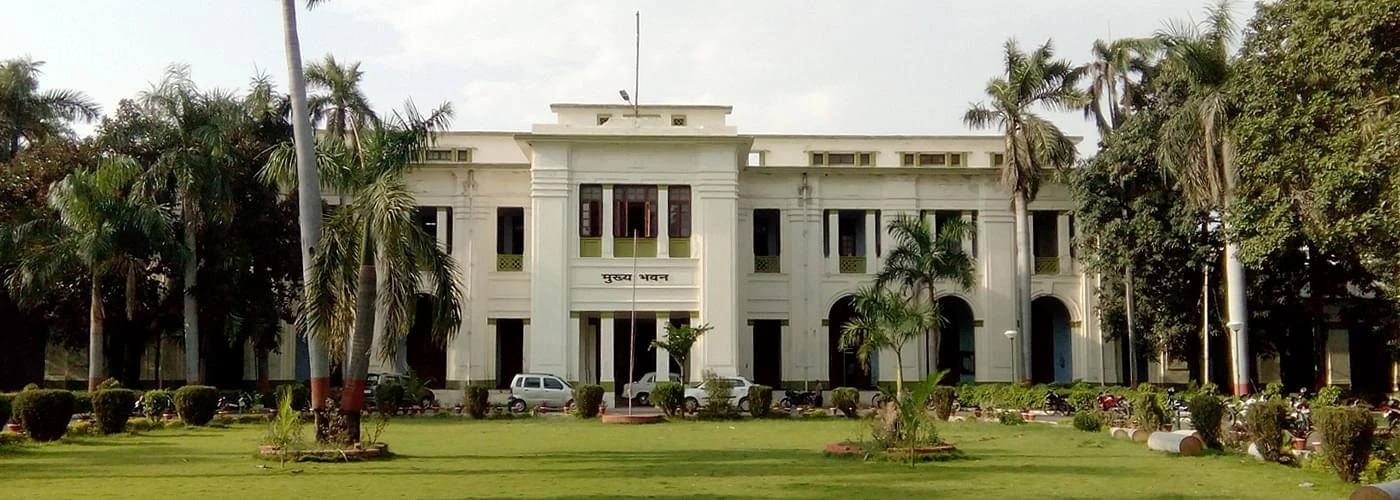
You have to manage your expectations here. The campus is massive—348 acres split into East and West sections about 3-4 km apart. The East Campus houses all academic departments, the historic main building, and the girls' hostels. The West Campus is mostly senior boys' hostels and major sports grounds. Traveling between them is a daily hassle for many.
Infrastructure is the most common griate. A Reddit user wasn't wrong when they quipped, "The legacy is real, but the buildings look like they haven't been painted since 1921." The labs, especially for chemical and paint tech, are excellent. The CSE labs have good hardware and LAN. The central library has over 1.1 lakh books and digital access. But overall, the feel is dated. Wi-Fi is 1 Gbps in academic blocks but gets called "unreliable" in hostels.
There are 14 hostels (8 for boys, 6 for girls). Rooms are reportedly spacious but basic. The girls' hostels are on the safer East Campus with a strict 9 PM curfew. Mess food is universally described as "average but edible." Social life isn't buzzing, but the location in Nawabganj is posh and close to cafes and malls. Sports facilities on the West Campus are good. Don't expect a glamorous college life. You come for the degree and the opportunities.
Synthesizing opinions from CollegeDunia, Shiksha, Reddit, and Quora reveals a clear consensus.
The positives are powerful. The "HBTI" brand (its old name) commands immense respect, particularly in core industries. The alumni network is considered one of the strongest in North India. The ROI is phenomenal—low fees coupled with solid placement outcomes in key branches. The coding culture is also growing organically, with students actively participating in competitive programming despite limited institutional push.
The negatives are just as consistent. The aging infrastructure tops the list. Administrative processes are described as slow and bureaucratic. The 75% attendance policy is strictly enforced and widely disliked. The split campus causes daily logistical headaches. As one Quora reviewer summarized, "Don't expect a Karan Johar college life. It's a place for serious studies and even more serious attendance issues."
Ragging isn't reported as a severe issue, with most describing it as introductory sessions with seniors. The overall sentiment is pragmatic: it's not a cushy experience, but for many, it's a worthwhile trade-off.
HBTU is a very specific kind of good. It's not a holistic, all-rounder university. If you are a student with a JEE Main rank between 15,000 and 70,000 who is genuinely interested in chemical engineering, paint, oil, or food technology, this is arguably one of the best choices in India. The placement record in these fields is exceptional, and the cost is low. The legacy is tangible. For CSE/IT, your decision depends on the alternatives; a lower NIT might offer a better overall package and campus life, but HBTU's brand still holds weight.
You should look elsewhere if a modern, integrated campus with vibrant student life is a priority. The infrastructure and administrative hurdles are real. HBTU is for the pragmatic student who views college as a launchpad, not a four-year vacation. It demands resilience but rewards it with a respected degree and a direct line to some of India's oldest and most stable industries. In the right branch, it's a steal.
In this preview: 1 photo · 0 videos
For Chemical, Paint, or Oil Technology programs, HBTU is often preferred over mid-tier NITs due to its strong legacy and placement record. For Computer Science (CSE) or IT, top-tier NITs are generally considered better options.
No. Admissions to HBTU are strictly based on merit through national entrance exams like JEE Main and CUET. The university does not offer any management quota or NRI quota seats.
HBTU has a strict zero-tolerance policy towards ragging. While students report informal "introductory sessions" with seniors, there have been no reports of severe ragging incidents in recent years.
The girls' hostels are situated on the safer East Campus, close to academic buildings. Security is strict, and there is a curfew in place, typically by 9 PM.
The East Campus is the main academic hub containing most departments and classrooms. The West Campus is primarily a residential area for senior boys and houses major sports facilities. The two campuses are approximately 3 kilometers apart.
Share what future students should know about HBTU.
Student voices are not rewritten by colleges. We remove spam and abuse.
Wider admission question? Community PulseWhat should future students know?
Tell us which course you're considering. We'll help you work out the next step.
Get instant Partner access after mobile verification. Your public edits are reviewed before they go live.
Claim this college
 Auditorium
 Bank & ATM
 Cafeteria
 Computer Labs
 Gym
Gym Hostel
 Medical
 Science Labs
 Sports Complex
 Study Library