Loading Admission Guardian content
Loading Admission Guardian content

Provisional score based on available data. It may change as more information is verified.
Find a program, read its fee details and explore the admission requirements.
Summary of the programs shown below. Fee amounts are not listed. Contact the college for its current fee schedule.
| Course | Stream | Fees |
|---|---|---|
| Ph.D | Science |
Eligibility: Post Graduation
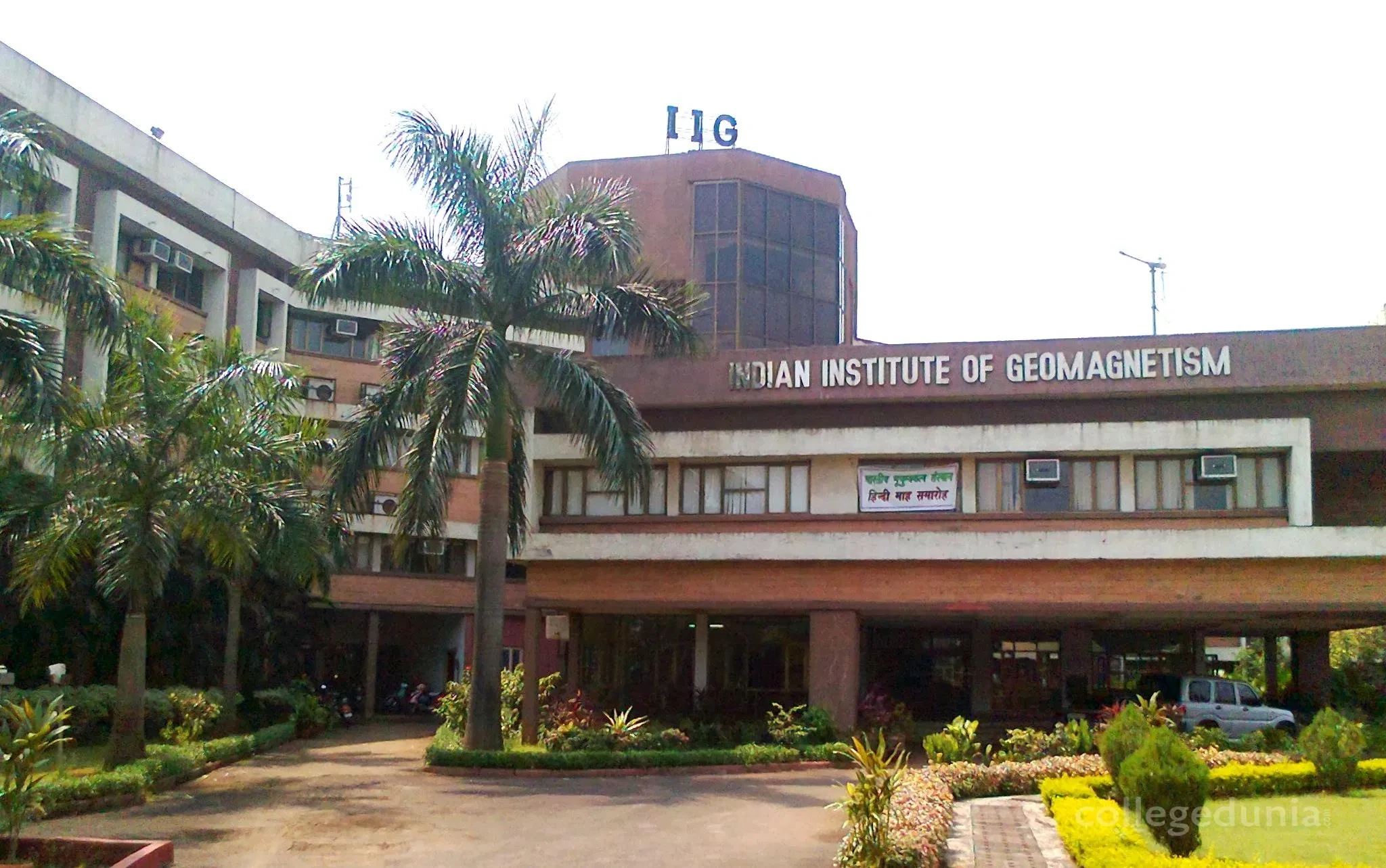
The Indian Institute of Geomagnetism isn't your typical college. It's a specialized, government-run research institute with a scientific lineage that stretches back to 1826. If you're looking for a bustling campus with thousands of undergraduates, this isn't it. But if you're a postgraduate student with a deep, specific passion for the physics of the Earth and its surrounding space, IIG represents a unique and authoritative destination. It's one of the few places in the world where you can work directly with data from a network of 12 magnetic observatories and contribute to the World Data Centre for Geomagnetism. The focus here is purely on research, not conventional placements, and that shapes every aspect of the experience.
Let's be clear: IIG is not for beginners. Its academic portfolio is built for students who already have a strong foundation in physical sciences and are ready to commit to specialized research.
The core offering is the Doctoral Program (Ph.D.) in Geomagnetism and its allied fields. The intake is small and focused—around 25-26 research scholars per year. That's a tight-knit community. Your research could fall into areas like Solid Earth Geomagnetism, Space Weather, Ionospheric Physics, or Plasma Physics. It's niche, high-level stuff.
They also run an Integrated MS(R)-PhD Program, details of which are best found on their official website. For master's students, IIG collaborates with its affiliated universities to offer M.Sc. programs, providing a pathway into their research ecosystem. A practical touch is the 8-week Certificate Course on 'Empowering Science Through Python', which is a smart, modern skill for any aspiring data-heavy scientist.
The academic culture is defined by its facilities and legacy. You're not just reading papers; you're potentially working in the Environmental Magnetism Lab with instruments like a JR 6 Spinner Magnetometer or a Scanning Electron Microscope. You have access to High-Performance Computing clusters. And your work connects to a living history—IIG manages the continuous geomagnetic data record from India that started in 1841. That's a rare kind of academic environment.
You won't find a placement cell here bringing in IT companies for mass recruitment. That's not the point. As a premier research institute under the DST, IIG's "placement" is the cultivation of scientific careers.
Graduates typically move into research, academia, and specialized scientific roles within government organizations. Think of places like ISRO (for whom IIG calibrates payload magnetometers), the National Centre for Medium Range Weather Forecasting, the Geological Survey of India, or various national laboratories. Others continue with postdoctoral fellowships in India or abroad, building on the institute's collaborations with entities like the British Antarctic Survey, Kyoto University, and the Norwegian Polar Institute.
The institute also provides summer training and internships for M.Sc./M.Sc.(Tech.) students from other institutions, which often serve as a feeder into their own Ph.D. program. These are proper research stints, with travel fare reimbursement and complementary accommodation if available.
So, the metric isn't an average salary package. It's about whether you secure a research fellowship, publish in reputable journals, and build a network in the global geomagnetism community. For the right student, that's the only metric that matters.
Given its government affiliation and research focus, the fee structure at IIG is distinct from private universities. The costs are primarily for its advanced programs.
For the Ph.D. program, the first-year fees are listed at ₹231,997. For the M.Sc. program (offered in collaboration), first-year fees are around ₹70,000. It's critical to check the official website for the most current breakdown, as these figures can change.
The financial support, however, is where IIG shines for research scholars. This isn't a loan system; it's a fellowship model.
Hostel accommodation is provided for Ph.D. scholars subject to availability. A newly renovated student hostel was recently inaugurated. If institute accommodation isn't provided, scholars are eligible for House Rent Allowance (HRA) as part of their fellowship. Specific hostel fees aren't detailed publicly, as they are often nominal for government research institutes.
Admission to IIG's Ph.D. program is a competitive process designed to filter for serious research aptitude. It's not just about marks.
Eligibility requires an M.Sc./M.Sc.(Tech.) in Physics, Geophysics, Atmospheric Science, Applied Geology, or allied subjects with a minimum of 60% marks (or equivalent CGPA). Crucially, you must have studied Physics or Mathematics at the B.Sc. level.
The gateway is through entrance qualifications. The institute accepts:
If you don't have a valid score from the above, you must take the IIG Entrance Exam. The minimum qualifying mark is 50% (with a 5% relaxation for SC/ST/OBC-NCL/PwBD/EWS candidates).
The selection process has a 70:30 weightage. Seventy percent of your score comes from the written test (GATE/NET/IIG exam), and 30% from the interview. Candidates with valid GATE/NET/INSPIRE(JRF) certificates may be called directly for the interview—a significant advantage.
Application windows are specific. For the 2026 Research Scholar intake, for example, applications were open from April 1 to April 30, 2026, with a modest application fee of ₹100. You need to monitor the IIG website closely for these announcements, as they don't follow a typical university calendar.
The 7-acre campus in New Panvel is functional and focused. It's a headquarters for science, not a sprawling residential university. The infrastructure is built to support research, not a vibrant social scene.
Hostels: Accommodation is guaranteed for Ph.D. scholars, which is a major benefit in the Mumbai region. The recent renovation of the student hostel suggests ongoing improvements. Details on room types, mess food, or strictness of rules aren't widely reviewed online—the student body is too small and focused for the typical review site chatter.
Research Infrastructure: This is the campus's heart. Beyond the specialized labs, there's a well-equipped library with digital access to a vast array of e-journals, e-books, and deep archives. Computer labs and HPC facilities imply robust internet/Wi-Fi access for academic work.
Amenities: Basic amenities like a cafeteria, medical services, and sports facilities are available. The location is near the Kalamboli Highway, with the Khandeshwar railway station about 2 km away (on the Mumbai Harbour line) and Panvel station 4 km away. It's connected, but you're not in the middle of the city.
Life at IIG is about your research. Social life likely revolves around your lab group and fellow scholars. The institute mentions promoting holistic development, but the vibe is undoubtedly one of concentrated, quiet scientific pursuit.
Finding candid student reviews for IIG is tough. It's not on CollegeDunia or Shiksha. This isn't because it's bad; it's because it's a specialized research institute with a tiny annual intake. The conversation happens in academic circles, not on public rating platforms.
From the available information and the institute's nature, a consensus picture emerges:
The Positives:
The Considerations (Not necessarily negatives):
In short, students who choose IIG know exactly what they're signing up for: a serious, funded, and well-equipped launchpad for a research career in a very specific domain.
The Indian Institute of Geomagnetism is not for everyone. It's a highly specialized tool for a highly specific purpose. Evaluating it through the lens of a standard engineering or arts college would be a mistake.
IIG is absolutely worth it if: You have a confirmed, passionate interest in geomagnetism, solid earth geophysics, space physics, or a directly allied field. You possess a strong academic record in physics/mathematics and see your future in research, either in academia or a government scientific organization. You value deep, practical work with unique data sets and world-class instruments over a broad, social campus experience. The financial security of a government fellowship is also a major plus.
You should probably look elsewhere if: You are seeking a traditional university experience with a wide range of subjects, a large peer group, and a vibrant campus social life. If your career goal is the corporate sector, an MBA, or software engineering, IIG's focus will not align with your ambitions. Similarly, if you're still exploring scientific fields and want a broader postgraduate foundation, a conventional university M.Sc. program would be a better first step.
In essence, IIG is a premier national institute for what it does. For its target audience—the future researchers of Earth's magnetic field—it is arguably one of the best places in the country, if not the world, to be. For anyone else, it simply doesn't apply. That's its greatest strength and its defining characteristic.
IIG primarily offers doctoral programs (Ph.D.) in specialized fields like Geomagnetism, Solid Earth Geophysics, Space Weather, and Ionospheric Physics. It also has an Integrated MS(R)-PhD pathway and offers an 8-week certificate course in Python for scientific computing. Master's (M.Sc.) programs are conducted in collaboration with its affiliated universities.
Candidates need an M.Sc./M.Sc.(Tech.) in Physics, Geophysics, Atmospheric Science, Applied Geology, or allied subjects with at least 60% marks. Physics or Mathematics must have been a subject in B.Sc. Admission requires a valid GATE/NET-JRF/INSPIRE(JRF) score or passing the IIG entrance exam, followed by an interview.
Yes, selected Ph.D. scholars receive a Junior/Senior Research Fellowship stipend as per CSIR/UGC norms. The institute also offers the prestigious Nanabhai Moos Research Fellowship for postdoctoral researchers, providing ₹75,000 per month plus a contingency grant. Ph.D. students get an annual book grant of ₹6,000 from their second year.
IIG boasts state-of-the-art labs, including an Environmental Magnetism Laboratory with advanced equipment like spinner magnetometers and SEM, a modern instrument fabrication lab, and High-Performance Computing facilities. It uniquely operates a network of 12 magnetic observatories across India and hosts the World Data Centre for Geomagnetism (WDC, Mumbai).
As a dedicated research institute, IIG prepares graduates for careers in scientific research, academia, and specialized roles in government organizations like ISRO, meteorological departments, and national labs. The focus is on building a career in geomagnetism, atmospheric sciences, and space physics research, both in India and internationally.
Share what future students should know about IIG.
Student voices are not rewritten by colleges. We remove spam and abuse.
Wider admission question? Community PulseWhat should future students know?
Tell us which course you're considering. We'll help you work out the next step.
Get instant Partner access after mobile verification. Your public edits are reviewed before they go live.
Claim this college Auditorium
 Cafeteria
 Computer Labs
 Medical
 Sports Complex
 Study Library