Loading Admission Guardian content
Loading Admission Guardian content

Selected ranking categories, with the recorded year beside each result. Open all records for the complete history.
26 published records · Lower numeric ranks are stronger
NIRF
Dental
#252021
IIRF
Management · public
#242023
IIRF
Medical
#62022
IIRF
Physiotherapy
#12022
Indiatoday
Medical
#62021
Outlook
Medical · public
#22020
Find a program, read its fee details and explore the admission requirements.
Summary of the programs shown below. Fee periods can differ by program. Check the note beside each amount before comparing costs.
| Course | Stream | Fees |
|---|---|---|
| Bachelor of Science [B.Sc] (Nursing) | Paramedical | 3385 |
| Bachelor of Dental Surgery [BDS] | Dental | 13410 |
| Bachelor of Ayurvedic Medicine and Surgery | Medical | 13410 |
| M.B.B.S. | Medical | 13410 |
| Bachelor of Pharmacy [B.Pharm] (Ayurveda) | Pharmacy | 13410 |
Specializations
Eligibility: 10+2
Eligibility: 10+2
Eligibility: 10+2
All accepted exams
Eligibility: 10+2 with 50% + NEET
Specializations
Eligibility: 10+2
2 exams with cutoff data available - showing recent entries
If you're looking at a government medical college that consistently ranks in India's top 10, offers near-unbeatable clinical exposure, and has a secret weapon for postgraduate admissions, you've found it. The Institute of Medical Sciences at Banaras Hindu University (IMS BHU) isn't just another medical school. It's a sprawling, historic institution that, as of 2024, has been formally upgraded to an "AIIMS-like" status through a major government MoU. But its real draw isn't just the new tag—it's a 50% internal quota for PG seats that makes it a strategic choice for any NEET-UG aspirant thinking long-term.
What sets IMS BHU apart is its structure. It houses three full faculties—Medicine, Dental Sciences, and Ayurveda—under one roof, plus a College of Nursing. That creates a unique interdisciplinary environment you won't find at a standalone medical college.
The MBBS program, with 100 seats, is the crown jewel. But the BDS (63 seats), BAMS (100 seats), and B.Sc Nursing (100 seats) programs are also highly sought-after, each filling through NEET-UG. For postgraduates, the offerings are vast: about 180-190 MD/MS seats across 33 specialties, MDS, MD in Ayurveda, and super-specialty DM/M.Ch programs.
The academic culture is traditional and rigorous. Professors are seasoned, many are pioneers in their fields like Prof. Gopal Nath in Bacteriophage therapy. Attendance is strictly enforced. The grading follows the annual professional exam system as per NMC. It's old-school, no doubt. But it works.
And then there's the ace card. 50% of all PG seats at IMS BHU are reserved for students who completed their MBBS here. This internal quota is the single biggest academic advantage the institute offers. It dramatically lowers the NEET-PG rank needed for a coveted clinical branch, making the grueling UG journey here a strategic investment for your specialization.
Let's be clear—medical colleges don't have "placement drives" like engineering schools. Career progression is about postgraduate seats and subsequent jobs. By that metric, IMS BHU is a powerhouse.
Nearly 80-90% of MBBS graduates immediately pursue MD/MS or DNB. The internal quota is a huge reason why. For those who enter service after internship, the median package reported in the NIRF 2025 report is a solid ₹18 LPA. For postgraduates, that median rises to ₹22 LPA.
During training, the stipends are a major financial relief. MBBS interns get ₹30,000 per month. Junior Residents (MD/MS) earn between ₹90,000 and ₹1,10,000 monthly—that's a decent living wage that beats most private college stipends. Senior Residents can make ₹1.2 to ₹1.5 lakhs.
Top recruiters for final appointments include major hospital chains like Apollo, Fortis, and Max Healthcare, various state government health services, and other AIIMS. The brand name of BHU carries significant weight in the public health sector.
This is where government institutes shine. IMS BHU is arguably one of the most affordable top-tier medical colleges in the country.
For the flagship MBBS program, the annual tuition is a mere ₹30,000 to ₹34,000. The total cost for the entire 5.5-year course is around ₹1.5 lakhs. Compare that to a private college charging that much per month. BDS and BAMS fees are similar. B.Sc Nursing is almost free, with annual fees between ₹900 and ₹2,500.
Hostel fees are heavily subsidized at ₹6,000–₹12,000 per year. Mess costs are extra, typically ₹3,000–₹5,000 per month on a pay-as-you-eat basis.
Financial aid is available through the National Scholarship Portal (NSP), UP State Scholarships for residents, and BHU's own merit-cum-means scholarships. No student from a financially weak background should be deterred by the fee structure here.
Admission is 100% based on the NEET exam and centralized counseling. There is no management quota, no NRI quota, and critically, no UP state quota. Every single MBBS, BDS, BAMS, and Nursing seat is filled through the All India Quota (AIQ) via the Medical Counselling Committee (MCC). This makes it a truly national institute.
The cutoffs are fiercely competitive, reflecting its top-10 status. In the 2024 MCC Round 1, the closing rank for MBBS (General AIQ) was between 850 and 1,100. For BDS, it was around 24,000–28,000. B.Sc Nursing closed between 45,000 and 80,000. These ranks can fluctuate each year based on applicant patterns, but they consistently remain in this elite bracket.
The process is straightforward: clear NEET-UG, register for MCC counseling, and choose IMS BHU when your rank allows. For PG and super-specialty, it's the same drill with NEET-PG and NEET-SS.
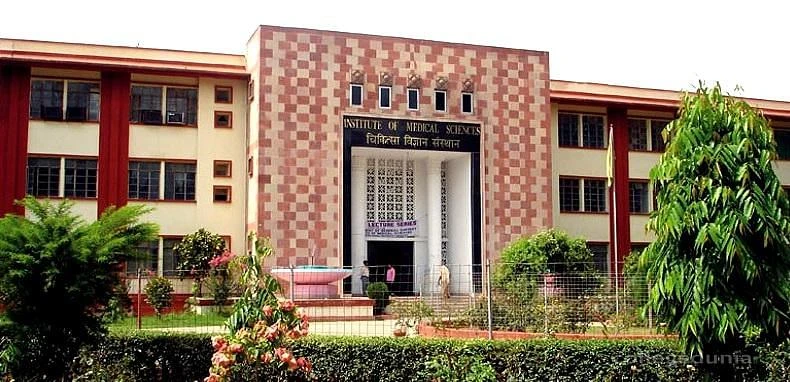
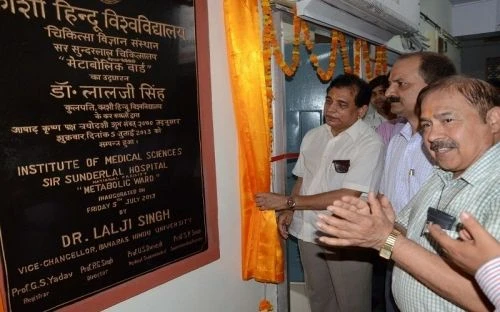
The campus is the 1,360-acre BHU main campus—a city within a city. The medical institute and its attached Sir Sunderlal Hospital (SSH) are located in the southern part. SSH is a behemoth, a tertiary care center serving a population crores strong across several states. The patient exposure is, in a word, insane. You'll see pathology here that textbooks treat as rare.
Hostel life is a mixed bag. The buildings (Punyavasu, Atreya, Kasturba) are old. Rooms are usually twin-sharing for UGs, single for PGs. You might face occasional maintenance issues with plumbing or electricity. But they're incredibly cheap, and the culture is strongly anti-ragging, which fosters a supportive, camaraderie-heavy environment.
Social life is vibrant because you're not just a med student—you're a BHU student. You have access to the university's massive sports infrastructure, the legendary Sayaji Rao Gaekwad Library, and a community of 30,000 students from diverse fields. The ghats of Varanasi are your weekend retreat. It's a unique, culturally rich experience no other top medical college can offer.
Talking to students and scanning forums reveals a clear consensus. The internal PG quota is the undisputed king. It's the reason many pick IMS BHU over newer AIIMS. The clinical exposure is the second biggest praise—hands-on, vast, and unfiltered.
Professors are respected for their knowledge but can be rigid. Administration is universally panned as slow and bureaucratic; getting documents or results can test your patience.
Hostels are loved for their community and price, but no one denies they need renovation. The location in Varanasi is either a profound spiritual plus or a chaotic minus, depending on your personality. But no one calls it boring.
The upgrade to "AIIMS-like" status (per the 2024 MoU) has boosted morale, with expectations of more central funding and infrastructure upgrades. You can check the latest official updates on the IMS BHU website.
Absolutely, but for a specific kind of student. If your NEET-UG rank is inside 1200 and your primary goal is to secure a clinical MD/MS seat after MBBS, IMS BHU is arguably the smartest choice in India. The 50% internal quota is a game-changing advantage that outweighs slightly better infrastructure at newer institutes. The cost is negligible, the exposure is unmatched, and the BHU brand is timeless.
Who should think twice? If you prioritize plush hostels and sleek campuses, look at the newer AIIMS. If you want to practice immediately after MBBS in your home state, a state college with a bond might make more geographic sense (IMS BHU has no service bond, just a seat-leaving penalty).
For the strategically-minded medical aspirant, IMS BHU isn't just a college—it's a long-term career plan. You come for the MBBS, but you stay for the near-guaranteed PG seat. In the high-stakes world of medical education, that's an offer that's very hard to beat.

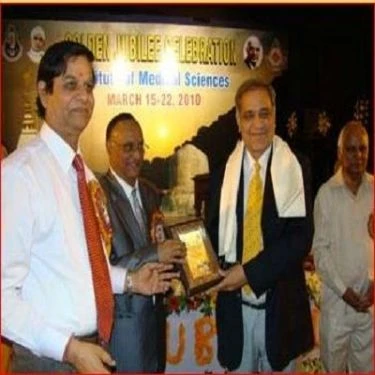
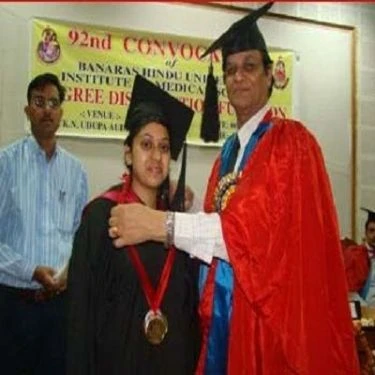
In this preview: 5 photos · 0 videos
No, IMS BHU does not have a state quota. All 100% of the MBBS and BDS seats are filled through the All India Quota (AIQ) via the Medical Counselling Committee (MCC).
The internal PG quota at IMS BHU is excellent. It reserves 50% of the total postgraduate seats for students who completed their MBBS from IMS BHU, which significantly lowers the required NEET-PG cutoff score for them.
Academically and for postgraduate prospects, IMS BHU is often preferred due to its strong internal PG quota. However, newer AIIMS institutions may have better hostel infrastructure and carry a distinct "brand" value for some individuals.
Currently, there is no compulsory service bond for MBBS graduates from IMS BHU. The only financial obligation is a seat-leaving penalty, which is approximately ₹3 Lakhs if a student vacates the seat.
Yes, all medical student hostels are located within the Banaras Hindu University (BHU) campus. Some hostels are situated about 1 to 2 kilometers away from the main hospital and college buildings.
Share what future students should know about IMS BHU.
Student voices are not rewritten by colleges. We remove spam and abuse.
Wider admission question? Community PulseWhat should future students know?
Tell us which course you're considering. We'll help you work out the next step.
Get instant Partner access after mobile verification. Your public edits are reviewed before they go live.
Claim this college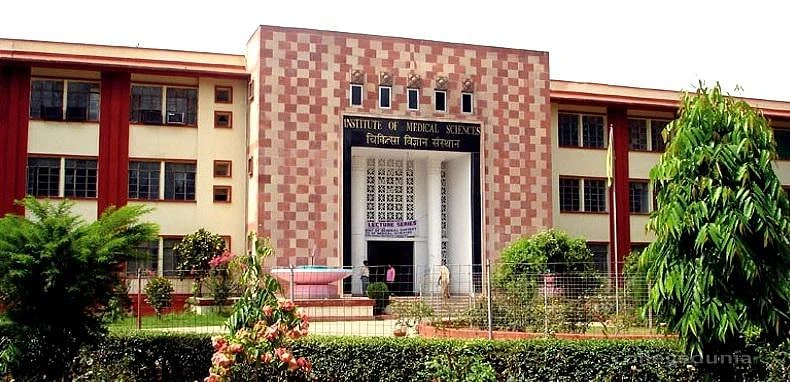
 Auditorium
 Cafeteria
 Computer Labs
 Hostel
 Medical
 Science Labs
 Sports Complex
 Study Library