Loading Admission Guardian content
Loading Admission Guardian content

Selected ranking categories, with the recorded year beside each result. Open all records for the complete history.
20 published records · Lower numeric ranks are stronger
IIRF
Design · private
#212023
Outlook
Fashion Design · private
#52021
The Week
Fashion Technology · private
#72024
Indiatoday
Fashion Design
#122020
The Week
Fashion Technology
#142020
Find a program, read its fee details and explore the admission requirements.
Summary of the programs shown below. Fee periods can differ by program. Check the note beside each amount before comparing costs.
| Course | Stream | Fees |
|---|---|---|
| Diploma | Design | 175000 |
| Master Of Business Administration [MBA] (Fashion Business and Event Management) | Management | 180000 |
| Master of Science [M.Sc] | Science | 180000 |
| Bachelor of Visual Arts [B.V.A] | Arts | 200000 |
| Bachelor of Science [B.Sc] | Science | 250000 |
Specializations
Eligibility: 10th
Specializations
Eligibility: Graduation
Specializations
Eligibility: Graduation
Specializations
Eligibility: 10+2 with 40%
Specializations
Eligibility: 10+2 with 40%
 Aditya Birla Group
 Arvind Group
 Design Cafe
 Hennes & Mauritz (H&M)
 IFB
IFB KREATIO Software
 Livspace
 Myntra
 Orient Craft
 PEBCO Motors
 Reliance Trends Limited
 Shahi Exports Pvt Ltd
 Shoppers Stop
 Tommy Hilfiger
 ZIVAME
If you're looking at fashion and design colleges in India, you'll hear about JD Institute. It's a name that carries weight, especially in Bangalore. Founded in 1988, it’s built a reputation as a premium, industry-focused finishing school rather than a traditional academic university. The location is a massive part of its appeal—right on Brigade Road, the heart of the city's shopping and social scene. You're paying for access: to industry mentors, a high-profile runway show, and a network that includes some of the biggest names in Indian fashion and interior design. But that access comes at a steep price, and student reviews are sharply divided on whether the return on investment is worth it.
JD offers a dizzying array of programs, from 3-month certificates to 4-year degrees. The academic structure is a bit of a patchwork. For the official degrees—B.Sc, B.Des, MBA, M.Sc—you're enrolled under Bengaluru City University (BCU). That means you follow their academic calendar and grading system. Then there are the institute's own diplomas and advanced diplomas, which are autonomous and heavily industry-skewed.
The undergraduate lineup includes B.Sc in Fashion & Apparel Design, Interior Design, and Jewellery Design (3 years), and the more comprehensive 4-year B.Des in Fashion, Interior, or Visual Communication. Postgraduate options like M.Sc and MBA in Fashion Business are also available. But the real volume is in the vocational courses: one-year diplomas in everything from Fashion Photography to UI/UX Design, and even short-term modules in makeup artistry.
Faculty is a mix. The institute claims 80% PhD holders, but that's a marketing stretch. In reality, you get a blend of academic instructors and, more importantly, working industry professionals. The teaching style is intensely practical. You're not just reading theory; you're constantly in labs building garments, creating models, or working on CAD software. The schedule is packed, and deadlines are strict. Miss one, and your internal assessment marks take a direct hit.
This is where the narrative splits. The official brochure and website paint a picture of glamour and high salaries. The student reviews on platforms like CollegeDunia and Shiksha tell a more nuanced, and often less rosy, story.
Let's start with the numbers. The official NIRF 2025 report lists a median salary of 5.0 LPA. That's a concrete, verifiable data point from an authoritative source like the NIRF portal. The institute also throws out a highest package range of 10-35 LPA. That upper limit is almost certainly an outlier—maybe a star alumnus who started their own label. The realistic top end for a campus recruit, according to alumni chatter, is closer to 6-7 LPA.
The average package students actually report? Between 3.5 to 4.0 LPA. That's a notable gap from the official median, and it's crucial for prospective students to understand. Placement percentage claims are similarly wide. JD says 96-99%. The student consensus puts core design role placement at around 60-70%. Many others find work independently or end up in retail-adjacent roles.
The process is entirely portfolio-driven. The JD Annual Design Awards is the real placement engine. It's a major runway event where final-year students showcase their collections to a room full of industry leaders. Get noticed there, and you're set. Recruiters are impressive on paper: Zara, H&M, Tommy Hilfiger, Myntra, Pepperfry, Livspace, and even Sabyasachi and Manish Malhotra. But these brands typically pick the top 5-10 students from a batch. For the rest, opportunities might be with smaller vendors or in sales-focused roles like visual merchandising, where starting pay can be as low as ₹15,000-20,000 a month.
Prepare for sticker shock. JD is unequivocally a premium, private institution, and the fees reflect that.
For the flagship 4-year B.Des program, annual tuition is approximately ₹2,00,000 + GST. Over four years, just the tuition and university fees can push the total cost to ₹8.5 to ₹9.5 lakhs. That's before you factor in the real kicker: material costs. Fabric, art supplies, model-making materials—these come out of your pocket and can add lakhs more over the course. The 3-year B.Sc programs run about ₹1,80,000 per year in tuition.
Then there are the ancillary charges. You'll pay a separate university fee to BCU (₹30,000/year), exam fees per semester, and a refundable security deposit. Student reviews consistently warn about "hidden costs": fines for low attendance (reportedly up to ₹5,000), charges for back-papers, and other administrative fees. They advise budgeting an extra 10-15% on top of the published fees.
Scholarships exist, but they only cover a portion of the tuition fee. They're offered for high academic merit (85%+ in 12th), students from defense backgrounds, or single-parent households. There's also a 10% discount for a one-time full payment of the annual fee.
Admission isn't just about an exam score. It's a multi-stage process designed to gauge creativity and aptitude.
For most of their core programs, JD conducts its own entrance tests: the JET (JD Entrance Test) or the GAT (General Aptitude Test). Some courses may also require a PAT (Performance Ability Test). If you have scores from national exams like NIFT, NID, or UCEED, those are often accepted and can sometimes get you a direct interview call.
The typical selection pipeline has four steps: 1) Submit the online application (₹1,500 fee). 2) Take the aptitude test (GAT). 3) Undergo a portfolio review. This is critical for design courses—they want to see your sketches, creative work, and sense of aesthetics. 4) Face a personal interview.
Basic eligibility is 50% in your 10+2. As a private institute, JD also has a management quota. If you meet the basic criteria, direct admission is possible, though it typically comes at the full fee with no scholarships.
The application window usually opens in January, with the main admission rush happening between May and July for an August/September start.
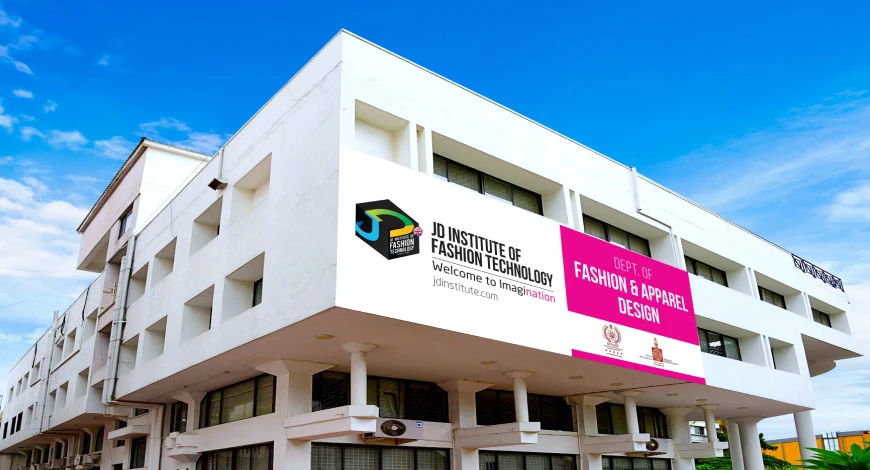
Forget the idea of a sprawling, green campus. JD Bangalore is urban and vertical. Its main center is at 18, Edward House on Brigade Road—a prime location that defines the student experience. Departments (Fashion, Interior) are sometimes spread across different floors or nearby buildings, which students say can mean running between classes.
The infrastructure is studio-focused. There's a fashion lab with industrial machines, an interior lab with drafting tables, and a well-equipped CAD lab with high-end systems running Adobe Suite, AutoCAD, and 3ds Max. The library is known for its collection of international fashion magazines and textile samples.
There is no traditional on-campus hostel. The institute provides references for managed PGs and accommodations. In the Brigade Road/Ashok Nagar area, expect to pay between ₹8,000 to ₹15,000 per month for a shared room, with food often being extra. The upside? You're in the middle of everything—cafes, shops, galleries. The canteen on-site is small, but with hundreds of food options within a five-minute walk, nobody goes hungry.
Social life is what you make of it in Bangalore. The college atmosphere is described as competitive and fast-paced, with a strong emphasis on your final portfolio and the Annual Design Awards.
Synthesizing feedback from Reddit, Quora, and education portals, a clear—and conflicted—picture emerges.
The praise is almost always about the industry edge. "The JD Annual Design Awards is the best platform you can get," is a common refrain. Students value the direct access to designers and the relentless practical focus. The faculty, particularly the industry mentors, are often described as accessible and helpful. The location on Brigade Road is universally loved.
But the criticisms are just as consistent and pointed. The top complaint is cost. Not just the high tuition, but the perpetual extra charges for materials, fines, and administrative fees. "The management can be very money-minded. Everything has a fine attached to it," one Quora user noted. The infrastructure, while adequate, gets flak for being fragmented.
The biggest reality check concerns placements. While the top tier of the batch lands dream jobs, there's a significant drop-off. Many average performers find themselves in low-paying retail or merchandising roles, feeling the ROI doesn't match the investment. The attendance policy is also notoriously strict, with even minor tardiness reportedly leading to being marked absent and fined.
JD Institute Bangalore isn't for everyone. It's a specific choice for a specific type of student. If you are deeply self-motivated, have a clear creative vision, and understand that your success will be 90% driven by your own portfolio and networking hustle, JD can be an excellent launchpad. The industry access via the Annual Design Awards is genuinely unparalleled in the private design college space. You're paying for that runway and the connections in the front row.
But if you're looking for a traditional, nurturing campus experience with predictable academics and guaranteed placement outcomes, look elsewhere. The fees are very high, the hidden costs are real, and the pressure is intense. The ROI is fantastic for the top 10% of the batch and can be disappointing for the rest. It's best seen as a premium finishing school—a place to polish your skills, build a killer portfolio, and make the contacts that might get your foot in the door. Just go in with your eyes wide open about the financial and personal commitment required.
NIFT is a government-funded Tier-1 institute with lower fees and higher prestige. JD Institute is a top-tier private alternative known for better industry networking and a more flexible, "glamorous" curriculum, but it is significantly more expensive.
JD Institute offers both. Through its affiliation with Bengaluru City University, it provides B.Sc, B.Des, and MBA degrees. It also offers autonomous diplomas which are industry-recognized but not university degrees.
The total cost for the B.Sc in Fashion Design at JD Institute Bangalore, including tuition, university fees, GST, and materials, is approximately ₹8.5 lakhs to ₹10 lakhs over the 3-year program, excluding living expenses.
Yes, JD Institute conducts the JET/GAT entrance exam. However, for many of its diploma courses, admission is merit-based followed by a personal interview.
No college guarantees placements. JD Institute provides "100% placement assistance," but actual hiring depends on the quality of the student's final portfolio and their performance in events like the JD Annual Design Awards.
Share what future students should know about JD Institute of Fashion Technology.
Student voices are not rewritten by colleges. We remove spam and abuse.
Wider admission question? Community PulseWhat should future students know?
Tell us which course you're considering. We'll help you work out the next step.
Get instant Partner access after mobile verification. Your public edits are reviewed before they go live.
Claim this college Auditorium
 Cafeteria
 Campus Security
 Computer Labs
 Medical
 Science Labs
 Sports Complex