Loading Admission Guardian content
Loading Admission Guardian content

Provisional score based on available data. It may change as more information is verified.
Find a program, read its fee details and explore the admission requirements.
Summary of the programs shown below. First-year fee. Check the note beside each amount for inclusions and exclusions.
| Course | Stream | Fees |
|---|---|---|
| Bachelor of Science [B.Sc] (Nursing) | Paramedical | 122000 |
| Master of Science [M.Sc] | Paramedical | 150000 |
Specializations
Eligibility: 10+2
Specializations
Eligibility: Graduation
1 exam with cutoff data available
 L&T Infotech
 SAP
SAP Subex
Subex TVS Motors
If you're looking for a nursing college in Mysore that prioritizes clinical rigor and discipline over campus glamour, Vidya Vikas College of Nursing (VVCN) is a name that comes up consistently. Established in 2005 under a trust dating back to 1991, it’s a private institution affiliated with the heavyweight Rajiv Gandhi University of Health Sciences (RGUHS). Its biggest selling point isn't fancy brochures but its direct access to hospital wards. Tied to the on-campus Vidya Vikas Hospital and other major Mysore facilities, the training here is intensely practical. You won't find a vibrant social scene, but you will find a pathway to a nursing license that’s recognized by the Indian Nursing Council (INC) and the Karnataka Nursing Council (KNC). For students who see nursing as a serious vocation, not just a degree, VVCN makes a compelling, if strict, case.
The academic slate is focused and follows the RGUHS curriculum to the letter. That means a heavy emphasis on internal assessments (20% weight) and university-conducted final exams (80%). The undergraduate anchor is the 4-year B.Sc. Nursing (Basic) program with an annual intake of 60 students. Eligibility requires 10+2 with PCB and English, and a minimum of 45% aggregate. They also offer a 2-year Post Basic B.Sc. Nursing for registered GNM diploma holders.
At the postgraduate level, the M.Sc. Nursing program offers specializations, though availability can shift yearly. The common ones include Medical-Surgical, Community Health, and Obstetrics & Gynecological Nursing. You’ll need a B.Sc. Nursing degree with at least 55% and one year of work experience to qualify.
The teaching style is a mix of traditional lectures and, more importantly, extensive clinical bedside training. With a faculty of about 25-30, the feedback from students often highlights the staff as being strict but genuinely supportive during practical sessions. The real academic edge here is the clinical rotation. Students don't just learn in labs; they train at the 200-bed Vidya Vikas Hospital on campus and get posted to major government hospitals in Mysore like K.R. Hospital and Cheluvamba Hospital. That exposure to a high patient volume and diverse cases is what many alumni point to as the program's core strength.
Nursing placements don't work like engineering campus drives. There's no single "placement day" with companies offering lakhs. Instead, recruitment is hospital-driven and often continuous. The college claims a 90-100% placement rate for eligible graduates, which, for a nursing college with solid hospital ties, is plausible. The key recruiters are the big healthcare chains: Apollo Hospitals, Narayana Health, Fortis, Manipal (formerly Columbia Asia), and Aster DM.
The salary reality in India for fresh B.Sc. Nursing graduates is modest. The average starting package typically falls between ₹2.4 and ₹3.6 Lakhs per annum (roughly ₹18,000 to ₹25,000 per month). You might see a claim of an ₹18 LPA highest package floating around—that almost certainly refers to an international placement or is data from the engineering wing. Don't bank on it.
The more compelling prospect for many is international mobility. The college's RGUHS-backed curriculum and training are aligned with global standards. A notable number of alumni have successfully moved to the UK, UAE, Canada, and Germany after clearing the required licensing exams like IELTS/OET or NCLEX. The college provides the necessary transcripts and training, but the actual application process to foreign agencies or hospital networks is largely student-driven, sometimes with campus assistance.
The cost depends entirely on how you get in. The Government Quota seats, allotted through KCET counseling, are significantly cheaper—around ₹40,000 to ₹60,000 per year for B.Sc. Nursing. The Management Quota seats, where you apply directly, cost between ₹1.25 and ₹1.75 Lakhs per year in tuition fees alone.
Then you have to factor in living costs. Hostel and mess fees add another ₹60,000 to ₹75,000 annually. Throw in one-time and recurring costs for uniforms, books, lab fees, and RGUHS exams (around ₹15,000-₹20,000), and the total 4-year cost for a management quota student in the hostel can land between ₹7.5 and ₹9 Lakhs.
Financial aid primarily comes through state government scholarships for SC/ST/OBC students, processed via the Karnataka State Scholarship Portal (SSP). The college administration has received mixed reviews on processing speed for this paperwork, so students are advised to be proactive.
For Karnataka domicile students, the primary gateway is the KCET (Karnataka Common Entrance Test). Your KCET rank determines your eligibility for the roughly 50% of seats under the Government Quota, which are allotted through the Karnataka Examinations Authority (KEA) counseling. NEET-UG scores are sometimes used for basic eligibility verification, but KCET is the rank-decider.
The cutoffs are a reflection of demand. For the 2024 admission cycle (Round 3), the closing rank for the General Merit (GM) category was 1,02,873. For category seats like 2AG, it was 1,29,019. These ranks give you a sense of the competition level—it's not the most competitive college in the state, but it has steady demand.
If you miss the KCET cutoff or are from outside Karnataka, the Management Quota is the route. This usually involves a direct application to the college, likely based on your 12th-grade marks and sometimes a personal interaction. The application window typically runs from April to July.
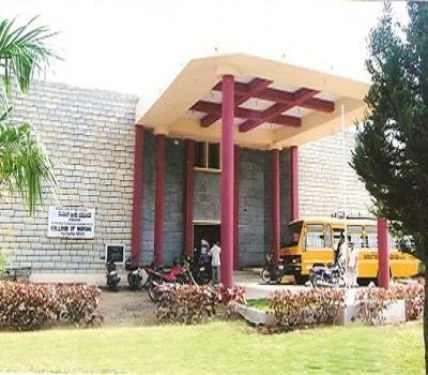
The college is situated on a sprawling 65-acre campus it shares with Vidya Vikas Institute of Engineering and Technology. This means ample greenery and space, which is a plus compared to many city-bound nursing colleges. The downside? Shared infrastructure. The common canteen and some facilities can get crowded when all institutions are in session.
Infrastructure for nursing is functional. You'll find dedicated labs for fundamentals, nutrition, community health, and OBG, plus an anatomy museum. The library holds over 10,000 books and provides digital access through the Helinet Consortium. Campus-wide Wi-Fi is available, powered by a shared high-speed fiber optic line.
The hostels are separate for boys and girls, described as clean and secure but basic. The word "strict" appears in nearly every review. There's a strict curfew, strict attendance policies (80% is mandatory), and strict rules regarding outings and visitors. The food is vegetarian and non-vegetarian South Indian fare, which gets monotonous for some. This isn't a campus known for its social life or events; it's academically and clinically focused. If you want a disciplined environment to study, it works. If you want a typical "college experience," you'll likely be frustrated.
Sifting through dozens of reviews on platforms like CollegeDunia and Shiksha paints a consistent picture. The consensus is that VVCN is a "disciplined and academic-centric" institution that produces competent, job-ready nurses. It's respected, not loved.
The positives are clear and repeated: excellent clinical exposure thanks to the hospital tie-ups, approachable faculty who are helpful in practical training, and a peaceful, green campus that's conducive to studying.
But the negatives are just as consistent. The discipline is often described as "school-like" and overly rigid, especially for hostelers. Administrative processes, particularly for certificates or scholarships, can be slow. And the shared campus means nursing students sometimes feel like second-class citizens when facilities are overcrowded with engineering peers.
A paraphrased quote from a review sums up the trade-off: "If you want a job in the UK or Middle East, the training here is solid. They focus a lot on the basics. But the hostel food is okay for the first month, and the warden is very strict about timings. You have to know what you're signing up for."
Vidya Vikas College of Nursing is a straightforward proposition. It's best for students who are dead-serious about a nursing career and value rigorous clinical training and discipline above campus life and freedoms. The access to hospital rotations is its strongest asset, providing the hands-on experience that is the bedrock of the profession. For a management quota student, the total cost is significant but not exorbitant compared to many private nursing colleges, and the pathway to jobs with major hospital chains is well-established.
You should probably look elsewhere if you crave a vibrant, liberal college atmosphere or if administrative hiccups are a major concern. The strict rules and sometimes slow paperwork are real drawbacks. Ultimately, VVCN is a vocational training institute in the best sense of the term. It won't coddle you, but if you put in the work, it will equip you with the skills to become a registered nurse in India or lay the foundation for an international career. It’s a practical choice for a practical profession.
Yes, Vidya Vikas College of Nursing is well-regarded in Mysore for its disciplined academic environment and strong clinical tie-ups with hospitals, providing practical training for B.Sc. Nursing students.
The annual fee for the B.Sc. Nursing program under the management quota ranges from approximately ₹1.25 lakh to ₹1.75 lakh. This fee structure typically excludes hostel and accommodation charges.
For the 2024-25 academic year, the primary entrance requirement for Karnataka residents is the KCET (Karnataka Common Entrance Test). NEET scores are often used for eligibility verification, but KCET is the key exam for the admission process.
The girls' hostel is described as safe and secure with 24/7 security. However, it is known for having very strict rules regarding leave permissions and curfew timings for resident students.
The college provides necessary training and academic transcripts for international opportunities. However, students typically apply to foreign positions independently or through campus-assisted hospital networks, rather than through direct overseas placement services from the college.
Share what future students should know about Vidya Vikas College of Nursing.
Student voices are not rewritten by colleges. We remove spam and abuse.
Wider admission question? Community PulseWhat should future students know?
Tell us which course you're considering. We'll help you work out the next step.
Get instant Partner access after mobile verification. Your public edits are reviewed before they go live.
Claim this college Auditorium
 Cafeteria
 Campus Shuttle
 Computer Labs
 Hostel
 Medical
 Science Labs
 Sports Complex
 Study Library