Loading Admission Guardian content
Loading Admission Guardian content

Find a program, read its fee details and explore the admission requirements.
Summary of the programs shown below. Fee periods can differ by program. Check the note beside each amount before comparing costs.
| Course | Stream | Fees |
|---|---|---|
| Bachelor of Science [B.Sc] (Nursing) | Paramedical | 122500 |
| Master of Science [M.Sc] (Nursing) | Paramedical | 122500 |
| Post Basic Bachelor of Science [P.B.B.Sc] (Nursing) | Paramedical | 122500 |
Specializations
Eligibility: 10+2
Specializations
Eligibility: Graduation
Specializations
Eligibility: 10+2
If you're looking for a nursing college in Northeast India where a job is almost guaranteed upon graduation, the Asian Institute of Nursing Education (AINE) in Guwahati is the name you'll hear. Established in 2004, it's the region's first private nursing institute and operates with a singular focus: turning out highly competent, clinically-ready nurses. Its defining feature is an unbreakable link to GNRC Hospitals, a connection that shapes everything from daily training to final placements. That's the trade-off. You get exceptional hands-on experience and near-certain employment, but you sign up for four years of intense, disciplined grind. It's not a typical college campus life. It's a professional boot camp for healthcare.
AINE’s portfolio is built around core nursing credentials, with a clear ladder from diploma to postgraduate specialization. The B.Sc. Nursing program, with an annual intake of 100, is the anchor. It’s a four-year rig that includes integrated internship. For those already in the field, the Post Basic B.Sc. (2 years, 25 seats) and the General Nursing & Midwifery (GNM) diploma provide upgrade paths. At the postgraduate level, the M.Sc. Nursing program offers 19 total seats across five specializations: Medical-Surgical, Community Health, Obstetrics & Gynecological, Pediatric, and Psychiatric Nursing. They also run niche programs like the 2-year Nurse Practitioner in Critical Care (NPCC, 10 seats) and a 1-year Post Basic Diploma in Oncology Nursing (20 seats).
The academic engine here is the clinical partnership. Theory happens in classrooms, but real learning is on the floor of GNRC Hospitals. It’s not an occasional visit; it’s a core part of the schedule from the early years. Additional rotations at Guwahati Medical College (GMCH) add public hospital exposure. The faculty, led by Principal Prof. (Dr.) Ranju Rani Das, is repeatedly praised in student reviews for being thorough and exam-focused. The calendar follows SSUHS, meaning annual university exams—a system that creates a high-pressure, study-intensive environment. You’ll know your protocols and your textbooks.
This is where AINE’s model pays off, literally. The official placement claim is 100%, and it’s one of the rare instances where student sentiment doesn’t contradict it. The caveat is the ‘how.’ Roughly 99% of graduates are initially absorbed by the parent GNRC Hospitals. It’s a pipeline. So yes, you are virtually assured a job, but your first offer will likely be from GNRC. The 2024 data shows a highest package of ₹7 LPA for international or corporate roles, an average of ₹5.7 LPA, and a median of ₹3.5 LPA for B.Sc. grads. That median figure is the one to watch—it’s a decent starting point for a staff nurse in the region, especially with job security thrown in.
The recruiter list beyond GNRC is impressive and speaks to the institute’s reputation: AIIMS Delhi, Max Healthcare, Medanta, Fortis, Apollo, and Tata Medical Center. Government options like GMCH and ESIC also recruit. The path is clear. Start at GNRC, gain two years of intense experience, and then you have the pedigree and skills to jump to these national brands. The placement cell’s main job is facilitating this initial absorption and then managing the network for later career moves. It’s a system that works, but it’s not about a campus placement ‘season’ with multiple offers; it’s about a guaranteed entry into the profession.
For a private institution with its placement record, AINE’s fee structure is positioned in the mid-range. The annual tuition fee for both B.Sc. and M.Sc. Nursing is ₹1,23,000. Add an estimated ₹50,000–₹60,000 for hostel and mess charges at the girls' hostel in Dispur, and you’re looking at an annual outlay of approximately ₹1.8 lakhs. Over four years for a B.Sc., the total cost lands between ₹6.5 and ₹7.5 lakhs all-in. Remember, this excludes one-time costs like uniforms, books, and university registration fees.
Financial aid is limited but present. The standout is a merit-based cash award of ₹25,000 for students who score over 75% in their university exams. It’s a direct incentive for academic performance. There’s no mention of need-based scholarships or education loan tie-ups in the brief, so prospective students should plan their financing accordingly, assuming the full fee burden.
The gateway is straightforward but specific. For the flagship B.Sc. Nursing program, you must be an unmarried female candidate with 50% aggregate in PCB (Physics, Chemistry, Biology) and English in your 10+2. The selection hinges entirely on the SSUHS Common Entrance Examination (CEE). The application window typically runs from April to May for exams in June. Your rank in this state-level entrance exam forms the primary merit list, which is usually followed by a personal interview at the institute.
Cutoff scores aren’t published in the brief, but as the premier private institute in the state, competition is stiff. A high rank is essential. For postgraduate M.Sc. courses, the process involves the SSUHS PG entrance exam and/or an institute-level interview. It’s worth noting that a limited number of management quota seats exist, but the B.Sc. program’s gender restriction is a non-negotiable policy.
Don’t expect a sprawling, vibrant university campus. AINE is a professional training center. The academic and administrative hub is on R.G. Baruah Road, while the main clinical campus is in North Guwahati near GNRC. Infrastructure is functional and geared towards practice: you’ll find well-equipped labs for Nursing Arts, Medical-Surgical, Community Health, and Nutrition, plus a solid library with nursing journals.
The girls' hostel in Usha Nagar, Dispur, houses between 185-300 students. Rooms are non-AC but furnished with the basics—bed, table, chair, wardrobe. Reviews consistently rate the hostel food as ‘average’ or ‘repetitive but edible.’ The college runs dedicated buses to ferry students between hostel, classes, and hospital sites, which is a logistical necessity given the split locations. Social life is minimal. The culture is one of discipline: high attendance mandates, a focus on studies and clinicals, and limited tolerance for absenteeism. One review put it bluntly: "Sick students are often discouraged from taking leave." Your social circle will be your batchmates, and your life will revolve around the hospital schedule.
The consensus from student forums is remarkably consistent, painting AINE as a “strict but high-yield” institution. The positives are powerful and career-defining. The clinical exposure at GNRC is universally hailed as the biggest advantage. “You see real cases from day one,” is a common refrain. Faculty are respected for being helpful and laser-focused on preparing students for university exams. And the overwhelming sentiment is one of security: “Students feel secure knowing they have a job at GNRC or Apollo upon graduation.”
But the negatives are a direct result of that high-pressure, high-reward model. The strict discipline is the most frequent complaint. The environment is more regimented than a typical college. Hostel food quality is a perennial grievance. And there’s a clear acknowledgement that you sacrifice a ‘normal’ campus life. “The four years are a grind,” one alum said. Another noted, “It feels more like a professional training center than a college.” It’s a trade-off every student must consciously make.
AINE is an exceptionally clear-cut choice. It is absolutely worth it for a specific type of student: an unmarried female candidate from the Northeast or elsewhere who is dead-serious about a nursing career, values job security above all else, and is willing to endure a spartan, disciplined four years for a rock-solid professional launchpad. The guaranteed clinical hours at a major hospital and the near-100% placement rate are benefits few Indian nursing colleges can match.
However, you should probably look elsewhere if you want a balanced college experience with a vibrant social life, more relaxed academic rules, or a campus where you can explore interests beyond nursing. The gender restriction for B.Sc. also limits its pool. Ultimately, AINE isn’t trying to be a liberal arts college. It’s a factory for proficient, employable nurses, and by that metric, it succeeds impressively. You just have to really want what it’s selling.

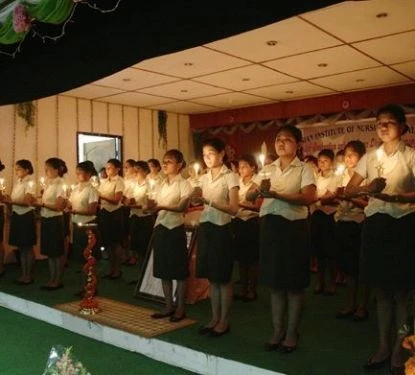
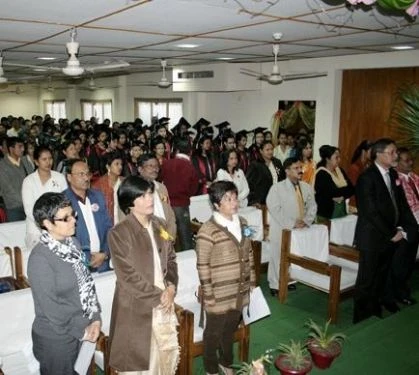


In this preview: 5 photos · 0 videos
Yes, the Asian Institute of Nursing Education (AINE) is fully recognized and approved by the Indian Nursing Council (INC) as well as the Assam Nursing Council.
The total approximate fee for the 4-year B.Sc. Nursing program at AINE ranges from ₹6.5 to ₹7.5 Lakhs. This estimate includes tuition fees and projected hostel expenses.
Yes, AINE provides 100% placement assistance for its students. Placements are primarily facilitated through its parent hospital, GNRC, and other established corporate hospital tie-ups.
Admission to undergraduate (UG) and postgraduate (PG) nursing courses at AINE requires candidates to appear for the SSUHS CEE (Common Entrance Examination), which is the primary gateway for these programs.
No, the B.Sc. Nursing program at AINE is currently restricted to unmarried female candidates only. Male students cannot apply for this particular course.
Share what future students should know about AINE.
Student voices are not rewritten by colleges. We remove spam and abuse.
Wider admission question? Community PulseWhat should future students know?
Tell us which course you're considering. We'll help you work out the next step.
Get instant Partner access after mobile verification. Your public edits are reviewed before they go live.
Claim this college
 Auditorium
 Cafeteria
 Computer Labs
 Hostel
 Medical
 Science Labs
 Study Library