Loading Admission Guardian content
Loading Admission Guardian content
Provisional score based on available data. It may change as more information is verified.
Selected ranking categories, with the recorded year beside each result. Open all records for the complete history.
23 published records · Lower numeric ranks are stronger
Outlook
Arts
#452020
Outlook
Commerce
#642022
Outlook
Science
#752020
Outlook
BCA
#302020
Outlook
Overall
#302020
Find a program, read its fee details and explore the admission requirements.
Summary of the programs shown below. Total course fee. Check the note beside each amount for inclusions and exclusions.
| Course | Stream | Fees |
|---|---|---|
| Bachelor of Commerce [B.Com] | Commerce | 25000 |
| Bachelor of Vocational Studies [B.Voc] | Vocational Courses | 25000 |
| Bachelor of Computer Applications [BCA] | Computer Applications | 30000 |
| Bachelor of Science [B.Sc] (Agriculture) | Agriculture | 35000 |
| Master of Science [M.Sc] | Science | 40000 |
Specializations
Eligibility: 10+2
Specializations
Eligibility: 10+2
Specializations
Eligibility: 10+2
Eligibility: 10+2
Specializations
Eligibility: Graduation
 Amazon
 Autodesk
 Capgemini
 IBM
IBM Infosys
 Loreal
 LOTUS HOSPITAL
 Luminous
 Matrix
 Microsoft
 Nevaeh Technology
 Nike
Nike SportKing
 State Bank of India
 TCS
TCS Tech Mahindra
 Wipro
Wipro Xerox
XeroxDev Samaj College for Women in Firozpur isn't just another degree mill. It's an institution with a 90-year legacy, a sprawling 25-acre campus, and a reputation as the safest educational enclave for women in Punjab's border region. That's the draw. But the reality, especially when you look at the hard numbers from NIRF and student reviews, paints a more nuanced picture of a traditional, disciplined college that excels in certain niches—like its vocational programs and sciences—while offering a very conventional path in others. Its recent NAAC 'A' grade re-accreditation signals solid institutional quality, yet the gap between its marketing claims and the on-ground student experience, particularly around placements, is something every prospective student should weigh carefully.
With around 52 courses, DSCW's academic portfolio is broad. It spans the expected—BA, B.Com, B.Sc in Medical and Non-Medical streams—and the distinctive. The B.Voc programs are a standout. In a region where traditional degrees dominate, courses in Software Development, Fashion Technology, Beauty & Aesthetics, and Hospital Administration offer a tangible, skill-based alternative. Student reviews consistently highlight these as a major strength. The B.Sc Agriculture program is another differentiator, a four-year professional degree rare in women's colleges here.
The academic culture is traditional and follows the Panjab University semester system. Faculty, numbering about 53 full-time with nearly half holding PhDs, are repeatedly described in reviews as "cooperative" and "motherly." That's a positive. But the teaching methodology, especially in streams like Commerce, is often cited as heavily theory-oriented. The college's "Star College" status from the Department of Biotechnology means science labs are well-equipped, a fact B.Sc Medical students specifically praise. You're getting a solid, if conventional, Panjab University education here. For the latest course list and details, always check the official college website.
This is where you need to read between the lines. The college's promotional material might mention a highest package of ₹24 LPA (L'Oreal) and an average of ₹5 LPA. The verified data from the NIRF 2024 report tells a different story: a median package of ₹1.8 LPA for both undergraduate and postgraduate students. That's a stark, official figure.
Placement percentage is the other critical metric. NIRF data and synthesized student reviews suggest only between 3% to 9.4% of a graduating batch secures a job through campus drives. A significant portion, 20-30%, opts for higher studies instead. The recruitment is niche. Top recruiters like Amazon, IBM, or Infosys typically participate in pooled or off-campus drives with other institutions. More consistent on-campus hiring comes from sectors like education (e.g., Ryan International School), banking (SBI, ICICI), retail, and BPOs like Concentrix.
The takeaway? If you're in a B.Voc course or B.Sc, you have a clearer, skill-defined path to employment, often in roles directly related to your training. For a BA or B.Com student, the campus placement cell offers limited direct opportunity. You'll likely be building your own career path post-graduation. As one Quora comment paraphrased it: "Placements are mostly for those in NCC/NSS or vocational courses. For regular BA/B.Com, you have to find your own job."
Fees are reasonable, especially for a private-aided institution with its facilities. For the 2024-25 session, expect to pay between ₹20,000–₹22,000 annually for BA programs, ₹25,000–₹32,000 for B.Com/B.Sc, and ₹25,000–₹30,000 for BCA/B.Voc. The B.Sc Agriculture program is at the higher end, around ₹35,000–₹40,000 per year.
Hostel fees add a significant layer. A standard non-AC room costs ₹25,000–₹30,000 per year, while premium AC rooms can go above ₹1,00,000 annually, including mess charges. Add in semester exam fees (≈₹2,500) and other development charges, and the total three-year UG cost, excluding hostel, ranges from ₹75,000 to ₹1,10,000.
Financial aid is available. The standard Post-Matric scholarships for SC/ST/OBC students from the Punjab Government are applicable. The college itself offers the Dr. Ambedkar Scholarship for meritorious students and has provisions for fee concessions for fatherless students or those who scored above 90% in their 12th board exams.
The process is straightforward and merit-based. For almost all undergraduate programs (BA, B.Com, B.Sc, BCA, B.Voc), there is no entrance exam. Admission is based solely on your Class 12 marks. The application window typically opens in May or June, with late admissions (with a fine) possible until August. You fill out an online form, pay an application fee of ₹500–₹800, and wait for the merit list.
Cutoffs aren't published in a centralized way like engineering colleges, but they fluctuate based on the program and applicant pool. For sought-after streams like B.Sc Medical or B.Voc, the cutoff percentage can be notably higher. Postgraduate admissions for some courses like M.Sc may require the Panjab University Common Entrance Test (PU CET PG), while others are merit-based. B.Ed and M.Ed admissions follow the state-level entrance and counseling process.
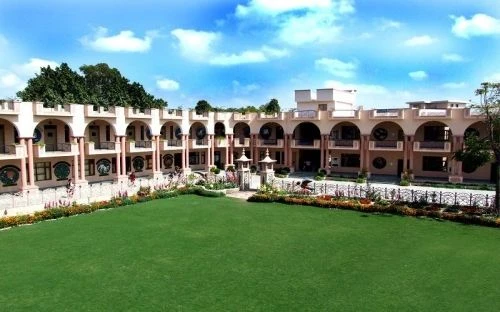
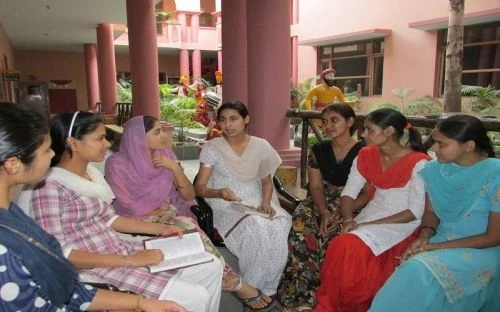
The 25-acre campus is consistently praised as lush, green, and extremely well-maintained. It feels secluded, which contributes directly to its biggest selling point: safety. For parents in the region, this is often the primary deciding factor.
Hostel life is a defining experience. The four hostel blocks are rated highly (4.5/5 in reviews) for safety and a "home-like" environment. But that comes with strings attached. The discipline is famously strict. Outings are limited and require permission, attendance is mandatory (75% minimum), and rules are enforced. As one Shiksha review put it: "The college is like a second home, but the rules are very strict. You cannot leave the campus without permission." The vegetarian mess food is considered good quality, though the menu can get repetitive. Some infrastructure complaints pop up, like washroom maintenance and limited chilled water access in peak summer.
Culturally, the college is active. It's a hub for the Panjab University Zonal Youth Festival, and internal events like the traditional "Teeyan" festival are major highlights. Sports facilities include large grounds for hockey and volleyball, along with a gymnasium.
Synthesizing feedback from CollegeDunia, Shiksha, and forums gives a clear consensus.
The positives are powerful and repeated: an unparalleled safe environment, supportive and qualified faculty, excellent practical training in B.Voc and science labs, and a vibrant cultural scene. For many, the trade-off for safety and a solid education is worth the strictness.
And the negatives are just as consistent. The "school-like" discipline is a major point of contention for students seeking a more independent college experience. The placement reality, as discussed, doesn't match the brochure for most general degree students. Some note a gap between theoretical teaching and practical application in certain departments. Infrastructure, while good overall, has specific pain points like hostel Wi-Fi speed and summer amenities.
It depends entirely on what you're looking for. If your top priority is a safe, disciplined, and supportive environment for a traditional Panjab University degree, DSCW is arguably the best option in the Firozpur region. Its NAAC 'A' grade and "College of Excellence" status aren't just labels—they reflect genuine institutional quality. It's particularly strong for students interested in B.Sc (especially Medical or Agriculture) and its unique B.Voc programs, which offer a direct skills-to-employment pathway that generic degrees often lack.
But if you're seeking a liberal campus life with high-flying corporate placements from campus drives, this isn't the place. The placement numbers are modest, and the culture is intentionally restrictive. You're paying for a reputable, secure education, not a guaranteed corporate launchpad. For a student from Punjab or nearby regions who values safety and a strong academic foundation, DSCW makes a lot of sense. For someone looking to break into top-tier national companies directly after a BA or B.Com, you'll need to supplement the college's offering with a lot of your own initiative.
In this preview: 5 photos · 0 videos
Dev Samaj College For Women is a private-aided institution. It is privately managed but receives financial aid from the government and is affiliated with Panjab University.
The college offers premium AC hostel rooms. The annual fee for a single AC room, including mess charges, typically ranges between ₹1,00,000 and ₹1,20,000.
Yes, DSCW offers a 4-year B.Sc Agriculture degree. It is one of the few women's colleges in the region to provide this program, which is affiliated with Panjab University.
Admissions for BA and B.Com programs are based entirely on the candidate's marks in the 10+2 board examinations. The college does not conduct its own entrance exams for these courses.
Placements for BCA students are moderate. Companies like Wipro and Infosys occasionally recruit through off-campus or pool drives, with average placement packages around ₹2.5 Lakhs Per Annum (LPA).
Share what future students should know about DSCW.
Student voices are not rewritten by colleges. We remove spam and abuse.
Wider admission question? Community PulseWhat should future students know?
Tell us which course you're considering. We'll help you work out the next step.
Get instant Partner access after mobile verification. Your public edits are reviewed before they go live.
Claim this college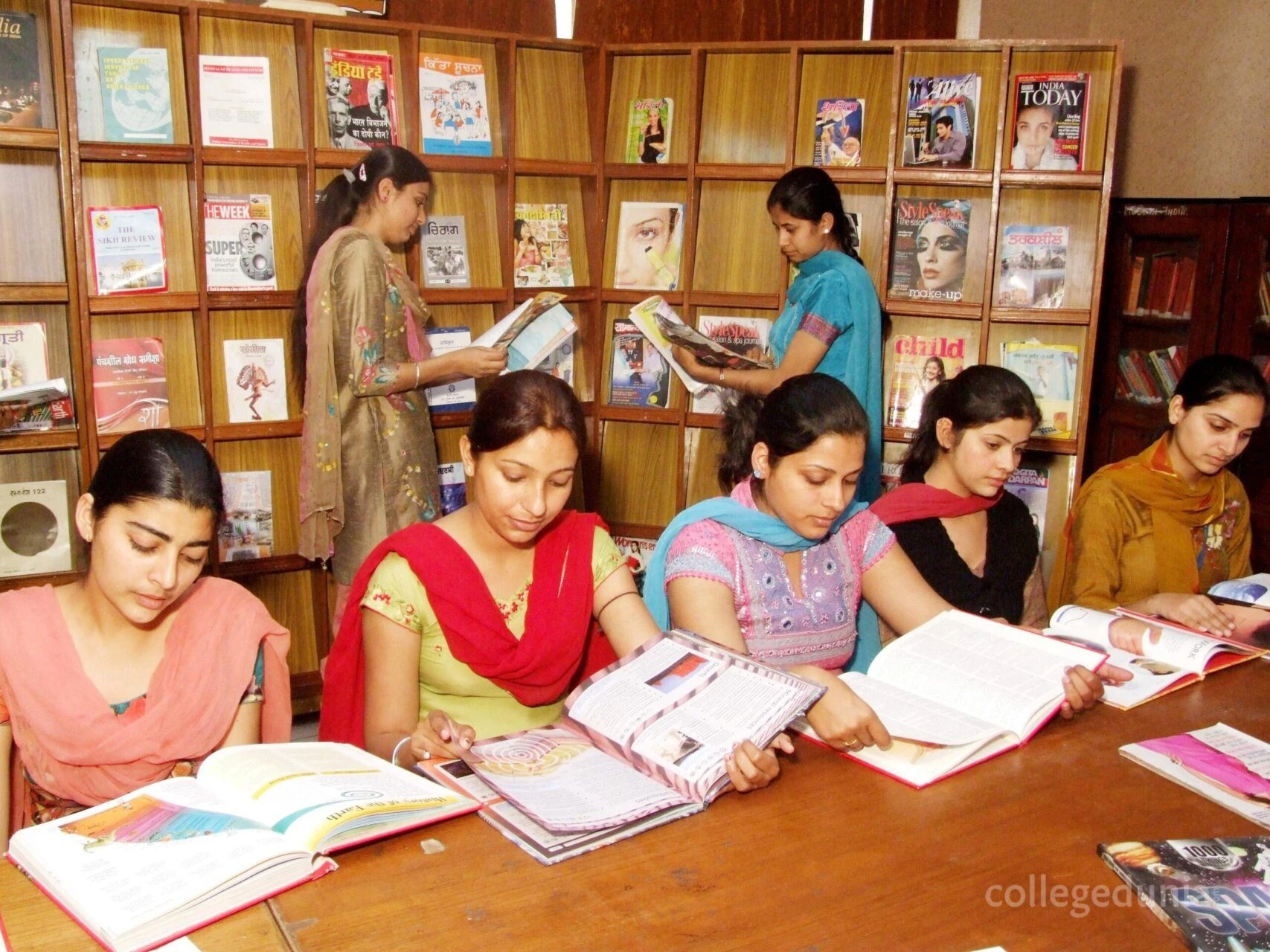

 Auditorium
 Bank & ATM
 Cafeteria
 Campus Shuttle
 Campus Wi-Fi
 Communication Centre
 Computer Labs
 Gym
Gym Hostel
 Medical
 Science Labs
 Smart Classrooms
 Sports Complex
 Study Library