Loading Admission Guardian content
Loading Admission Guardian content
Provisional score based on available data. It may change as more information is verified.
Find a program, read its fee details and explore the admission requirements.
Summary of the programs shown below. First-year fee. Check the note beside each amount for inclusions and exclusions.
| Course | Stream | Fees |
|---|---|---|
| Bachelor of Arts [BA] (English with Journalism) | Arts | 18000 |
| Bachelor of Commerce [B.Com] | Commerce | 18000 |
| Bachelor of Business Administration [BBA] | Management | 18000 |
| Bachelor of Science [B.Sc] | Science | 22500 |
| Bachelor of Computer Applications [BCA] | Computer Applications | 30000 |
Specializations
Eligibility: 10+2
Specializations
Eligibility: 10+2
Specializations
Eligibility: 10+2
Specializations
Eligibility: 10+2
Specializations
Eligibility: 10+2
Tucked away on a panoramic hillock in the Western Ghats, Devamatha Arts and Science College offers a specific kind of educational experience. Established in 2003 and managed by the Catholic Diocese of Tellicherry, this self-financing college is affiliated with Kannur University. It’s a place where discipline, a supportive faculty, and a serene, distraction-free environment are the primary selling points. You won’t find a bustling city campus here. Instead, you get a quiet, focused atmosphere that appeals to students looking to secure a solid degree from a recognized university without the chaos of urban college life. The trade-off is a remote location and a social scene that’s more subdued than what you'd find in Kannur town. For the right student, it’s a viable, affordable option. For others, the isolation might be a dealbreaker.
The college offers a standard suite of undergraduate and postgraduate programs under the Kannur University syllabus, with a total annual intake hovering around 328 students. The academic structure follows the university's Choice Based Credit and Semester System (CBCSS).
On the UG front, B.Com is the most prominent, with streams in Finance, Computer Applications, and Co-operation. They've also added newer specializations like Logistics & Supply Chain Management and Business Analytics. B.Sc programs in the core sciences (Physics, Chemistry, Mathematics) are available, alongside BBA and BCA. The BA in English with Journalism is a notable arts offering. At the PG level, options are limited to M.Com (Finance) and MA (English).
The faculty, numbering around 32-35, is often highlighted in student reviews as a strength. A good portion are retired professors from government colleges or PhD holders, and they’re generally seen as accessible and invested in student success, especially when it comes to preparing for the rigorous Kannur University exams. It’s a teaching-focused environment. The college promotes extracurricular engagement through a dedicated Campus Radio station and has a strong NSS unit with over 40 volunteers, which is a decent point of activity.
Let’s separate the brochure claims from the ground reality. Officially, the college talks about an 80-90% placement rate for eligible students. But if you sift through student reviews on portals like CollegeDekho, a more conservative figure of 50-60% for on-campus core placements emerges. Many students, particularly from the B.Sc streams, opt for higher studies like M.Sc or B.Ed as a primary path.
The package data for 2024 points to modest outcomes. The highest package reported is 5 LPA, with an average of 4.2 LPA and a median of 4 LPA. That’s a realistic snapshot for a self-financing arts and science college in this region. Recruiters are a mix of regional banks and large IT service firms. South Indian Bank and Federal Bank are consistent visitors for commerce graduates. For IT roles, names like Wipro, Infosys, and TCS appear, though these are often accessed through pooled drives or off-campus opportunities shared by the university. Students from the BBA in Hospital Administration have found roles in private hospitals, and Nissan Motors has recruited a few alumni for operations roles.
It’s a functional placement cell, not a powerhouse. If your goal is a stable entry-level job in banking, IT services, or logistics after your degree, there’s a pathway. But don’t expect a flood of high-profile MNCs or dream packages. You’ll need to be proactive.
One of the college’s compelling advantages is its affordability, especially within the self-financing sector. The fees are regulated under Kannur University's norms.
For a three-year UG program, the total tuition cost is relatively low. BCA is the most expensive at roughly ₹90,000 to ₹1.1 lakhs for the full course. B.Sc programs will cost about ₹67,500 to ₹85,000, while B.Com and BBA are in the ₹54,000 to ₹75,000 range. Postgraduate degrees total around ₹75,000 to ₹90,000 for two years. On top of tuition, budget for annual university and exam fees of about ₹5,000.
Hostel fees are extra and run between ₹4,000 to ₹5,500 per month, which includes mess charges. A key point here: the girls' hostel is on-campus and tightly managed, while the boys' hostel is about 3 km away, which is a logistical consideration.
Financial aid is available through state government schemes. SC/ST/OEC students can apply for scholarships via the E-Grantz portal. The college also offers its own merit scholarships for students who top university exams. It’s a budget-friendly option, no doubt.
The admission process is straightforward and merit-based. There’s no separate entrance exam; your Class 12 marks are your ticket.
The selection follows the standard Kerala pattern. Fifty percent of seats are filled through the Kannur University Centralized Allotment Process (CAP), which is a single-window system based on your 12th-grade percentage and preferences. The other 50% are Management Quota seats, filled directly by the college. For the management quota, they typically demand a minimum of 60% in your qualifying exams.
The application window usually opens in May or June, right after the Kerala HSE and CBSE results are out. The application fee is nominal, between ₹200 to ₹500. Cutoffs for the CAP quota vary each year based on applicant pool and seat availability, but for a college of this profile, they aren’t astronomically high. If you have a decent score above 70-75%, you stand a good chance. The process is administrative and clear, without the complexity of national-level entrance exams.
This is where the college’s character is most defined. The campus is its best and most challenging feature. Located on a scenic hilltop, it’s peaceful, green, and isolated. That’s great for focus, not so great for connectivity.
Transport is the biggest headache. The nearest major railhead is Kannur station, about 50 km away. Kannur International Airport is closer at 35 km. For daily commuters, the college runs a bus service, but if you’re relying on public transport, the 9:30 AM start time can be a struggle. The remote location directly impacts social life. Fests and cultural events are more traditional and low-key compared to city colleges. If you’re dreaming of a vibrant, event-packed campus calendar, you’ll be disappointed.
Infrastructure is adequate. There’s a well-stocked library with over 10,000 books and INFLIBNET access for e-journals. Two computer labs with 50+ systems and dedicated physics and chemistry labs serve academic needs. For daily essentials, having a South Indian Bank branch with an ATM on campus is a major convenience. Sports facilities for basketball, cricket, and football are present, and the college does participate in university meets.
Discipline is notable. Uniforms are mandatory, mobile phone use in class is restricted, and the 75% attendance rule is strictly enforced. Fall below it, and you’re barred from exams—no exceptions. The hostel life, especially for girls, is supervised and secure, with strict timings. It’s an environment parents tend to love.
Student sentiment paints a consistent picture. The positives are recurring: the serene, pollution-free hilltop environment is almost universally praised. Faculty accessibility and support, particularly for exam preparation, get high marks. The disciplined atmosphere is seen as a positive for academic results, even if it feels restrictive at times.
And the negatives are just as consistent. The remote location and transport woes are the number one complaint. The strict attendance policy is a frequent point of contention. The limited social and cultural scene leaves some students feeling they missed out on a quintessential college experience. You’ll see reviews that sum it up perfectly: "One of the best self-financing colleges in Kannur University if you want good marks and a disciplined life, but don't expect a high-fi city campus life."
That’s the authentic median review. It’s not polarizing; it’s just very clear about what the college is and isn’t.
So, who is this college for? It’s a solid fit for students from the surrounding districts of Kannur, Wayanad, and Kasargod who prioritize a affordable, disciplined, and academically supportive environment. If your goal is to earn a respectable Kannur University degree with good marks, avoid distractions, and step into a stable graduate job or higher studies, Devamatha delivers that value proposition effectively. The low fee structure is a significant advantage for middle-class families.
Who should look elsewhere? If you crave an independent, vibrant campus life with lots of events, peer networking, and easy city access, this isn’t it. The remote location is a genuine lifestyle constraint. Students aiming for ultra-competitive corporate placements or extensive industry exposure might find the opportunities here too limited.
In essence, Devamatha College is a pragmatic choice. It knows its strengths—discipline, support, and a peaceful setting—and plays to them. It doesn’t pretend to be something it’s not. For the right student, that’s exactly what makes it worthwhile.

In this preview: 1 photo · 0 videos
Devamatha Arts and Science College Paisakary is a private, self-financing institution. It is affiliated with Kannur University.
Yes, the college provides a boys' hostel. It is located approximately 3 kilometers away from the main campus. The girls' hostel, in contrast, is situated adjacent to the campus.
For admission to the B.Com program, the required percentage varies. For the general merit (CAP) quota, it depends on the annual cutoff marks. For the Management Quota, a minimum of 60% in qualifying exams is typically required.
Yes, the college has specific rules regarding attire and mobile phone use. Wearing a uniform is mandatory for students. The use of mobile phones is restricted during class hours.
Many students from B.Sc Science streams like Physics and Chemistry pursue higher studies such as M.Sc or B.Ed after graduation. For placements, some students secure positions in IT companies like Wipro and TCS through general graduate trainee recruitment drives.
Share what future students should know about Devamatha Arts and Science College Paisakary.
Student voices are not rewritten by colleges. We remove spam and abuse.
Wider admission question? Community PulseWhat should future students know?
Tell us which course you're considering. We'll help you work out the next step.
Get instant Partner access after mobile verification. Your public edits are reviewed before they go live.
Claim this college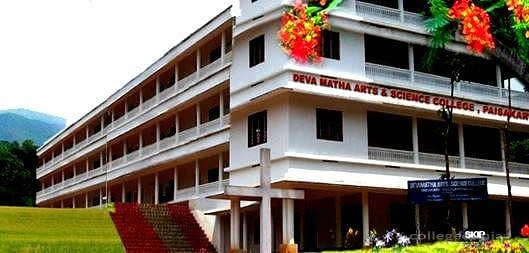
 Auditorium
 Cafeteria
 Computer Labs
 Gym
Gym Hostel
 Medical
 Science Labs
 Sports Complex
 Study Library