Loading Admission Guardian content
Loading Admission Guardian content
Find a program, read its fee details and explore the admission requirements.
Summary of the programs shown below. Fee periods can differ by program. Check the note beside each amount before comparing costs.
| Course | Stream | Fees |
|---|---|---|
| Bachelor of Arts [BA] | Arts | 2210 |
| Bachelor of Science [B.Sc] | Science | 2263 |
| Master of Arts [MA] | Arts | 34016 |
| Master of Science [M.Sc] | Science | 34052 |
| Master of Business Administration [MBA] | Management | 49016 |
Specializations
Eligibility: 10+2
Specializations
Eligibility: 10+2
Specializations
Eligibility: Graduation
Specializations
Eligibility: Graduation
Specializations
All accepted exams
Eligibility: Graduation with 50% + OJEE
1 exam with cutoff data available
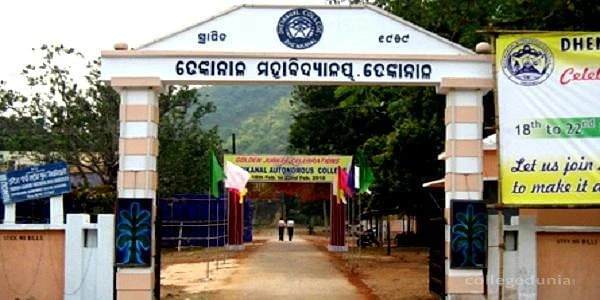
Established back in 1959, Dhenkanal Autonomous College is a government institution that’s become a cornerstone of higher education in central Odisha. It’s the kind of place where the 56-acre campus, nestled at the base of the Kapilas hills, feels more like a sprawling, green retreat than a typical college. With its autonomous status under Utkal University and a Grade 'B++' from NAAC (validity extended post-2021), it operates with a significant degree of academic freedom. For students in the region looking for a solid, affordable education in arts, sciences, or commerce—without the cutthroat competition and sky-high fees of metro city colleges—this is often the first and best choice. Just don’t expect a corporate placement powerhouse; its strengths are deeply rooted in traditional academia and value.
The college offers a broad, traditional curriculum with 33-34 courses across UG and PG levels, catering to an intake of roughly 1,004 undergraduates. You’ve got the standard trio: B.A., B.Sc., and B.Com Honors. The B.Sc. stream is particularly strong, with honors options in Physics, Chemistry, Mathematics, Botany, Zoology, Computer Science, and Biotechnology. The B.A. side covers everything from Economics and History to Odia and Psychology. It’s a classic liberal arts and sciences setup.
At the postgraduate level, M.A., M.Sc., and M.Com programs continue in that vein. The professional courses are where things get more contemporary. The self-financing MBA program (60 seats) and the MSW (Master of Social Work) are the main draws for students with an eye on industry. The faculty, around 101 strong, is a point of pride. A significant chunk are permanent, PhD-holding staff who’ve cleared rigorous state or national commissions like the OPSC or CSIR-NET. That translates to classrooms led by experienced educators, not temporary instructors.
The academic system follows the Choice Based Credit System (CBCS), and the year is split into two semesters. If there’s one department that consistently gets singled out for praise, it’s Botany. Students and reviews often mention the department's dedicated 'Eden' garden and its focused research environment as a standout feature.
This is where you need to separate the brochure from the bench talk. Placements are a tale of two tracks. For students in general B.A., B.Sc., or B.Com programs, on-campus placement is minimal. The realistic placement rate for these streams, as per student reviews, hovers around 20-30%. The college’s official claim of 60-70% placement refers almost entirely to the professional courses—namely, the MBA and, to a lesser extent, B.Sc. in Computer Science.
For those in the MBA program, the picture is brighter. The verified on-campus package range is between ₹4-6 LPA. You’ll see a flashy figure of 20 LPA cited in some places, but that’s widely considered an off-campus outlier, not the norm from college drives. The average package across all placed students typically falls between ₹3.0 and ₹4.0 LPA.
Recruiters are a mix of regional and national names. IT service giants like TCS, Wipro, Infosys, Capgemini, and IBM Daksh show up for pool campus drives. Vedanta is a notable core sector recruiter, and you’ll see education tech firms like Vedantu and local microfinance companies. The college has a Career Counseling and Placement Cell, but student sentiment is clear: the focus is about 90% on academic knowledge and exams, and maybe 10% on proactive career support. Internships are largely student-driven, often via platforms like Internshala, though Vedanta has offered some short-term training opportunities.
The affordability is arguably the college’s biggest draw. For regular government seats in BA, BSc, or BCom, the annual tuition is astonishingly low—between ₹3,500 and ₹4,500. That means your entire three-year degree might cost you just ₹11,000 to ₹14,000. Self-financing courses cost more: B.Sc. in Biotech or Computer Science runs about ₹51,000 for the full course, and the two-year MBA totals around ₹98,020.
Hostel fees add another ₹21,000 to ₹25,000 per year, which covers accommodation but not mess charges. And the mess food, according to countless student reviews, is a consistent pain point described as "horrible" or "not up to the mark."
Where the college shines again is in scholarship access. Odisha state scholarships are widely available. Key ones include the Prerana scholarship for SC/ST/OBC students, the Nua-O scholarship (₹9,000 for boys, ₹10,000 for girls), and merit-based EWS scholarships. This support structure makes higher education genuinely accessible for a huge segment of the local population.
The process is centralized and straightforward, run by the state systems. For all undergraduate programs (B.A., B.Sc., B.Com), admission is strictly merit-based through the SAMS Odisha portal. Your Class 12 marks are the sole ticket. There’s no separate entrance exam for these courses.
For postgraduates (M.A., M.Sc., M.Com), you need to take the state-level CPET (Common PG Entrance Test). Cutoffs aren’t about ranks but minimum percentage scores. For the 2024 cycle, examples include M.A. Odia at 56%, M.A. Economics at 52%, and M.A. English at 47%. These are not overly competitive, reflecting the college's role as a quality regional provider.
The MBA program requires the OJEE (Odisha Joint Entrance Examination). The application window for all these routes typically opens in May and runs through July, with centralized counseling following the exam results.
The campus is universally praised for its environment. Set against the Kapilas hills, it’s lush, green, and peaceful—a great place to focus on studies. Infrastructure is a mix. The Nanak Bhawan (Parija Library) is a solid resource with over 51,150 books. Labs for sciences and computers are adequate, with two computer labs housing about 30 systems each. Wi-Fi is present but reported to be spotty in older buildings.
Hostels—'Kapilas' for boys (capacity 220-300) and 'Upasana' for girls (capacity 164)—are basic. They’re functional, with 2-3 sharing rooms, but maintenance in the older blocks can be an issue, with complaints about bathrooms and water facilities. New blocks have been added, though.
Sports facilities are decent: a large playground, courts for badminton and basketball, and indoor spaces for table tennis and carrom. Social life is typical of a government college in a small town. It’s not a "happening" metro campus, but there are societies and events. A notable negative that pops up in reviews is occasional student politics, with campus elections sometimes bringing "outside interference" that can disrupt the calm.
Scouring platforms like Shiksha and CollegeDunia reveals a clear consensus. The positives are strong: Academic rigor and faculty quality top the list. Reviews often say teachers are "highly qualified" and treat students "like their own children." The natural beauty and serene atmosphere of the campus get repeated mentions. And the affordability is a huge win, with many calling it the best "value for money" college in the region. The Botany department, in particular, is highlighted as exceptional.
The criticisms are just as consistent. Hostel food is the number one complaint, almost universally panned. Infrastructure maintenance in older buildings is another gripe. The biggest career-oriented critique is the placement gap—students feel utterly unprepared for the job market, wishing for more corporate interaction and soft-skills training. While the placement cell exists, its impact is felt most by MBA and CS students, leaving arts and science grads to fend for themselves.
It depends entirely on what you’re after. If you are a student from Odisha or the surrounding region looking for a reputable, government-run college to earn a traditional degree in arts, science, or commerce without taking on debt, Dhenkanal Autonomous College is an excellent choice. The faculty is qualified, the campus is conducive to study, and the cost is almost unbeatable. It’s perfect for those aiming for government service exams, teaching, or further academic pursuits like an M.Sc. or PhD.
However, if your primary goal is a campus that guarantees a corporate job placement right after graduation, you’ll likely be disappointed unless you’re in the MBA program. The placement support for general degrees is minimal. It’s also not the place for a glamorous, metropolitan campus life. Think of it as a serious academic institution with deep local roots and fantastic value, but one that leaves the job hunt largely in your own hands. For the right student, that’s a more than fair trade-off.
In this preview: 1 photo · 0 videos
Yes, Dhenkanal Autonomous College is considered a good, cost-effective option for an MBA. It features a newly renovated department and offers decent local placement opportunities, especially when compared to general degree programs.
Admission to the B.Sc. program is conducted strictly through the SAMS Odisha online portal. Selection is based on the candidate's Class 12 marks.
The annual hostel fee for girls is approximately ₹24,900. It is important to note that this fee does not include the monthly mess bills.
Yes, the college has a Career Counseling and Placement Cell. It is most active and effective for students pursuing MBA and Computer Science degrees.
Yes, attendance is mandatory. As an autonomous government college, it requires students to maintain a minimum of 75% attendance to be eligible to appear for the semester examinations.
Share what future students should know about Dhenkanal Autonomous College.
Student voices are not rewritten by colleges. We remove spam and abuse.
Wider admission question? Community PulseWhat should future students know?
Tell us which course you're considering. We'll help you work out the next step.
Get instant Partner access after mobile verification. Your public edits are reviewed before they go live.
Claim this college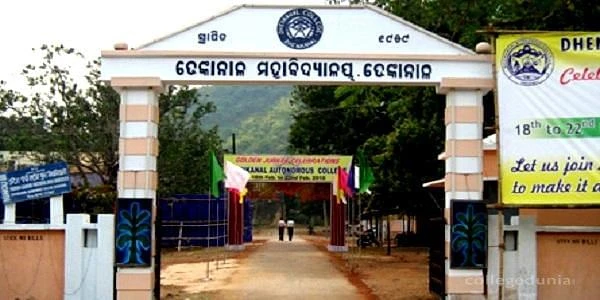
 Auditorium
 Cafeteria
 Computer Labs
 Medical
 Science Labs
 Study Library