Loading Admission Guardian content
Loading Admission Guardian content

Find a program, read its fee details and explore the admission requirements.
Summary of the programs shown below. Fee periods can differ by program. Check the note beside each amount before comparing costs.
| Course | Stream | Fees |
|---|---|---|
| Bachelor of Arts [BA] {Hons.} | Arts | 5105 |
| Bachelor of Commerce [B.Com] {Hons.} (Accounting and Finance) | Commerce | 5465 |
| Bachelor of Science [B.Sc] | Science | 7765 |
| Master of Arts [MA] (Bengali) | Arts | |
| Master of Science [M.Sc] (Zoology) | Science |
Specializations
Eligibility: 10+2
Specializations
Eligibility: 10+2
Specializations
Eligibility: 10+2
Specializations
Eligibility: Graduation
Specializations
Eligibility: Graduation
Egra SSB College is a government institution that’s been serving students in Purba Medinipur since 1968. It’s a classic example of a regional college that’s built its reputation on affordability and accessibility, not flashy rankings. With a sprawling 5-6 acre campus on the outskirts of Egra, about 35 km from the beach town of Digha, it’s a significant educational hub for the district. The college is affiliated with Vidyasagar University and holds a NAAC ‘B’ grade with a CGPA of 2.32. That’s a decent score for a state-run college, reflecting a baseline of quality. You won’t find it on the NIRF rankings, and that’s okay—its value proposition is different. It’s about providing a solid, low-cost arts and science education to local students who might not have the means or the inclination to migrate to Kolkata. The vibe is functional, not fancy. And for many families in the region, that’s exactly what’s needed.
The academic offering here is broad and traditional, covering the standard arts, science, and commerce spectrum you’d expect from a well-established government college. It’s a three-year degree system under Vidyasagar University.
Undergraduate programs are split into Honours and General streams. For BA, Honours specializations include Bengali, English, History, Political Science, Philosophy, Sanskrit, Geography, Music, and Physical Education. The BA General program covers a similar range. On the science side, BSc (Honours) is offered in Geography, Mathematics, Physics, Chemistry, Botany, Zoology, Nutrition, and Computer Science. There’s a B.Com (Honours) in Accountancy. They’ve also introduced some vocational B.Voc programs in Software Development, Renewable Energy Management, and Theatre Studies, which is an interesting, practical addition.
At the postgraduate level, options are more limited, with an MA in Bengali and an MSc in Zoology. Doctoral programs aren’t explicitly listed.
The faculty count is a mix—11 teachers, 36 lecturers, and various contractual and associate professors. Student reviews often mention faculty being “experienced,” which in a government college context usually means seasoned educators who know the university syllabus inside out. The teaching style is likely to be conventional.
A notable academic feature is the Coastal Environmental Studies Research Centre. It’s not just a name; it has dedicated labs with some serious equipment like HPLC, Fluorescent Microscopes, and a UV-VIS Spectrophotometer. For a college in a coastal district, this is a smart, location-relevant specialization. The Computer Science department has its own seminar library and two labs with high-speed internet. They organize seminars and special lectures, and there’s a tie-up with Netaji Subhas Open University to extend study options.
This is where you need to read between the lines. The official line is that placement assistance is a “core focus” and opportunities are “varied,” spanning corporates, the public sector, and entrepreneurship. They claim a highest package of 12 LPA and an average of 4.5 LPA, with over 200 recruiters in their network.
That sounds promising. But here’s the reality check: detailed placement reports or long lists of top-tier company names aren’t publicly prominent. The data is thin. In colleges like this, placement is often driven by individual department efforts and student initiative rather than a high-powered, centralized corporate relations cell. The 4.5 LPA average is a believable figure for regional recruiters and government job entry. The 12 LPA is likely an outlier, perhaps for a standout student in Computer Science or through off-campus drives.
Students shouldn’t enroll here expecting a guaranteed corporate job pipeline. The value is in the degree and the extremely low cost. Placement should be viewed as a potential bonus, not the primary draw. The college does have MoUs with banks and firms for skill development and partners with organizations like Hulladek Recycling for e-waste management projects, which can lead to practical exposure.
This is arguably the college’s strongest suit. The fees are remarkably low, even by West Bengal government college standards.
For the 2025-26 cycle, the total tuition fee for an entire three-year BA (Hons) Bengali program is around ₹18,105. That’s roughly ₹6,000 per year. For BSc (Hons) Botany, the three-year total is similar. B.Com (Hons) Accountancy is listed at ₹15,115 for three years. When you see fees this low, it changes the entire cost-benefit analysis. You can find the detailed fee structure on the college's official website.
Hostel fees are extra and vary by accommodation type. For 2026, a triple-sharing room with mess charges totals about ₹24,000 per year. Double sharing is ₹28,000, and single sharing is ₹36,000. A student review mentioned paying around ₹1,500 per month, which aligns with these figures. The hostels are described as non-AC but furnished with a bed, table, chair, and wardrobe. Discipline is said to be strict, and food quality is reported as good.
Financial aid is a big deal here. The college actively facilitates government scholarships like the SVMCM (Swami Vivekananda Merit Cum Means Scholarship), OASIS, and post-matric scholarships for SC, ST, and OBC students. They also provide special financial academic care to non-creamy layer minority community students. For a student from a middle-class or economically weaker family, this support system can make college education virtually free.
The process is straightforward and merit-based. There are no entrance exams for UG or PG courses.
Admission is based purely on your marks in the qualifying examination—Class 12 marks for UG, graduation marks for PG. The college generates merit lists based on the volume of applications and the academic performance of the pool. Specific cutoff percentages aren’t published widely; they fluctuate year-to-year depending on applicant competition. For popular Honours programs like Bengali or Botany, the cutoffs will naturally be higher.
The application process is online. For the 2025 cycle (tentative), UG applications were slated to open July 1st, with PG applications starting August 1st. The application fee is described as “not so much,” which fits the college’s affordable ethos. After application submission, merit lists are published, followed by a counseling round for document verification and seat allotment.
There is no mention of an NRI or management quota. It’s a transparent, marks-based system.
The campus is sizeable, between 5.2 and 6 acres. The infrastructure is a mix of older administrative buildings and newer facilities. They have smart classrooms, ICT-enabled rooms, a seminar hall, and an auditorium. Power backup is handled by two sound-proof generators, and there’s a 10 KV rooftop solar panel installation—a thoughtful touch.
The library, established in 1968, spans about 5000 sq ft and has an OPAC system. Reviews note scope to strengthen e-resources, which is a common gap in many government colleges.
Sports facilities include an Outdoor & Indoor Stadium. There’s a canteen, and a medical unit is set up on campus. The college is connected by state highways; the nearest major railway stations are Contai (30 km) and Belda (32 km). Kolkata is about 180 km away by road.
A recurring point in student feedback is that while facilities are “good,” they can feel “inadequate… in comparison to the number of admitted students.” That’s a classic challenge for popular government colleges—infrastructure stretches to meet demand. Labs are described as well-equipped, particularly the research centre, but might get crowded.
Social life likely revolves around college events, departmental seminars, and sports. It’s not a “campus life” college in the residential university sense. Most students are likely from the surrounding regions, creating a familiar, local atmosphere.
Getting a loud, clear consensus is tough because detailed public reviews (on Reddit, Quora) are scarce. Sentiment from platforms like CollegeDekho and CollegeDunia is limited but points to a clear pattern.
The positives are consistent: affordability and adequate facilities. Students from middle-class families repeatedly highlight the low fees and availability of scholarships as the biggest plus. The hostel gets good marks for maintenance, discipline, and food. The faculty is generally respected.
The main criticism, as noted, is infrastructure strain relative to student intake. It’s a capacity issue, not a quality one.
No one is raving about glamorous placements or a vibrant party scene. The reviews paint a picture of a no-frills, value-for-money institution that does its core job—providing an accredited degree at a minimal cost—quite well. Alumni aren’t complaining about being in debt, and that counts for a lot.
It depends entirely on what you’re looking for.
Egra SSB College is an excellent, pragmatic choice for:
You should probably look elsewhere if:
In essence, Egra SSB College understands its role. It’s a community pillar. It provides affordable, quality higher education to the region it serves. It won’t dazzle you, but it will educate you without burdening your family financially. For thousands of students over the decades, that’s been more than enough. You can check its official NAAC accreditation status on the NAAC website for the latest grade details.
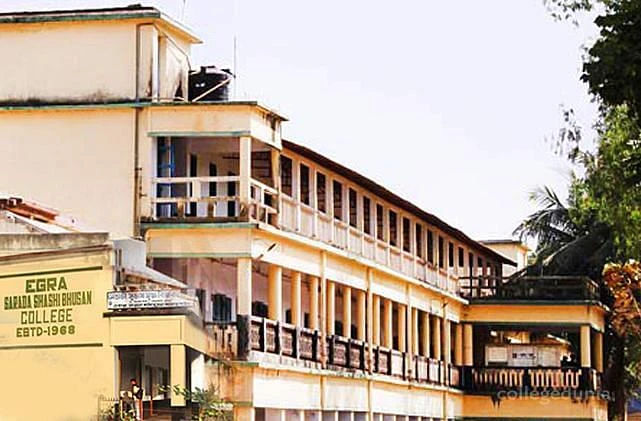
In this preview: 1 photo · 0 videos
Egra SSB College offers a standard suite of three-year undergraduate degrees under Vidyasagar University. Key UG programs include BA (Honours) in subjects like Bengali (189 seats), English, History, and Political Science; BSc (Honours) in Botany (49 seats), Chemistry, Physics, Zoology, and Computer Science; and B.Com (Honours) in Accountancy. They also have BA/BSc General streams and newer B.Voc courses. At the postgraduate level, options are currently limited to an MA in Bengali and an MSc in Zoology.
Admission is strictly merit-based. There are no entrance exams. Your Class 12 marks (for UG) or graduation marks (for PG) are the sole criteria. The college publishes merit lists based on applicant performance each year. The process is online: you submit an application during the window (typically July for UG, August for PG), await the merit list, and then attend a counseling session for document verification and seat allotment. It's a transparent, marks-driven system.
Fees are exceptionally low. For the 2025-26 academic years, the total tuition for a full three-year BA or BSc (Hons) program is approximately ₹18,000 to ₹22,600. That's roughly ₹6,000-₹7,500 per year. Hostel fees, including mess charges, range from ₹24,000 per year for triple-sharing to ₹36,000 for single-sharing. Additional mandatory fees like exam and library charges are around ₹1,500-₹2,500 annually.
The college reports an average placement package of 4.5 LPA and a highest package of 12 LPA, with a network of over 200 recruiters. However, placement is described as "varied" and includes corporate, public sector, and entrepreneurship avenues. It's important to have realistic expectations: detailed placement reports are not heavily publicized, and for many students, this government college serves as a quality, affordable stepping stone to further studies or government job exams, rather than a direct corporate pipeline.
The 5-6 acre campus features smart classrooms, a library with an OPAC system, and well-equipped labs. A standout facility is the Coastal Environmental Studies Research Centre, which has advanced instruments like HPLC and fluorescent microscopes. There are two computer labs with high-speed internet, an auditorium, a medical unit, and a canteen. Sports facilities include an Outdoor & Indoor Stadium. Hostels are available and are described as well-maintained with strict discipline. The campus has power backup and solar panels.
Share what future students should know about Egra SSB College.
Student voices are not rewritten by colleges. We remove spam and abuse.
Wider admission question? Community PulseWhat should future students know?
Tell us which course you're considering. We'll help you work out the next step.
Get instant Partner access after mobile verification. Your public edits are reviewed before they go live.
Claim this college
 Auditorium
 Cafeteria
 Computer Labs
 Science Labs
 Study Library