Loading Admission Guardian content
Loading Admission Guardian content

Provisional score based on available data. It may change as more information is verified.
Selected ranking categories, with the recorded year beside each result. Open all records for the complete history.
3 published records · Lower numeric ranks are stronger
Find a program, read its fee details and explore the admission requirements.
Summary of the programs shown below. Fee amounts are not listed. Contact the college for its current fee schedule.
| Course | Stream | Fees |
|---|---|---|
| Bachelor of Arts [BA] | Arts | |
| Bachelor of Commerce [B.Com] | Commerce | |
| Master of Commerce [M.Com] | Commerce | |
| Bachelor of Science [B.Sc] | Science | |
| Master of Science [M.Sc] | Science |
Specializations
Eligibility: 10+2
Specializations
Eligibility: 10+2
Specializations
Eligibility: Graduation
Specializations
Eligibility: 10+2
Specializations
Eligibility: Graduation
Government Arts College in Tiruvannamalai is a classic example of what a state-run institution can offer when the focus is on access, not exclusivity. With an annual tuition fee that often stays under INR 2,500, it provides a legitimate pathway to a degree for thousands of students in the region. Its 40-acre campus, set against the Arunachala Mountain, houses a functional academic ecosystem that has been operating since 1966. The college, affiliated with Thiruvalluvar University, holds a NAAC-B grade and consistently ranks in the 151-300 band in the NIRF Colleges category. For students whose primary filter is affordability, this is a compelling starting point.
The academic portfolio here is broad and traditional, covering the core arts, science, and commerce streams. You won't find niche specializations, but you will find the foundational degrees that still form the bedrock of higher education in the state.
Undergraduate programs (B.A., B.Sc., B.Com, BBA) run for three years with sizable intakes—typically 180 to 200 seats per major. That's a lot of students, which speaks to its role as a mass educator. Specializations are standard: B.A. in English, Tamil, History, Economics; B.Sc. in Physics, Chemistry, Mathematics, Botany, Zoology, and Computer Science; and B.Com with options in Commerce and Computer Applications.
Postgraduate and research programs follow suit. M.A., M.Sc., and M.Com programs have smaller cohorts of 20-40 seats. The college also offers a one-year M.Phil. and full Ph.D. programs across most departments, with just 2-5 seats each. It's a modest research footprint, but it's there.
A practical feature is the morning and evening batch system, which likely helps manage the large student body and accommodates different schedules. Faculty strength was listed at 89 as of 2019, with department heads holding advanced degrees. The teaching feedback, which we'll get to, is generally positive, which is a significant asset for an institution at this fee level.
This is where you need to calibrate expectations sharply. The official placement narrative and the ground-level student sentiment don't fully align, which is common but important to note.
The hard data from the NIRF 2024 report gives a sober baseline. For the 2022-23 batch, the median package for UG three-year programs was INR 2.41 lakhs per annum (LPA). For two-year PG programs, it was INR 3.12 LPA. The highest packages mentioned in reviews hover around INR 3-4 LPA, with an average range of INR 1.5-2.5 LPA.
Now, the placement percentage. One unverified student review claims "almost 93%" get placed. Others immediately counter that, suggesting a more realistic 30-50% of students secure on-campus offers. That gap is notable. The truth likely sits somewhere in between, heavily dependent on the program. A B.Sc. Computer Science graduate probably has better odds than a B.A. History student.
Recruiters are a mix of "government tie-up companies," local firms, banks, and educational institutions. TCS is named, along with other MNCs, but the roster isn't vast. This isn't a campus where top-tier consulting firms or tech giants queue up. Placement support exists, but students should plan for proactive job hunting. The ultra-low fee does offset the modest placement outcomes, but it's a trade-off you must acknowledge upfront.
This is the college's undisputed strongest card. The affordability is staggering by today's standards.
For the 2025 academic year, annual tuition for UG programs under the government quota is between INR 1,000 and INR 2,000. Postgraduate fees are INR 2,000 to INR 4,000. Even Ph.D. programs cost just INR 5,000 to INR 10,000 per year. One review from 2023 stated the total annual fee was around INR 2,300. That's not a monthly payment; that's for the whole year.
Hostel fees add to the cost, ranging from INR 10,000 to 30,000 annually depending on facilities, with mess fees separate. A refundable caution deposit of ₹5,000 is also required at admission.
Where the college truly supports its student demographic is through scholarships. It facilitates access to all major government schemes: fee waivers and stipends for SC/ST/OBC students, merit-based awards, financial aid for Economically Weaker Sections (EWS), and minority scholarships. For eligible students, the already low cost can drop to near zero.
The process is straightforward and entirely merit-based. There are no entrance exams for undergraduate or most postgraduate courses.
Admission hinges on your 12th standard (HSC) marks. The higher your percentage, the better your chance. The college follows standard Tamil Nadu government reservation policies. Unverified student reviews mention a general cutoff mark of around 230 out of 300, with more competitive programs like B.Sc. Computer Science requiring over 300. These numbers aren't official but give a ballpark.
The application window typically opens in May, with a June deadline. Merit lists come out by June-July, and classes start in July-August. You'll need your academic transcripts, identity proof, and photos for verification.
For Ph.D. admissions, it's a different process involving shortlisting based on your master's academic record followed by an interview. There's no mention of management or NRI quotas—seats are allocated as per government norms.
For a government college, the infrastructure receives consistently good marks from students. The 40-acre campus is described as green and spacious. Classrooms are reportedly "smart" and digitalized. The labs—all 14 of them—are called well-equipped and spacious for practical work.
The library is a standout, not just for its collection but for its inclusivity. It's equipped with JAWS software, reading machines, and Braille printers for visually impaired students.
Hostels have separate facilities for boys and girls. Rooms come with basic furniture: a bed, study table, almirah, and fan. The food in the canteen and mess gets positive reviews for being hygienic and nutritious. A 500-seater auditorium with audio-visual systems hosts events. Sports facilities cover outdoor fields, courts, indoor games, and a basic gym. Wi-Fi is available across campus, and there's college transport. Medical first-aid and ambulance services are also noted.
Social life seems active but not overwhelming. Students mention clubs, cultural and academic events, and the simple benefit of forming good friendships. The college's location on the main road with good bus connectivity makes it accessible.
Synthesizing the feedback, a clear consensus emerges on strengths and a few critical realities.
The Positives are Loud and Clear:
The Critical Reality Check:
It depends entirely on what you're looking for. If your primary constraint is budget and your goal is to earn a reputable, accredited bachelor's or master's degree with minimal financial burden, this college is an excellent, pragmatic choice. The value-for-money is exceptional: you get decent infrastructure, reportedly good teachers, and a full campus experience for a yearly fee that's less than a month's rent in a metro city. The scholarship ecosystem further sweetens the deal for eligible students.
However, if your primary goal is high-paying, assured campus placements or cutting-edge academic specializations, you'll likely be disappointed. The placement outcomes are modest, and the programs are traditional. This college serves as a solid launchpad for government exams, further studies (like a PG or B.Ed.), or for entering the local job market where a degree is a prerequisite. It's best for students who are cost-conscious, self-motivated, and view the degree as a foundational step rather than a direct ticket to a corporate career. For that specific, large demographic, it's undoubtedly worth it.
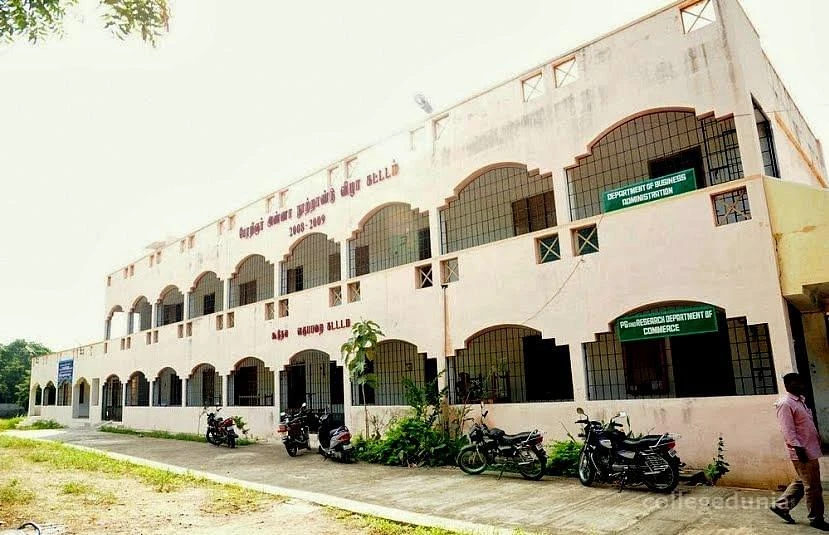
In this preview: 1 photo · 0 videos
Admission to UG programs is strictly merit-based, using your 12th standard (HSC) marks. No entrance exams are required. The process starts with an application in May-June. After the deadline, a merit list is published. Selected candidates then submit documents for verification and pay the fee to confirm their seat.
Tuition fees are extremely low. For 2025, UG program fees are INR 1,000–2,000 per year. PG programs cost INR 2,000–4,000 annually. Hostel fees are extra, ranging from INR 10,000 to 30,000 per year depending on the room, with mess charges paid separately.
Placement outcomes are modest. According to the official NIRF 2024 report, the median package for UG graduates is INR 2.41 LPA. The highest packages reach around INR 3-4 LPA. Recruiters include local firms, banks, and some government-tied companies like TCS. Student reviews suggest placement rates vary significantly by program.
The college facilitates access to all major Tamil Nadu and Central Government scholarship schemes. These include full fee waivers and stipends for SC/ST/OBC students, merit-based awards, financial aid for Economically Weaker Sections (EWS), and minority scholarships. Eligible students can significantly reduce or eliminate their educational costs.
The 40-acre campus has good infrastructure, including smart classrooms, well-equipped labs, and a library with special assistive technology. Hostels are separate for genders, with furnished rooms (bed, table, almirah). The canteen and mess serve hygienic food. Facilities also include sports grounds, a gym, Wi-Fi, and college transport.
Share what future students should know about Government Arts College.
Student voices are not rewritten by colleges. We remove spam and abuse.
Wider admission question? Community PulseWhat should future students know?
Tell us which course you're considering. We'll help you work out the next step.
Get instant Partner access after mobile verification. Your public edits are reviewed before they go live.
Claim this college
 Auditorium
 Cafeteria
 Computer Labs
 Medical
 Science Labs
 Sports Complex
 Study Library