Loading Admission Guardian content
Loading Admission Guardian content

3 programmes · 1 institution. Check the admission year and requirements.
3 programmes · 1 institution. Check the admission year and requirements.
IIM Amritsar is a public management institute established in 2015 under the Ministry of Education, with support from the Government of Punjab. Its current official overview describes a split institutional footprint: academic sessions take place at the Manawala campus, while some administrative functions remain in the Punjab Institute of Technology building. Applicants should account for these as separate locations when planning a campus visit or asking about transport.
The institute offers a general MBA, an MBA in Business Analytics (MBA-BA), an MBA in Human Resources (MBA-HR), an Executive MBA, a five-year Integrated Programme in Management (IPM), a doctoral programme in Business and Management, and an MSc in Data Science and Management offered with IIT Ropar. These routes differ in audience and structure, so the right comparison is programme-specific rather than a single institution-wide claim about seats, fees or admissions.
Before shortlisting, write down the qualification you want and the work you hope to do after it. A candidate seeking broad management preparation can compare the general MBA curriculum with the more focused MBA-BA and MBA-HR routes. Someone who needs an executive schedule should check the Executive MBA page directly rather than assume it follows the same residential calendar. An applicant considering an integrated or research route should review its own progression, degree and supervision terms; the two-year MBA policies do not answer those questions.
The institute’s programme list is a starting point, not a substitute for the current programme brochure. Check the award name, duration, mode, course structure and any joint-institute responsibilities in the notice for your intended intake. For the MSc route, verify which institution handles each part of the application and who awards the degree. For IPM, ask how the five-year structure is organised and which rules govern movement into later stages. For doctoral study, compare research areas with your proposal and confirm whether a relevant supervisor is accepting candidates. The reviewed overview confirms that these routes exist, but it does not settle each of those operational details.
The MBA, MBA-BA and MBA-HR are the clearest like-for-like options for applicants choosing a full-time management degree. The MBA is framed as general management; MBA-BA explicitly develops analytical methods and data-driven decision-making; MBA-HR focuses on HR strategy and workforce questions. This distinction is visible in the institute’s programme descriptions and admissions policies. The Executive MBA and IPM have separate candidate profiles and should not be treated as alternate names for the two-year MBA.
The latest official MBA, MBA-BA and MBA-HR admission policies reviewed here are for the 2026-28 batch and use CAT 2025. They give minimum section-wise and overall percentiles for the first shortlist, require positive raw scores in all CAT sections, and then rank eligible candidates through programme-specific composite scores. The three programmes share the same CAT 2025 first-shortlist percentile table, but MBA-HR uses a different pre-PI weighting from the MBA and MBA-BA routes. Meeting a minimum percentile is not itself a PI invitation or an offer.
The institute states that selection criteria and weights are decided annually. Therefore, CAT 2025 thresholds, score weights and dates should be read as 2026-28 policy evidence, not as the 2027-29 rules. The official programme admissions pages, MBA-BA policy and MBA-HR policy are the sources to revisit when the next batch notice appears. Do not infer a future cutoff from the older tables or third-party estimates.
When the new notice is released, read the whole programme-specific policy rather than relying on a single percentile number. Separate eligibility conditions from the shortlist formula, and the shortlist formula from the final selection formula. Confirm the required CAT year and whether every section must meet a minimum; then check how academic record, work experience, interview and other components are treated for that programme. Keep a copy of the applicable notice and note its publication date, because a revised document can supersede an earlier one. If two programme pages differ, use each route’s own policy and ask admissions to resolve any ambiguity before submitting an application.
The latest fee schedule reviewed is the institute’s notional schedule dated 10 April 2026 for the 2026-28 batch. It covers MBA, MBA-BA and MBA-HR. It lists a ₹19.50 lakh programme fee across two years; separately listed caution and mess deposits bring the stated total payment to ₹21.50 lakh. That schedule is a dated reference for the named batch, not a confirmed amount for 2027-29. It also distinguishes the programme fee from deposits, so applicants should not treat the full payment figure as tuition or assume every deposit has the same refund terms.
For a realistic affordability comparison, separate the programme fee from deposits and from living costs that the schedule may not include. Ask for the payment calendar, the amount due at acceptance, instalment dates, deposit refund rules and any charges that sit outside the stated schedule. If you are comparing two programmes, verify that both figures cover the same batch and the same items before treating them as comparable. A total-payment line is useful for cash-flow planning, but it does not by itself describe net cost after scholarships or establish the amount of any future intake’s fee.
IIM Amritsar’s fee and scholarship page describes a limited number of institute and corporate-sponsored awards based on academic performance, including awards for the highest CGPA in each of the three MBA routes and awards for top-ranked students across the combined programmes. The page says the scholarship amount equals the full tuition fee for the year awarded. It also describes a need-based scholarship buffer considered case by case and points students to ministry scholarships. These are eligibility-dependent supports, not a fee reduction guaranteed to every student. For loans, the institute directs applicants to contact banks about eligibility, interest rates and conditions.
Treat scholarship information as possible application routes rather than money already deducted from the invoice. Confirm how academic ranking is calculated, when awards are announced, whether a student must apply separately and what documents support a need-based request. For an external or ministry scheme, verify its own eligibility and application calendar; the institute’s reference to a scheme is not confirmation that a particular applicant qualifies. Compare loan offers using the lender’s current interest rate, repayment start, collateral conditions and total repayment, since those terms are set by the bank and can change independently of the institute’s fee schedule.
In the NIRF Management category, IIM Amritsar was ranked 64th in the 2025 edition. This is a dated national ranking, not a measure of an individual applicant’s likely outcome. Check the ranking edition and category before comparing institutions, and do not describe the 2025 result as a 2027 ranking.
Use rankings as one input alongside curriculum, location, cost and the specific outcomes that matter to you. A rank is meaningful only when the category and edition match; comparing a Management result with a ranking from another category or year can mislead. It also cannot tell you whether a programme’s specialisation, learning environment or placement profile fits your goals. If you make a comparison table, record the rank source and year in its own column and keep claims from different editions separate.
The institute’s latest final-placement summary reviewed here is for the MBA 2024-26 batch. It reports a graduating cohort of 256 and a highest CTC of ₹43 lakh per annum. The reported average and median figures are for the top 50 students and the top 50% of the batch, not for the whole graduating class. The summary does not state the number of students placed, the overall placement rate, or an overall-batch average or median. For a prospective student, those omissions matter: a maximum or top-subgroup figure cannot stand in for a typical outcome across the cohort.
The institute’s placement page and its linked report are the source for this MBA summary. Read compensation by the exact subgroup named in the report; do not substitute these top-group figures for an overall-batch average or median.
For a careful placement comparison, note the programme, graduating cohort and denominator beside every number. The highest package describes a single maximum; a top-50 average or median describes only the named group; and a top-50%-of-batch measure uses a different population again. None is interchangeable with a full-cohort median. Ask whether a report provides placed-student counts, the eligible cohort, the number seeking placement, sector and role mix, and domestic versus international compensation. Those details help distinguish reported coverage from individual prospects. The current summary does not answer all of these questions, so applicants should request the latest complete report if the missing denominator affects their decision.
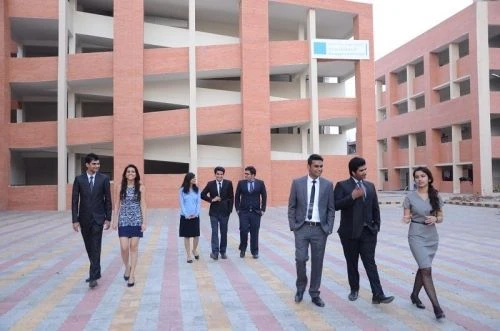
The Manawala campus page describes smart classrooms, tiered lecture halls, seminar rooms, a digitised library, student hostels, an operational health centre and cafeteria. It identifies the gymnasium and indoor sports complex as planned for a later expansion phase, so they should not be counted as confirmed operating facilities based on the page. The current overview also says that some administrative functions remain at the Punjab Institute of Technology building.
There is a specific point applicants should verify: the campus page describes hostels at Manawala, while a separate hostel page still places the hostel in Blessing City. The latter page also describes twin-sharing flats, room furnishings, Wi-Fi, a mess and recreation amenities. Because the published location descriptions differ, confirm the exact residence, occupancy, included amenities, mess charges and any travel arrangement for the incoming batch directly with the institute. The sources reviewed do not establish shuttle routes, frequency, cost or current room allocation.
If you visit, ask the institute to distinguish facilities available on the academic campus from accommodation and services at the residence. Confirm the address for classes, orientation and reporting separately, especially while academic and administrative functions are described at different sites. Prospective students who depend on a specific amenity should ask whether it is open now, whether access is programme-wide and whether any fee applies. The campus page’s planned expansion language is not a completion commitment, and the pages reviewed do not establish a delivery date for the gymnasium or indoor sports complex.
The institute’s library page lists books, journals, magazines, cases, videos and newspapers, with remote access through RemoteXs and links to the OPAC and MyLOFT catalogues. It also names a range of databases and publishers. The list helps prospective students understand the breadth of resources advertised, but it does not specify which subscriptions are active for every programme or how access works before enrolment. Ask the library about current subscriptions and access instructions if a particular database matters to your study plan.
The next batch’s admission criteria, dates, category-wise shortlist thresholds, final-year completion deadline, total fee and hostel arrangements were not established by the current documents reviewed here. For a 2027-29 decision, confirm those in the next official batch notice and a written fee schedule. Compare the MBA routes by curriculum and policy, read placement statistics by cohort and denominator, and verify the campus and residence details for your assigned batch. The evidence above gives a dated starting point, not a promise that last year’s terms will continue.
Loading programmes and admission routes.
Selected ranking categories, with the recorded year beside each result. Open all records for the complete history.
34 published records · Lower numeric ranks are stronger
Outlook
Management · public
#122025
IIRF
Management · public
#232025
Outlook
MBA · public
#212023
Find a program, read its fee details and explore the admission requirements.
Summary of the programs shown below. See each program's fee period below.
Showing 5 courses
Specializations
Eligibility: Graduation
Specializations
Listed entrance exams
Eligibility: Graduation + CAT
Eligibility: Graduation
Eligibility: 10+2
Specializations
Eligibility: Post Graduation
1 exam with cutoff data available
 Accenture
 Adani group
 Amazon
 Bisleri
 Byju's
 Canara Bank
 Crisil
 Dell
 Emami Limited
 Ernst & Young
 Fiitjee Group
 HDFC Bank
 HFCL
 ICICI Lombard
 Infosys
 JK Technosoft
 Kent
 KPMG
 L&T Ltd.
 Maruti Suzuki
 Mind Tree Limited
 Motilal Oswal
 Mphasis
 Oyo Rooms
 Pidilite Industries
 Polycab
 Protiviti Consulting Pvt. Ltd.
 Reserve Bank of India
 SBI
 ShopClues.com
 Tata Steel
 Tech Mahindra
 Thomas Cook
 Tolaram Corporation Pte Ltd
 Virtusa
 Walmart

In this preview: 5 photos · 0 videos
The total program fee for the MBA (2025-27 batch) is INR 21,50,000. This amount covers tuition, hostel accommodation (twin-sharing), and academic support fees. Mess food is paid separately via a deposit of approximately INR 75,000, which covers daily meals and snacks. So, the all-inclusive cost for the two years, factoring in the mess, is roughly INR 22.25 lakhs.
For the 2024 final placements, the average package was INR 19.73 LPA, with a median package of INR 15 LPA. The highest domestic package offered was INR 28 LPA, and the highest international package was INR 58.52 LPA. The institute has shown consistent growth, with the average package rising from INR 12.67 LPA in 2021.
The CAT 2025 first-shortlist policy for the 2026-28 batch lists the General minimums for MBA, MBA-BA and MBA-HR separately: QA 80, DILR 75, VARC 80 and overall 90 percentile. The published table does not list a lower MBA-HR minimum of about 85. These are first-shortlist eligibility thresholds, not a guarantee of an interview call or admission. Final selection uses a separate programme-specific score formula; consult the official policy for the relevant batch rather than applying the old 50% PI shorthand.
IIM Amritsar identifies Manawala as the campus where academic sessions are held, while some administrative functions remain at the Punjab Institute of Technology building. Its campus page describes a 60-acre site and lists operational and planned facilities separately. The old answer’s 2025-27 transit-campus prediction is outdated; the public pages do not confirm where a future incoming batch will be assigned, so check the institute’s latest instructions for your term.
Student reviews indicate the hostel facilities are good. They offer fully furnished, twin-sharing rooms (with AC options) in a 2 BHK apartment-style setup. Amenities include 24/7 high-speed Wi-Fi, a gym, TV rooms, and housekeeping. The main critique isn't the hostel quality but its location, which requires a commute to the academic blocks. The mess serves four meals a day, with a night canteen also available.
About IIM Amritsar.
Colleges cannot rewrite published reviews. We remove spam and abuse.
Ask the communityWhat should future students know?
Tell us which course you're considering. We'll help you work out the next step.
Get instant Partner access after mobile verification. Your public edits are reviewed before they go live.
Claim this collegeProgramme information: Official source · Source as of: 2026-11-04
Each route applies only to this named programme and the stated year.
CAT: Common Admission Test · 2026-28
Admission-route evidence:
Programme information: Official source · Source as of: 2026-11-04
Each route applies only to this named programme and the stated year.
CAT: Common Admission Test · 2026-28
Admission-route evidence: Official source · Source as of: 2026-11-04
Programme information: Official source · Source as of: 2026-11-04
Each route applies only to this named programme and the stated year.
CAT: Common Admission Test · 2026-28
Admission-route evidence: Official source · Source as of: 2026-11-04
3 recorded programmes · 1 institution. Admission years and conditions apply to the named programme.

 Auditorium
 Cafeteria
 Campus Wi-Fi
 Computer Labs
 Hostel
 Medical
 Sports Complex
 Study Library