
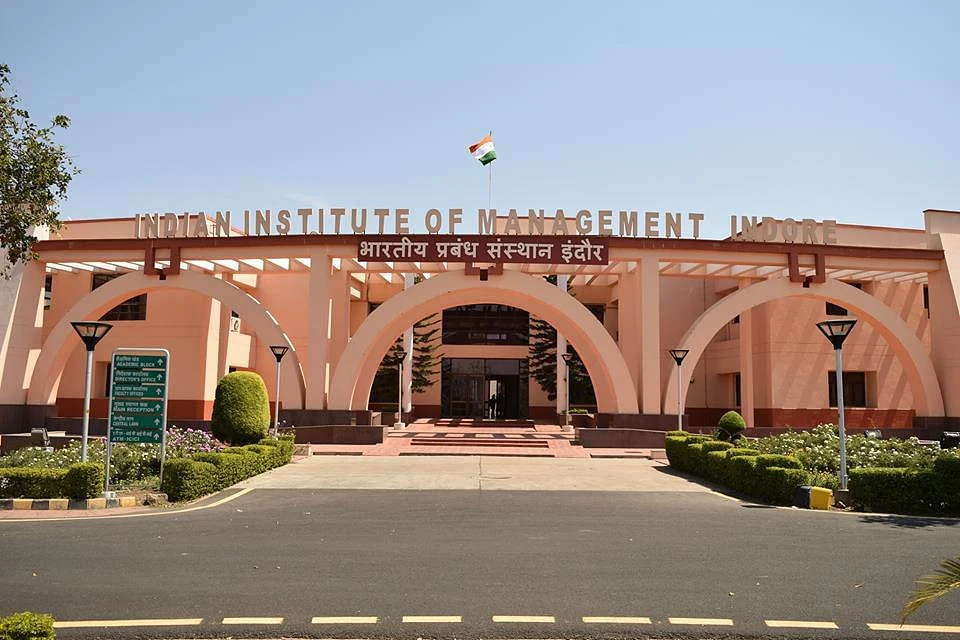
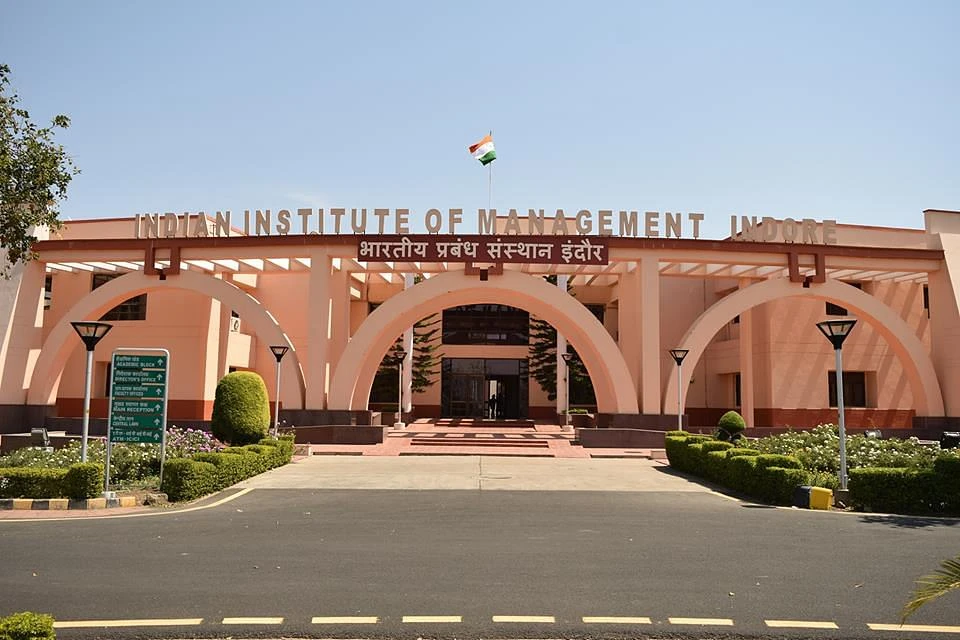






IIM Indore admissions: CAT and IPM routes
IIM Indore has two distinct admission routes for its main management degrees. Graduates apply to the two-year PGP, described by the institute as an MBA, through CAT. Students applying after Class XII use the Five-Year Integrated Programme in Management (IPM) route and its aptitude test. Experienced professionals can also consider the separate one-year EPGP, for which IIM Indore currently lists a 2027–28 admission process. These routes have different eligibility rules, exams, stages and score formulas, so do not use one programme’s cutoff or selection weights to estimate another’s.
This article is in the 2027–28 content edition, but the detailed official policies cited here are for PGP 2026–28/CAT 2025 and IPM 2026–31. They explain those named batches only. They are not a confirmed 2027–29 PGP or 2027–32 IPM policy. The current PGP admissions landing page is internally ambiguous: its heading says “PGP 2026-28 Batch Admissions Details,” it links a CAT 2026 advertisement, and its domestic procedure is explicitly for CAT 2025 applicants. The detailed cutoff and score formulas below therefore remain tied to CAT 2025; this page does not resolve the next PGP batch policy. Before applying, use the latest IIM Indore notice and the relevant CAT or IPM instructions for your actual batch.
PGP after graduation: eligibility and CAT application
For the PGP 2026–28 batch, candidates needed a bachelor’s degree with at least 50% marks or equivalent CGPA. The stated minimum was 45% for SC, ST and PwD candidates. The notice also allowed final-year bachelor’s students and applicants who had completed degree requirements but were awaiting results, subject to the provisional-admission certificate requirements and deadlines in that batch’s policy. Professional qualifications listed in the notice could also meet its qualifying route when the stated percentage conditions were satisfied. Applicants should confirm equivalence and percentage conversion with the policy and the authority that issued their qualification.
For the same batch, candidates applied through CAT 2025 and had to select IIM Indore’s PGP option during CAT registration. The institute’s procedure was divided into three stages: eligibility, personal-interview shortlisting and final selection. This ordering matters. The CAT percentile table was a minimum screen for consideration at the next stage; it was not the final admission formula.
CAT 2025 minimums for PGP 2026–28
The figures are CAT 2025 percentiles, with the three sectional columns in QA, DILR and VARC order. Candidates had to meet the relevant category’s sectional and overall minimums to be considered for Stage II. The policy explicitly cautioned that meeting minimum eligibility did not guarantee consideration for shortlisting. A candidate above the table’s numbers could still be outside the personal-interview shortlist because the next stage used a separate composite score and category-wise merit list.
The notice’s percentage and category conditions are specific to its own policy. Check the category definition and required documents in the notice that applies to you; do not assume that a prior year’s table remains unchanged. The institute may verify eligibility at different points in the process, and the policy says incomplete degree-result requirements could affect provisional admission.
How the PGP shortlist and final selection differ
For PGP 2026–28, IIM Indore first considered applicants who cleared Stage I for a personal-interview shortlist using a Stage-II composite score. That formula assigned 10 points to Class 10, 25 to Class 12, 55 to CAT sectional scores, 7 to the diversity factor and 3 to work experience. The CAT component was divided across sections: VARC 16, DILR 16 and QA 23. School marks were normalized using the procedure in the policy, while CAT sectional points were based on a candidate’s score relative to the highest score in that section.
Final selection used another formula, not the Stage-II weights. In the final composite score for that batch, Class 10 and Class 12 each carried 5 points, CAT carried 40, the PI carried 45 and the diversity factor carried 5. Within CAT’s final-stage 40 points, VARC carried 20, DILR 10 and QA 10. The policy also required interview candidates to meet a minimum performance standard set by the Admissions Committee; failing a PI parameter could prevent consideration at the next stage.
A useful way to read this is to separate three questions: whether you meet basic degree and CAT eligibility; whether the institute shortlists you for a PI; and how it ranks candidates for final offers. The minimum percentile table answers only the first question. The Stage-II and Stage-III formulas use different weights, so a high CAT percentile alone does not describe the full selection calculation. Past academic marks and the PI have explicit roles in the cited batch’s process.
The CAT 2025 policy also gave an instruction for candidates interested in IIM Indore: select the PGP application option while registering for CAT. It stated there was no additional cost for that option. That detail is tied to CAT 2025’s registration flow and should not be carried forward to another CAT year without checking that year’s bulletin and IIM Indore’s current notice.
IPM after Class XII: a separate test and selection path
The IPM 2026–31 domestic policy accepted applicants who had passed Class XII in 2024 or 2025, or were appearing in 2026, and required a Class X pass. The policy also set a birth-date condition and a five-year relaxation for SC, ST and PwD applicants. Those dates are historical batch-specific eligibility terms; a later IPM cohort will have its own permitted examination years and date rules.
For that batch, the institute’s application window and test date were in 2026. The aptitude test had three sections: Quantitative Ability multiple-choice, Quantitative Ability short-answer and Verbal Ability multiple-choice. Each question carried four marks; wrong answers incurred a one-mark penalty except in QA short-answer. Each section had a 40-minute duration. Stage III created the eligible interview pool from candidates with positive raw scores and category-based minimum marks in each section. The Admissions Committee set the sectional minimums, so applicants should not mistake the score-weighting table for a published fixed raw-mark cutoff.
At the shortlist stage, the aptitude-test score used weights of 25 for QA multiple-choice, 25 for QA short-answer and 50 for verbal ability. After the PI, the final composite score used a 65% aptitude-test score and 35% PI. The 2026–31 policy listed a domestic intake of 150 and, on successful completion, the award of a BA (Foundations of Management) and MBA. These numbers and degree details belong to that named cohort and do not establish the intake or test policy for a later batch.
EPGP for experienced professionals: 2027–28 cycle
The one-year Executive Post Graduate Programme in Management (EPGP) has a distinct current admission notice for the 2027–28 batch. The official procedure asks for at least 50% in a bachelor’s, master’s or five-year integrated degree and at least five years of managerial, entrepreneurial or professional experience after graduation by the applicable deadline. It accepts a valid GMAT, GRE or CAT score; the notice defines score-validity periods by phase. It says to count full-time paid work after a bachelor’s and exclude training or project work that formed part of a curriculum.
The application schedule has two phases. Phase 1’s application deadline was October 31, 2026; Phase 2’s deadline is January 11, 2027. The page lists the Phase 2 PI shortlist for January 19 and interviews on January 23–24, 2027, with provisional offers on February 8. It labels these dates tentative and subject to change. As of November 5, 2026, the Phase 1 deadline has passed; applicants considering Phase 2 should recheck the live page before relying on any date. The application processing fee shown is ₹5,900 for Indian nationals and US$118 for foreign nationals.
EPGP shortlisting uses GMAT/GRE/CAT scores and/or other criteria set for the academic year, followed by an interview. The 2027–28 notice’s final composite score assigns 40% to the test score, 55% to the PI and 5% to diversity. These values are specific to EPGP 2027–28 and do not apply to the two-year PGP or IPM.
Application checklist
- Identify your entry point: PGP is the graduate CAT route; IPM is the Class XII route.
- Open the policy for your exact batch and confirm eligibility, category documentation and degree or board-equivalence rules.
- For PGP, distinguish the CAT minimum table from the Stage-II PI shortlist and final composite formulas. For IPM, distinguish test-section eligibility thresholds, shortlist scoring and the final test-plus-interview score.
- Verify the application and test dates, exam pattern, fees, interview mode and document deadlines in the current notice. The dates and application fee in the cited IPM policy are for 2026, and the CAT registration instructions cited here are for CAT 2025.
- Keep copies of the official notice and your application confirmation. If your marks use CGPA or grades, follow the conversion method certified by your board or university and the specific policy’s instructions.
IIM Indore’s admissions policies can change from one intake to another. The most useful comparison is therefore not an old cutoff against an unofficial predicted cutoff, but the exact official notice for your batch, read stage by stage. Where a later notice is not in hand, treat the previous policy as context only and leave the next cycle’s dates, cutoffs and weights unconfirmed.