Loading Admission Guardian content
Loading Admission Guardian content

Provisional score based on available data. It may change as more information is verified.
Find a program, read its fee details and explore the admission requirements.
Summary of the programs shown below. First-year fee. Check the note beside each amount for inclusions and exclusions.
| Course | Stream | Fees |
|---|---|---|
| General Nursing and Midwifery [GNM] | Paramedical | 25000 |
| Bachelor of Science [B.Sc] (Nursing) | Paramedical | 50000 |
| P.B.Bachelor of Science [B.Sc] (Nursing) | Paramedical | 70000 |
| Master of Science [M.Sc] | Paramedical | 85000 |
| Diploma | Paramedical |
Specializations
Eligibility: 10+2
Specializations
Eligibility: 10+2
Specializations
Eligibility: Graduation
Specializations
1 exam with cutoff data available
Unity Institute of Nursing in Mangalore is a long-standing, private nursing college that’s built its reputation on one thing: practical, hands-on clinical training. Established in 1982 and affiliated with the prominent Rajiv Gandhi University of Health Sciences (RGUHS), it’s a place where the curriculum is designed to get you into a hospital setting quickly. You won’t find glossy national rankings here—it’s not ranked in the NIRF for nursing—but what you will find is a functional, no-frills institution with deep ties to major hospitals in Mangalore and beyond. That’s the core trade-off. It’s not about flashy packages or a sprawling campus; it’s about whether you can get a solid nursing education at a relatively accessible cost, with your feet firmly planted in the realities of patient care from day one.
This is a specialized institute, so the focus is narrow and deep. The undergraduate flagship is the 4-year B.Sc. Nursing program. For those already in the field, there’s a 2-year Post Basic B.Sc. (P.B.B.Sc.) and the foundational 3.5-year General Nursing and Midwifery (GNM) diploma. They’ve also expanded into paramedical streams like Operation Theatre Technology and Cardiac Care Technology, which is a smart move given hospital demands.
The postgraduate offering is an M.Sc. in Nursing, a 2-year program with specializations in Community Health, Medical-Surgical, OBG, Paediatrics, and Psychiatric Nursing. That’s a decent spread for a private institute.
Where Unity Institute seems to punch above its weight is in clinical exposure. The list of affiliated hospitals is its biggest selling point. Rotations at Wenlock (a major government hospital) and Father Muller’s provide a volume and variety of cases that purely theoretical colleges can’t match. The brief also mentions students gaining administrative stints at AIIMS and Apollo in Delhi, and visits to UNICEF and WHO offices. If that access is consistent and not just for a select few, it’s a genuine advantage. The academic culture, per student feedback, is heavily geared toward “practicals” and applying theory, which is exactly what you want in nursing.
Here’s where the data gets thin. The institute does not publish official placement statistics like highest or average packages. That’s not uncommon for nursing colleges, where career paths are more standardized than in engineering, but it requires a reality check.
Instead of a traditional placement “drive,” the pathway is built into the program. The top “recruiters” are essentially the hospitals where you train: Unity Health Complex, Wenlock Hospital, Lady Goshen Hospital, and Father Muller’s Hospital. The model is implicit: perform well during your clinical rotations and internships, and you have a foot in the door for a staff nurse or technician position there. The college notes it provides “comprehensive support” for internships and that alumni return as guest lecturers and mentors, which hints at a functional network.
But you have to be proactive. Nursing placements in India are rarely about mass campus recruitment with signing bonuses. They’re about leveraging your clinical experience, your performance reports from ward supervisors, and the institute’s connections to secure a position. The college facilitates the opportunity; your skills and hustle secure the job. For those looking at government jobs or competitive hospital chains, you’ll be preparing for and writing those separate entrance exams.
The fee structure here has some ambiguity that prospective students must clarify directly with the administration. For the key B.Sc. Nursing program, the total course fee is listed as both ₹40,000 and ₹2,00,000. That’s a major difference. The lower figure is exceptionally affordable for a 4-year professional degree; the higher one is more in line with typical private college fees. It could represent different fee categories (government quota vs. management quota), or one figure might be outdated. You must verify the current, all-inclusive fee during the admission process.
Other total course fees are noted as: GNM for 3.5 years at ₹75,000, P.B.B.Sc. at ₹20,000 for 2 years, and M.Sc. Nursing at ₹1,60,000 for 2 years. Hostel and mess fees are not detailed in the available data, so factor in an additional ₹60,000-₹80,000 per year as a rough estimate for living costs in Mangalore.
The institute does mention scholarships are available based on merit, reserved categories, or financial need. Given the potential affordability of some programs, this could be a significant enabler for students from modest backgrounds.
Admission to the B.Sc. Nursing program is primarily channeled through the Karnataka Common Entrance Test (KCET). The basic eligibility is 10+2 with Physics, Chemistry, Biology, and English, with at least 45% aggregate (40% for SC/ST).
The process seems standardized: check eligibility, take the entrance exam (KCET for B.Sc. Nursing), submit the application (with a ₹400 form cost and ₹150 registration fee), and then go through document verification and counseling. An interview may also be part of the selection. The application window for the 2026 cycle for B.Sc. and P.B.B.Sc. is noted as July 7 to September 8, with reporting for selected students on August 9, 2025. Always confirm these dates on the official college website or the RGUHS portal, as they shift annually.
For other programs like GNM, M.Sc., or the paramedical diplomas, the process may be more direct or involve institute-level tests. The college also states it admits international students, implying an NRI/management quota is likely operational.
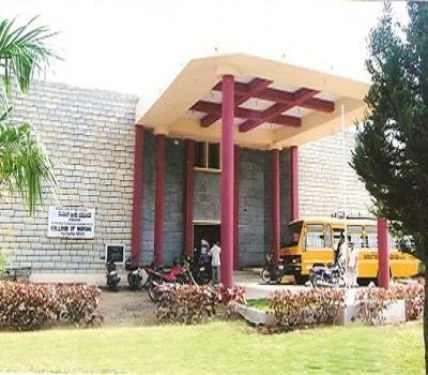
The campus is a 6-acre, purpose-built facility for nursing that opened in 2008. Don’t expect a university-style sprawling lawn. It’s described as functional, with modern classrooms, a multipurpose hall, and well-equipped nursing labs—the tools for the job are there. The library is digital and holds over 2,600 books and 1,800 journals. The campus is Wi-Fi enabled, and there’s a canteen, transport, and on-site medical facilities.
Hostels are separate for boys and girls, with the girls’ hostel having a capacity of 350 beds. Reviews simply state the accommodation is “good,” but details on room types, food quality, or strictness of rules aren’t available. It seems adequate, not luxurious.
Student life reflects the professional focus. Students mention well-organized college functions and extracurricular activities that aid personality development. But there’s a recurring, almost plaintive note in feedback: a desire for “proper planned trips” and “some fun things.” The social life appears to be largely campus-bound and academically oriented. If you’re looking for a vibrant, typical college social scene, this might feel restrictive. If you’re there to work, it’s probably sufficient.
Synthesizing student sentiment paints a clear, two-toned picture. On the positive side, the faculty is consistently praised. Words like “very good and experienced,” “dedicated,” and “highly qualified” come up repeatedly. They’re seen as accessible mentors who use innovative teaching methods. That’s a huge plus. The “college environment is very nice,” the canteen is good, and the proximity to a bus stand and shops adds practical convenience.
The negatives are specific and operational. Some students felt the teaching of “principles” (likely foundational nursing theory) wasn’t strong enough. A few complained about “external staffs” (possibly visiting clinicians or adjunct faculty) being “rood [rude] and not operating properly.” The most heartfelt critique is the desire for more recreational outlets—those planned trips—suggesting a curriculum that can feel all-consuming without relief.
The overall rating on platforms like Justdial is an average 3.4/5. That’s a fair summary: it’s considered a good, reliable institute for a nursing education, with clear strengths in clinical training and faculty, but it’s not without its bureaucratic or social limitations.
Unity Institute of Nursing is a straightforward proposition. It’s best for the student who views nursing as a vocation, not just a degree. If your priority is affordable access (pending fee verification), strong clinical rotations at reputable Mangalore hospitals, and learning from a dedicated faculty, this institute delivers on that core promise. You’ll graduate with real-world experience, which is the primary currency in healthcare.
You should probably look elsewhere if you prioritize a vibrant campus social life, demand transparent, high-placement statistics with corporate recruiters, or expect luxurious accommodations. The experience here is professional and pragmatic. The gaps in student feedback—wanting more fun, occasional issues with external staff—are the trade-offs for that focus. For a student from Karnataka or nearby regions aiming to build a solid nursing career without a massive financial burden, Unity Institute represents a practical and legitimate choice. Just go in with your eyes open: you’re there to learn how to be a nurse, and the institute is structured to do exactly that.
Unity Institute of Nursing offers a 4-year B.Sc. Nursing, a 2-year Post Basic B.Sc. (P.B.B.Sc.) Nursing, and a 3-year 6-month General Nursing and Midwifery (GNM) diploma. For postgraduates, it provides a 2-year M.Sc. Nursing program with specializations in areas like Medical-Surgical Nursing and Paediatric Nursing.
To be eligible for the B.Sc. Nursing program, candidates must have passed 10+2 or equivalent with Physics, Chemistry, Biology, and English, securing a minimum of 45% aggregate marks (40% for SC/ST categories). Admission is primarily based on the candidate's rank in the Karnataka Common Entrance Test (KCET).
Reported total course fees show some variation. For the 4-year B.Sc. Nursing program, the total tuition is listed as either ₹40,000 or ₹2,00,000—prospective students must confirm the exact current fee with the institute. The total fee for the 2-year M.Sc. Nursing program is approximately ₹1,60,000. Hostel and mess charges are additional.
Students gain hands-on clinical experience through rotations and internships at major affiliated hospitals including Unity Hospital, Wenlock Hospital, Lady Goshen Hospital, and Father Muller's Hospital in Mangalore. The campus itself features well-equipped nursing laboratories, a digital library, and modern classrooms to support practical learning.
Students generally praise the faculty as being experienced, dedicated, and supportive. The campus environment is considered pleasant with good facilities. However, some students express a desire for more organized recreational activities and trips, indicating a socially quiet but academically focused campus life.
Share what future students should know about Unity Institute of Nursing.
Student voices are not rewritten by colleges. We remove spam and abuse.
Wider admission question? Community PulseWhat should future students know?
Tell us which course you're considering. We'll help you work out the next step.
Get instant Partner access after mobile verification. Your public edits are reviewed before they go live.
Claim this college Auditorium
 Campus Shuttle
 Computer Labs
 Hostel
 Medical
 Science Labs
 Study Library