
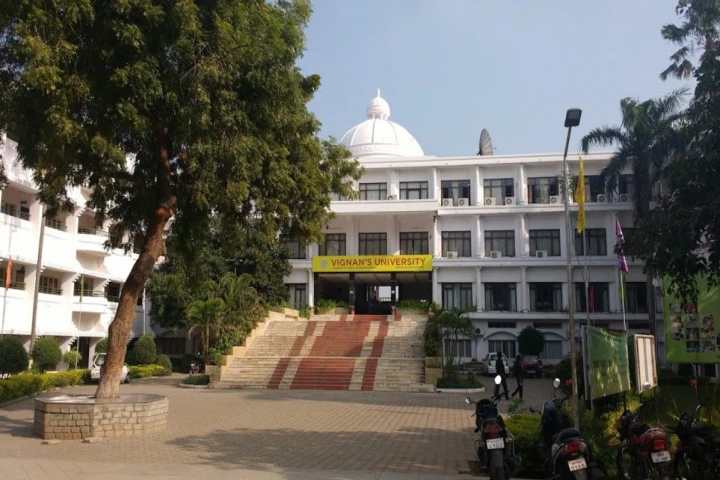

Vignan University admission: routes and eligibility
Vignan’s Foundation for Science, Technology, and Research (VFSTR) publishes programme-specific routes rather than one entrance test for every degree. Its official admissions page is currently framed around the 2026 intake. As of 15 November 2026, the displayed 2026 application and V-SAT dates are past, and the sources reviewed do not confirm a 2027–28 calendar. Use the 2026 rules below as a dated guide to the university’s published process, not as permission to apply now or as a guaranteed rule for the next cycle. Before paying or submitting a form, verify that the 2027 notice names your programme and confirm its current eligibility, test, dates and documents.
Undergraduate applications: identify the programme before choosing the test
The university describes V-SAT, its online Vignan Scholastic Aptitude Test, as an admission route for B.Tech, B.Pharmacy, B.Sc. (Hons.) Agriculture and Pharm-D. For the 2026 process, its admissions page also listed AP or TS EAMCET, JEE Main and JEE Advanced as qualifying routes for those specified programmes. The page stated a minimum 60% aggregate in Intermediate or an equivalent qualifying examination for candidates using those routes, alongside a 2026 date-of-birth condition: candidates had to be born on or after 1 July 2005 and pass Intermediate or equivalent with at least 60% aggregate to appear for the admission test. That age cutoff belongs to the displayed 2026 intake. Do not reuse it for a new cycle without the current official notice.
V-SAT is not stated as a universal requirement for every undergraduate degree. The admissions page presents the test in connection with the listed technical, pharmacy and agriculture programmes. Other offerings—including BBA, BCA, integrated law, B.Sc. routes and the Integrated Teacher Education Programme—may have different tests or qualification rules. The university’s programme catalogue and admission notification should be checked together: first confirm the exact award and branch, then find the corresponding eligibility section and accepted selection route. If a page lists an exam but the notice does not identify the programme or seat category, ask Admissions to confirm that the route applies to your intended course.
The public admissions page displays “March 31” for issue of applications and a January–March 31 exam window in the V-SAT section, under its 2026 admissions context. These are not upcoming dates in November 2026. The page does not establish a 2027 schedule. Monitor the university’s admission portal for a dated notice and record the notice year before planning travel, test preparation or application payments. A page that still displays a previous cycle’s schedule should not be read as an extension or fresh opening.
Postgraduate and doctoral routes differ by course
The admissions page lists separate postgraduate pathways. For M.Tech it names GATE, PGECET and VUGATE and states a 50% aggregate in the qualifying examination; the surrounding eligibility text is difficult to interpret as a single clean rule, so applicants should confirm the exact score and qualifying-mark combination in the current M.Tech notice. For the MBA, the same page states 55% in a bachelor’s degree and lists ICET, MAT above 500 or CAT at a minimum 70 percentile, with an alternative stated for applicants holding 60% in B.Tech. It also describes a university written test for bachelor’s-degree holders who have not appeared in an entrance test, followed by group discussion and personal interview. Because this page is for 2026 and does not explain every test-score equivalence or exception, request the current MBA selection notice before deciding that one score is sufficient.
The university lists MCA, M.Sc., M.Pharm and M.A. English among postgraduate options. Their eligibility is not interchangeable. The admissions page gives separate conditions for MCA, M.A. English and M.Sc. Chemistry, including qualifying-degree marks and, for some programmes, a university written test or interview. Read the course-specific page instead of applying the MBA or M.Tech rule to another degree. The catalogue may also list programmes whose current intake status or specialization availability has changed; listing alone does not prove seats are open.
For Ph.D. applications, the university page describes eligibility through a postgraduate qualification in a relevant discipline, and separately discusses some engineering and technology candidates entering provisionally while completing the master’s qualification. It requires relevant research alignment and a literature review in that provisional route. These are doctoral rules, not an alternative undergraduate or postgraduate entrance pathway. Check the current department-specific notification for qualifying tests, interview stages, research proposal requirements, supervisor availability and application deadlines.
Scholarships: treat the 2026 seat allocation as a separate competition
The admissions page describes scholarship seats for candidates qualifying through V-SAT 2026. It states that 25% of programme seats are reserved for scholarships: 5% of total seats at 75% tuition scholarship, 10% at 50%, and 10% at 25%. Allocation is described as merit-based, subject to availability, and first-come, first-served. The page also says the benefit is applicable for four years subject to maintaining at least 7.0 CGPA in the preceding year or years with no backlogs. Those conditions make an advertised maximum scholarship different from an assured award. Confirm the current cycle’s number of seats, rank bands, payment treatment and renewal rules in writing, and ask whether the stated percentage reduces tuition only or other charges too.
The admissions page also refers to JEE Main or Advanced rank for scholarship consideration, but the details and categories should be matched to the active notice. Do not infer that a scholarship guarantee follows from meeting basic admission eligibility. Keep the scholarship letter, award percentage, tuition schedule and annual renewal conditions with the admission offer so you can compare the net cost over the full programme.
A practical application checklist
Before submitting an application, confirm these points against a dated official source:
- The exact programme, branch, degree title and intake year are accepting applications.
- Your qualifying subject combination, marks and age satisfy that cycle’s written eligibility.
- The entrance test or qualifying score is accepted for your programme and seat category, and the required counselling or interview stage is clear.
- The application window, test date, result stage and document-verification instructions are current rather than carried forward from 2026.
- Any scholarship is a separate award with written eligibility, seat availability, amount, renewal conditions and refund treatment.
- The admissions office confirms the amount payable and the refund terms before you pay a non-refundable fee or reserve a seat.
Keep copies of the submitted form, score report, category or reservation documents where applicable, qualifying-examination marksheets, identity documents and every payment receipt. Submit only through the university’s official portal linked from its website; confirm the domain before entering personal or payment details. If your result is pending, the 2026 page says some candidates awaiting qualifying-examination results may apply, but the current notice must confirm whether that provision applies to your course and what deadline governs submission of final documents.
Vignan’s published process offers multiple routes, but the safe route depends on the exact course and intake. The university’s official admissions page is useful for understanding its 2026 structure; it is not a live 2027 calendar. When the next notice is issued, compare it with the course page and get written clarification for any test-score threshold or scholarship condition that remains unclear.