Loading Admission Guardian content
Loading Admission Guardian content

Explore the available options or ask for admission guidance.
Explore the available options or ask for admission guidance.
Woxsen University is a private university in Telangana whose official site describes a large, residential campus near Hyderabad and a broad portfolio across business, technology, design, architecture, law, liberal arts and sciences. Its published information combines a 2027 intake announcement with pages that still state 2026 eligibility rules. Applicants should therefore treat each programme page and its stated cycle as controlling, rather than assume that last year's exam list, deadline or fee applies to the next cohort.
This profile separates university-level awards from school-level rankings, and programme-specific results from one another. The strongest recent outcome figures available in the official material are for MBA graduates in 2024-26 and B.Tech graduates in 2021-25. They show different cohorts and should not be combined into a university-wide placement average. For 2027-29, an official MBA General schedule separates tuition from the required food and hostel plan; it is a useful example of how to read Woxsen's costs, not a fee quotation for every degree.
Woxsen's official contact page places its campus at Sadasivpet, Sangareddy District, roughly 60 kilometres from Hyderabad city. A UGC notice identifies the university's campus as Kamkole, Sadasivpet, Telangana. The university's housing page describes a 200-acre setting. That location matters in practical planning: students considering a residential degree should ask about travel arrangements, room assignment, move-in rules and the exact payment schedule rather than assume that a city-campus commute is part of the student experience.
The current homepage advertises its AY 2027 undergraduate and postgraduate Scholar's Round and lists academic offerings including MBA; M.Tech in Artificial Intelligence and Machine Learning; M.Des in Product Design Innovation; M.Arch; Ph.D.; B.Tech; BBA and BBA (Hons.); B.Des (Hons.); BA-LLB (Hons.); BBA-LLB (Hons.); BA (Hons.); B.Arch; B.Sc (Hons.); B.Sc in Sports Science; and BCA. It groups provision under schools for Business, Technology, Arts and Design, Architecture and Planning, Liberal Arts and Humanities, Law, and Sciences. The site may change programme names and availability between cycles, so confirm that the exact degree and specialisation appear in the application portal for the intended intake.
The public information is detailed but distributed across programme pages, admission pages, fee PDFs, placement releases and campus pages. A useful first step is to identify the programme and cohort, then read the linked eligibility, fee, scholarship and outcomes documents for that exact degree. A university homepage or school-specific award does not by itself establish a programme's curriculum, professional approval, current fee or placement denominator.
Woxsen spans several fields, but the admissions unit is the named programme. Technology applicants can compare B.Tech routes such as Computer Science Engineering, Data Science, Artificial Intelligence and Machine Learning, Blockchain, Internet of Things and Cybersecurity, and Electronics and Communication Engineering. The specific B.Tech pages describe their own curriculum, eligibility and specialisations. The School of Technology's 2021-25 placement report, for example, profiles a cohort concentrated in Computer Science and Data Science and AI, so its outcomes should not be read as evidence about every engineering specialisation or a later batch.
Business applicants will find undergraduate BBA routes and postgraduate MBA routes, including general management and named specialist options. Woxsen also lists an MBA for experienced professionals. The official programme pages and fee schedules distinguish these courses; applicants should not assume that an MBA General fee document covers a different specialisation, or that eligibility for one MBA route automatically applies to another.
The university lists B.Des (Hons.) programmes and a B.Arch route alongside its law degrees, BA (Hons.), B.Sc degrees, BCA, M.Des, M.Arch and M.Tech. These areas can have specific portfolio, subject, professional or entrance requirements. B.Arch, for example, is a regulated professional pathway with its own Council of Architecture approval and NATA requirement in the university's published 2026 eligibility table. That is cycle-bound evidence, not a guarantee that no other rule will apply in 2027.
The breadth of the menu can be useful to students who want a residential campus with several fields represented. It also makes careful programme comparison more important. Before applying, note the exact award title, duration, specialisation, school, entry test, required subjects and fee schedule. If a page calls a programme an honours route or provides a specialisation choice, check the current curriculum and award structure rather than infer it from a marketing summary.
Woxsen's official admissions-process page describes an online application, an accepted online entrance examination, a personal interview and an offer based on Composite Score requirements. The homepage currently advertises a 2027 Scholar's Round, while the general eligibility page explicitly says it covers programmes commencing in July or August 2026. That mismatch is material: the existence of a 2027 application banner does not establish that every 2026 test list, academic threshold or selection step remains unchanged. Applicants should use the current programme page and written offer for the target cohort.
The university's 2026 eligibility table gives examples of how routes vary. It lists B.Tech eligibility through a Science 10+2 with Physics, Chemistry and Mathematics, at least 50% in each of those subjects and 55% aggregate; listed scores include W-JEET, JEE Main, VITEEE, AP or TS EAMCET, MHT CET and SAT. Its BBA entry accepts any stream with a 55% aggregate and lists WAT or SAT. The table lists B.Arch with Physics, Chemistry and Mathematics, or a 10+3 diploma with Mathematics, a 55% threshold and NATA. These examples belong to the stated 2026 cycle. They are not a single entrance-test list for the university.
Entrance tests vary by course. A score accepted for one degree is not an institution-wide route, and the general process page directs applicants to the eligibility page for each programme. Verify both the qualifying degree and the accepted score for the programme and intake being considered.
The university's scholarship page says applicants are considered automatically for scholarships and describes composite-score assessment. It also says available awards are limited and allocated on a first-come basis during the first application period. Its cycle table shows different dates by course: the MBA Scholar's Round deadline was 14 November 2026; the listed undergraduate and several other postgraduate rounds show 1 December 2026. Since dates can move or seats can fill, applicants should check the live portal and not rely on a saved deadline from another programme. The exact award, eligible fee component and acceptance deadline should be read from the offer letter.
The sources reviewed did not provide a reliable, comparable closing-rank table across Woxsen programmes. Do not treat a prior applicant's score or a third-party prediction as an official cutoff. Ask admissions whether the target programme has a minimum score, subject condition or interview requirement for the current round, and preserve the answer in writing.
There is no single institution-wide fee that can represent the cost of every Woxsen degree. A current official example is the MBA General fee schedule for batch 2027-29. It lists university tuition of ₹15.66 lakh over two years: a one-time non-refundable ₹1 lakh admission commitment fee, ₹13.46 lakh in academic fees and ₹1.20 lakh for learning resources. The schedule divides tuition into ₹7.83 lakh in each year, although its academic-fee component differs between the two years.
The same schedule presents food and hostel charges separately, payable to INFIZIC LLP, and requires students to select a standard or premium plan. For the standard plan, food totals ₹3.20 lakh, non-AC triple-sharing accommodation totals ₹3.20 lakh, and sports and infrastructure charges total ₹30,000 over two years. Combined with tuition, the displayed standard-plan grand total is ₹22.36 lakh. The premium plan uses AC triple-sharing accommodation at ₹4.47 lakh over two years; its displayed grand total is ₹23.63 lakh. These are MBA General batch 2027-29 amounts only, not a university-wide rate or a promise that a later offer remains unchanged.
The fee PDF says scholarships apply only to the academic-fee component. It also notes that some textbooks may be purchased separately, laundry is pay-per-use, outstation study tours are charged at actual cost, and a 2% card-payment surcharge may apply. It directs students to the Student Handbook for instalments and late-payment penalties and states that the fee may change under university ordinances. Ask for the current written demand, the chosen residential plan and a clear ledger of any commitment fee already paid. This prevents comparing a tuition subtotal against a residential total or counting the seat commitment twice.
The university's scholarship page describes merit awards based on academic records, entrance scores and overall profile, with awards up to 50% on academic fees. It separately describes sports scholarships up to 100% on academic fees for eligible athletes with demonstrated sporting achievement. The page says scholarships are limited, with allocation tied to the first application period. Its AY 2027 round notes additional merit support for selected candidates who complete the entrance-score and personal-interview requirements, but the percentage and payment condition depend on the named programme and offer. Do not calculate a net fee by applying the maximum advertised scholarship to every cost component. Confirm the award in writing and check exactly which fee lines it reduces.
Woxsen's official releases report different outcomes for different programmes and graduating batches. In its MBA 2024-26 final placement release, the university states a highest CTC of ₹28 lakh per annum, an overall average of ₹10.10 lakh, a median of ₹9.20 lakh and a top-20% average of ₹15.10 lakh. It also reports 151 companies, 84% listed organisations and 71 new recruiters. The release does not state an overall placement rate or a graduating-student denominator in the excerpt reviewed. These numbers describe a particular MBA cohort; the top-20% average is not the average salary of all students.
For B.Tech, the official 2021-25 report lists a ₹12.2 lakh top-20% average, ₹9.5 lakh overall average and ₹8.5 lakh median, with 48 companies listed. The report labels the cohort and places its functional-area breakdown in fields such as data science, software engineering, AI/ML and ServiceNow consulting. It is a historical engineering result, not an MBA comparison or a 2026 placement result. The university's B.Tech 2022-26 release reports 108 companies visited, including 75 new recruiters, but that release does not supply the same salary measures. Treat those reports as separate evidence rather than combine their counts or infer missing compensation statistics.
Across programme reports, a median, average, top-group average and highest offer answer different questions. The headline highest offer is not a typical outcome; a top-group average excludes most of the cohort. Before comparing programmes, check the batch, degree, placement denominator, whether figures are CTC or fixed pay, and whether the result includes all eligible graduates.
Placement assistance, recruiter access and a reported result do not guarantee an individual job or salary. Students should ask the school for the eligible batch size, number seeking placements, number placed, number pursuing further study, internship status and the method used to calculate each statistic. The current placement landing page includes programme-level highlights, but without a cohort label alongside every metric it should not replace the dated report for a precise comparison.
The university's current rankings page lists several 2026 university-level results: #3 in Outlook-ICARE's Top 10 Practice-Integrated Multi-Disciplinary Universities, #8 in its Top 50 State Private Universities, #4 in IIRF's Top New-Age Private Universities, and global rank 351 in the World University Ranking for Innovation (WURI) Global Top 500. The same table lists QS Sustainability band 1301-1400 and QS Southern Asia regional rank 212 for 2026. These are separate categories, not the university's overall QS world rank.
The same rankings page has awards for the School of Business, School of Technology, School of Arts and Design and School of Architecture and Planning. Those rankings refer to the named school or subject category, not necessarily to Woxsen University overall. Compare like with like: edition, awarding body, category, level and whether the ranking is for the university, a school or a programme. A rank is a ranking publisher's assessment under its methodology, not a direct measure of teaching quality, student fit or personal career outcome.
The university's rankings page identifies EFMD MBA programme accreditation and states that its B.Arch programme is approved by the Council of Architecture. These statements have different scopes. Check the official regulator or accreditor listing for the exact award and programme when it is a deciding factor, and do not extend a school-specific accreditation to every degree at the university.
Woxsen's housing page describes a 200-acre campus with 1,087 rooms across its hostel blocks. It says boys and girls are accommodated in separate blocks and describes quadruple-sharing rooms, with air-conditioned and non-air-conditioned options. The page lists Wi-Fi and water supply, housekeeping, maintenance, security and fire-safety arrangements. The general housing page describes quadruple-sharing rooms, while the 2027-29 MBA fee schedule prices triple-sharing options. That difference shows why a general campus description should not be used to infer a specific programme room assignment. The page lists Wi-Fi and water supply. Confirm room allocation, occupancy, accessibility, move-in dates and residential charges with the university. The room count is not a reservation or guarantee of a particular room type.
The site also presents facilities for classrooms, studios, labs, library, sports and student support through separate pages. Applicants should inspect the facilities connected to their course: an engineering candidate may care about the relevant technology studios, a design candidate about studios and workshops, and a law candidate about moot-court resources. A campus-wide marketing list does not prove that each facility is available in every programme timetable or open at all hours. Ask about access, supervision, equipment and any extra charges.
The residential model can make campus services central to daily life, while the location outside Hyderabad may affect trips, transport and access to off-campus activities. Visit the campus if possible and ask students about the actual travel routine. For a two-year residential MBA, compare the stated food and accommodation plan with the day-to-day facilities and your personal requirements. For other degrees, verify whether the same residence terms apply before using the MBA schedule as a proxy.
Woxsen may suit applicants who want to compare programmes across several fields on a single residential campus and who value the university's current mix of academic, industry-facing and international opportunities. The official programme menu and placement reports show that the university's schools serve different academic paths. A student interested in technology, for example, should assess the B.Tech curriculum and specialisation directly, while a management applicant should compare MBA routes, admission requirements and programme-specific fees.
The trade-offs also deserve a direct check. Published costs can be substantial, and the MBA schedule shows that tuition is only part of a required residential total. Fee schedules can change, scholarship availability is limited, and the selected award may reduce academic fees rather than the full bill. The campus is a residential setting outside the city; that may be a benefit for students seeking an immersive environment and a constraint for those who want daily city access. Placement releases show meaningful programme-specific outcomes but do not guarantee an individual result.
A careful decision should rest on the exact course, current fee schedule, personal affordability, programme accreditation where relevant, campus visit and dated outcomes for the same degree. Ask for written answers about admissions conditions, scholarship amount, all payment dates, room allocation and placement denominator. If any claim in a brochure is important to your choice, confirm it against the programme's current official page or regulator record. That approach makes Woxsen's broad menu easier to compare with alternatives and keeps the decision grounded in the intake you would actually join.
Selected ranking categories, with the recorded year beside each result. Open all records for the complete history.
13 published records · Lower numeric ranks are stronger
IIRF
Overall · university
#52025
Outlook
Engineering · private
#112025
Find a program, read its fee details and explore the admission requirements.
Summary of the programs shown below. First-year fee
Showing 5 courses
Eligibility: 10+2 with 60%
Specializations
Eligibility: 10+2 with 60%
Listed entrance exams
Eligibility: 10+2 with 60%
Specializations
Listed entrance exams
Eligibility: 10+2 with 60%
Specializations
Listed entrance exams
Eligibility: Graduation with 60%
 Adani Gas Limited
 Aditya Birla Group
 Airtel
 Alight
 Amazon
 Byju's
 Collegedunia Web Pvt. Ltd
 Ctrls
 Dell
 Deloitte
 Factset
 Hawkins
 Hitachi consulting
 Home First Finance Company India Private Limited (HFFC)
 IDBI Federal Life Insurance
 IHS Markit
 Invesco
 Jaro Education
 KPMG
 Lancers Counsel
 Lido Learning
 Naukri.com
 NoPaperForms
 Outlook
 Panasonic India
 Pepsico Holdings (I) Pvt. Ltd.
 PhonePe
 PlanetSpark
 Rockwell Automation
 S&P Global
 Signode
 South Indian Bank
 Square Yards
 Standard Chartered
 Tata Elxsi
 TCS
 Tech Mahindra
 UBS
 Whitehat Jr
 Wipro
Yes, Woxsen University is considered good for B.Tech, particularly for its modern infrastructure and new-age specializations like Artificial Intelligence and Robotics. It is important to note that as a relatively new institution, its alumni network in engineering is still developing compared to older, established institutions like IITs and NITs.
The consistent NMAT cutoff score for admission to Woxsen University is 160.
Yes, hostel accommodation is mandatory. All undergraduate and MBA programs at Woxsen University are fully residential, and day scholar options are generally not available.
Woxsen University is located approximately 65 km from Hyderabad city center. The journey by road typically takes between 1.5 to 2 hours.
Woxsen University claims to provide 100% placement assistance and has reported achieving 100% placement rates for its MBA and BBA programs in recent cycles. The quality and specific outcomes of placements can vary based on individual student profiles.
About Woxsen University.
Colleges cannot rewrite published reviews. We remove spam and abuse.
Ask the communityWhat should future students know?
Tell us which course you're considering. We'll help you work out the next step.
Get instant Partner access after mobile verification. Your public edits are reviewed before they go live.
Claim this college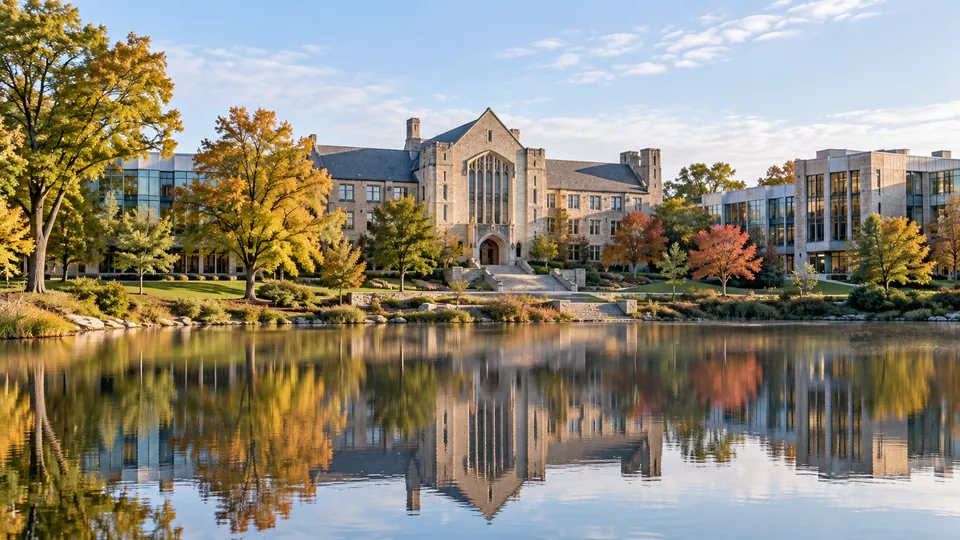
 Cafeteria
 Campus Shuttle
 Campus Wi-Fi
 Hostel
 Medical
 Science Labs
 Sports Complex
 Study Library
 Campus Security