
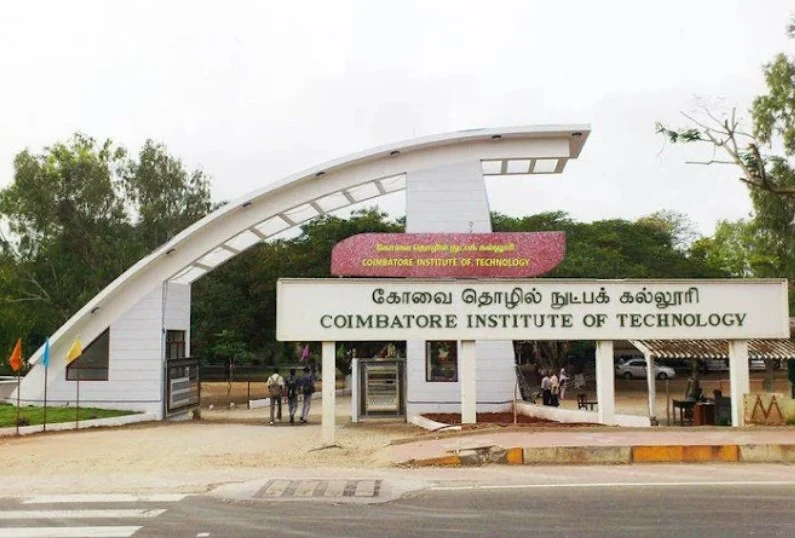

Coimbatore Institute of Technology admission: routes and requirements
CIT does not use one entrance route for every programme. The 2026-27 first-year B.E./B.Tech forms are tied to aided, self-supporting and lateral-entry categories, while the institute’s published 2025-26 admissions table places B.E./B.Tech selection through Tamil Nadu’s Directorate of Technical Education (DoTE) single-window counselling. The five-year integrated M.Sc. programmes use an institute-level test, and postgraduate routes differ by degree. For the 2027-28 intake, use these as the latest documented patterns, then confirm the new cycle’s notice before applying: the reviewed pages do not yet publish a 2027-28 schedule.
Choose the route by programme
For first-year B.E./B.Tech, start with Tamil Nadu Engineering Admissions (TNEA), not an assumed separate CIT entrance test. CIT lists nine engineering programmes on its requirements page, from B.E. Computer Science and Engineering to B.Tech. Artificial Intelligence and Data Science and B.E. Electronics Engineering (VLSI Design and Technology). Its first-year page provides separate 2026-27 aided and self-supporting application forms, a lateral-entry form, and a first-graduate form. The forms are institute paperwork for the admission process; CIT’s 2025-26 admissions table identifies DoTE single-window counselling as the selection route.
The TNEA 2026 information brochure describes a common online application for eligible government and government-aided engineering colleges, university departments and constituent colleges, plus specified seats surrendered by self-financing colleges. CIT’s homepage identifies its TNEA counselling code as 2007. Confirm that code and the exact branch and seat type in the current TNEA choice list before locking preferences. Aided and self-supporting options are separate choices, and the brochure’s seat matrix and counselling instructions govern the available seats for the cycle.
CIT also lists four five-year integrated M.Sc. programmes: Software Systems, Data Science, Decision and Computing Sciences, and Artificial Intelligence and Machine Learning. The institute’s programme page says each has an approved intake of 60, subject to the current notice. This is a separate institute process, not a TNEA branch choice. CIT describes selection as considering higher-secondary performance and an institute-level entrance examination; the 2026 admissions page labels the test stage as an entrance test followed by interview. The examination centre is Coimbatore. Applicants should check the programme-specific notice for the exact stage sequence and reporting instructions.
For postgraduate applicants, the 2025-26 CIT admissions table lists M.E. selection through Anna University single-window counselling, while MBA and MCA selection is listed through DoTE single-window counselling. CIT’s postgraduate page later posted MBA and MCA admission dates in August 2026. That dated notice confirms a 2026 admission window, not a current 2027-28 schedule or an entrance-exam rule. The pages reviewed do not establish a universal CAT, TANCET or GATE requirement for every CIT postgraduate programme, so do not rely on aggregator shorthand; use the current CIT and responsible counselling notices for the programme you seek.
CIT also describes part-time B.E. study for diploma holders. Its postgraduate page lists Civil, Mechanical and Electrical and Electronics Engineering, requires the diploma to have been completed at least two years before application, and says the applicant’s workplace must be within 90 km of the institute. It describes evening classes from 6 pm to 9 pm and a weighted selection method using diploma results and work experience. The same page directs applicants to DoTE notifications and says forms are obtained from the institute office during the notified period. Treat these as the published page’s rules and verify that the next cycle retains them.
B.E./B.Tech eligibility and TNEA merit
The latest opened TNEA brochure is for 2026. For academic HSC applicants it requires a pass in +1 and +2 and a minimum average in Mathematics, Physics and Chemistry in +2. The listed minimum is 45% for the general category and 40% for BC, BC Muslim, MBC/DNC, SC, SCA and ST applicants. The brochure also provides a vocational-stream route using the related subject together with vocational theory and practical marks; the same 45% and 40% community thresholds are shown. These are TNEA 2026 rules, not a promise that a later brochure will be identical.
CIT’s own requirements page also names diploma holders among eligible engineering applicants and states a qualifying-examination appearance limit and minimum marks. Because entry through the first-year form and lateral entry are distinct, do not apply a first-year HSC rule to a diploma applicant. The 2026 TNEA booklet and CIT’s specific lateral-entry notice should be checked together for the programme, entry level and documents. The CIT first-year page confirms a separate lateral-entry form but does not itself explain the full diploma eligibility or seat rules.
TNEA does not use a separate engineering entrance-test score in the 2026 brochure’s general-category merit method. It reduces the prescribed qualifying-examination marks to 200, weighted as Mathematics 100, Physics 50 and Chemistry 50. Marks from different boards are normalized into a common merit list. The brochure says overall and community rank lists are published through DoTE/TNEA, and online allotment follows the applicant’s rank, preferences and eligible seat matrix. The ranking is therefore not a fixed “CIT cutoff mark”: a closing rank depends on the branch, seat category, counselling round, available seats and the applicant pool.
The 2026 counselling guide describes multiple rounds. Applicants fill choices in preference order, receive a tentative allotment, confirm it within the stated window, and then report to the college or a Facilitation Centre and pay as instructed. The guide also lists options that can retain, accept, seek upward movement or leave an allotment. Read the choice-filling and confirmation rules inside the relevant round: missing a confirmation or reporting deadline can cancel the allotment. Keep the login credentials and monitor the official portal rather than treating an allotment screenshot or an old cutoff table as final admission.
Integrated M.Sc. eligibility and selection
CIT’s current integrated M.Sc. page separates eligibility for Decision and Computing Sciences from the other listed M.Sc. specialisations. For Software Systems, Data Science and Artificial Intelligence and Machine Learning, it says candidates need HSC or equivalent with Mathematics, Physics and Chemistry; applicants other than SC/ST need at least 70% in Mathematics plus Physics plus either Chemistry or Computer Science. The institute clarifies that 70% is a combined total across the three subjects, not 70% in each one.
Decision and Computing Sciences accepts that same science-subject route or, alternatively, one Category A subject (Mathematics, Applied Mathematics, Statistics, Business Mathematics, or Business Mathematics and Statistics) with two Category B subjects (Commerce, Economics, Accountancy or Computer Science). Its page states a 70% combined requirement for non-SC/ST candidates on the alternative route. The page does not spell out the corresponding minimum for SC/ST applicants; candidates in that group should ask CIT rather than infer one.
The 2026 timetable is historical: applications closed 25 May, shortlisting was listed for 1 June, test/interview dates ran 7-10 June, the selected list was listed for 13 June, and fee-payment dates differed across two CIT pages (19 June on the M.Sc. Admissions page and 22 June on Admissions Details). This internal date discrepancy is material. Neither date should be treated as a future deadline; consult the next cycle’s notice and confirm the final payment date with the M.Sc. help desk. The M.Sc. Admissions page lists 94883 16334 and the general contact email [email protected].
Documents, dates and next steps
For TNEA, use the 2026 brochure only as the latest rules reference and review the new cycle’s portal before applying. Nativity and reservation documents depend on the candidate’s circumstances; for example, the brochure requires a digitally signed nativity certificate for certain Tamil Nadu natives educated outside the state and employer documentation for some non-native eligibility categories. It also says a common application is used for the covered college choices. The exact document list, deadlines, special-reservation rules and seat matrix must be taken from the live cycle instructions, not reconstructed from an earlier application.
For CIT B.E./B.Tech, download the matching aided, self-supporting or lateral-entry form from the institute page and submit it with the required documents at admission as directed. The page warns that incomplete forms will not be accepted. For M.Sc., use the separate application link and notice. For MBA/MCA and M.E., follow the responsible DoTE or Anna University notification named for that programme. CIT lists the B.E./B.Tech admissions contact as 94868 37757 and the M.Sc. contact as 94883 16334.
A practical sequence is: identify the exact degree and entry level; check the current eligibility and category documents; register through the responsible counselling or institute route; verify the branch and seat type in the live choice/seat list; save the application and payment acknowledgements; and complete every allotment, reporting and institute-form step by its deadline. For 2027-28, start at CIT’s admission requirements, first-year B.E./B.Tech forms, integrated M.Sc. page, and the TNEA portal. The reviewed official pages provide no 2027-28 admission dates yet.