
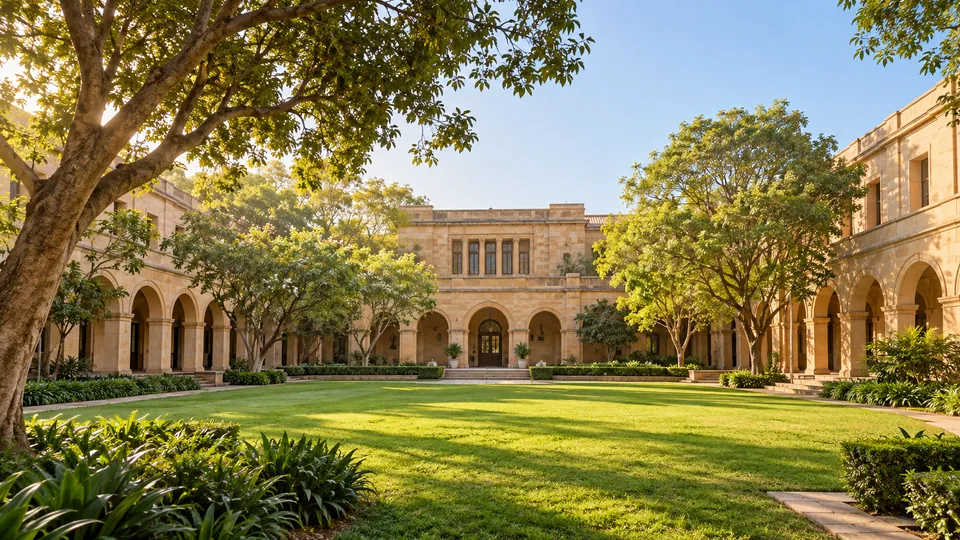

 Auditorium
 Cafeteria
 Computer Labs
 Hostel
 Medical
 Science Labs
 Sports Complex
 Study Library
CET Thiruvananthapuram facilities: library, computing and campus support
CET’s published facilities include a central technical library, shared computing resources, department laboratories, research facilities and separate men’s and women’s hostels. The most useful details for a prospective student are practical: library access and borrowing, the kind of computing and lab resources CET lists, and the difference between published hostel capacity and an individual room allotment. Availability, access rules and operating hours can change, so confirm current arrangements with the relevant office before making travel or accommodation plans.
Central library and study resources
CET’s Technical Library and Documentation Centre describes a collection of more than 104,500 documents and access to over 13,200 online journals. It reports regular library hours of 9 a.m. to 9 p.m. Monday through Friday and 9 a.m. to 4 p.m. on Saturdays. The reference section has around 28,000 books and 150 seats; the page separately lists 168 as the library’s seating capacity. These are institutional descriptions of capacity, not a promise that a seat is free at every time.
The library page also describes a Book Bank aimed mainly at SC/ST and financially backward students. It says undergraduate students can reserve and issue up to eight books per semester, graduate students up to ten, and OBC/OEC students two. Students need a physical ID card for the Book Bank. The e-Library lists 16 internet-connected computers and says students can use e-resources off campus through individual ONOS logins. Ask the library about current membership, eligibility documentation, the applicable book limit for your category and whether your course’s journal access is included.
Computing shared across departments
The Central Computing Facility (CCF) says it serves departments and offices and is open 9 a.m. to 9 p.m. on working days. CET lists a server room, three labs, nine high-end servers, more than 200 computers and equipment such as printers, scanners and projectors. Its page names hosted applications including MATLAB and Campusoft, and describes a campus network with fibre connectivity and Wi-Fi. It also lists the Sree Chithirathirunal Centre for Computing and a Centre for Training in Software Engineering, including facilities used for training sessions, seminars and short courses.
These facilities support teaching and campus services, but the public page does not specify per-student computer access, software licence availability for each course, lab booking rules or whether every machine is open outside scheduled sessions. For a course decision, ask the department which facilities are used in the curriculum and whether students can access them outside class.
Department labs and research facilities
Facilities vary by discipline. CET’s Civil Engineering facilities list includes soil mechanics, highways, traffic engineering, structures, hydraulics, coastal engineering, hydroinformatics, environmental engineering and a Transportation Engineering Research Center. The Electronics and Communication Engineering department lists undergraduate spaces such as communications, control systems, fibre optics, instrumentation, IoT, microcontroller, microwave and project labs, as well as separate PG and research labs. CET’s research-facilities index links pages across Civil, Electrical, Mechanical, Electronics and Communication, Computer Science, Architecture, Computer Applications, Physics, Chemistry and common facilities.
This is a useful starting map rather than an inventory of current equipment or access conditions. A department page can establish that a lab is listed, but it does not show its present timetable, staffing, capacity, maintenance state or whether a particular programme uses it. Ask the department about the labs tied to your year and specialisation, the kinds of projects students can complete there and any safety or booking requirements.
Hostels and residential capacity
CET describes separate men’s and women’s hostels. Its page states 250 rooms and capacity for 500 students in the men’s hostel, and 140 rooms with capacity for 400 in the women’s hostel. It also lists reading rooms, fitness centres and indoor and outdoor sports and cultural facilities in both hostels. The page says the hostels are managed by wardens and resident tutors, and that the mess is run through a student-elected committee.
The stated capacity does not establish current vacancies, eligibility priority, room sharing, charges or whether every first-year student can obtain a place. The college maintains a separate Hostel Admission page and management system; check the current notice for application timing, documents, fees, allocation rules and any separate arrangements by programme or student category. Confirm meals, daily access rules and resident support directly with the hostel office.
Questions to verify before you enrol
For the library, confirm current opening hours, borrowing privileges and off-campus e-resource access. For computing and laboratories, ask what is actually available to your programme, whether access is supervised and how project use is scheduled. For a hostel, verify application dates and allotment rather than relying on room capacity alone. If accessibility, medical support, transport or a specific workshop matters to you, request the relevant current policy or contact for that service; the pages reviewed here do not establish those details comprehensively.
Evidence date and scope
This summary uses CET’s current public library, CCF, hostel and department-facility pages as checked on 1 November 2026. Named facilities and capacities reflect those pages; they are not independent inspections. No current hostel allotment, cost schedule, equipment audit or programme-specific access guarantee was verified. Recheck the responsible office before relying on operational details.