Loading Admission Guardian content
Loading Admission Guardian content

1 programme · 1 institution. Check the admission year and requirements.
1 programme · 1 institution. Check the admission year and requirements.
See each program's fee period below.
Showing 5 courses
Specializations
Eligibility: Graduation
Specializations
Eligibility: Post Graduation
Specializations
Listed entrance exams
Eligibility: Graduation + CAT
Listed entrance exams
Eligibility: Graduation
Specializations
Eligibility: Graduation
See courses and fees at other colleges.
Explore collegesLoading programmes and admission routes.
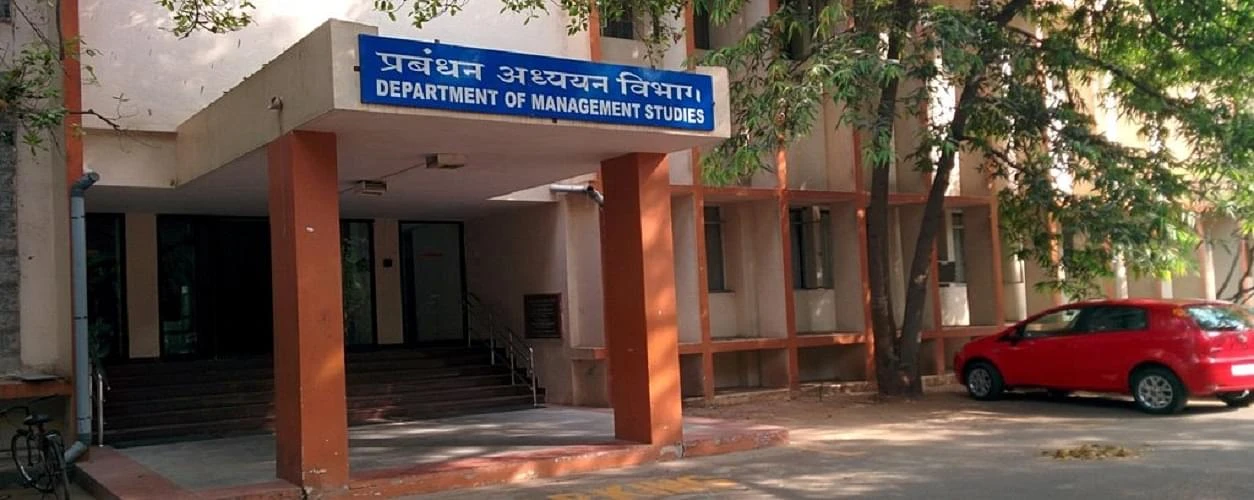
The Department of Management Studies (DoMS), IIT Madras runs a two-year full-time MBA organised over seven academic quarters. The programme combines core management subjects, electives, cross-department learning and a summer industry project. The latest fee schedule captured here applies to students admitted in 2025-26; it is a dated budgeting reference, not a confirmed 2027-28 fee. Applicants should request the schedule for their own intake before accepting an offer. MBA programme · 2025 admission fee schedule
The department describes the MBA as a two-year programme with seven quarters. A pre-term precedes the academic sequence, and students complete a summer industry project between the first and second year. The quarter format packs teaching into shorter blocks than a conventional semester system, so candidates should consider whether they are comfortable moving quickly between subjects and assessments. The exact timetable, workload and course availability should be confirmed from the current batch handbook; the public programme page is a curriculum overview rather than a guarantee that every elective runs in every year.
The listed sequence moves from foundations into functional management and then advanced electives and integrative work. The public curriculum includes financial and management accounting, statistics, economics, organisational behaviour, marketing, operations research, financial management, programming for management, business intelligence, strategy, human-resource management and business ethics. This mixture is relevant to applicants who want exposure to quantitative and technical material alongside conventional management disciplines. It does not mean every student will take every subject in the same term, nor should a course title be read as a particular specialisation unless the current registration guide identifies it that way.
The second-year elective structure gives students room to shape study around interests. The department says MBA students may also audit courses from other IIT Madras departments, whose public page describes a wider institute offering in science, technology, humanities and social sciences. Access to a broad course catalogue can be useful for students pursuing technology, analytics or interdisciplinary interests, but actual enrolment depends on prerequisites, timetable, seat availability and institute rules. Applicants who have a specific course or cross-registration plan should ask DoMS how the rule is applied to the incoming batch rather than assume every elective is open to everyone.
The summer industry project is a distinct part of the MBA structure. It provides an opportunity to apply first-year learning in an organisation before returning for the remaining quarters. Its availability, evaluation and recruiting calendar are part of the academic design, but the public curriculum page does not promise a particular project employer or role. Candidates should distinguish the programme’s structured project requirement from placement outcomes: one does not establish that a student will receive a specific job or salary.
The captured official schedule is titled for MBA students admitted in 2025. For Indian nationals it lists a one-time institute fee of ₹40,000, a per-semester fee of ₹2,95,402 and a refundable caution deposit of ₹5,000. It shows first-semester payable totals of ₹3,40,402 for GE/OBC/EWS students, ₹90,402 for SC/ST/PwD students after the tuition waiver, and ₹4,40,402 for sponsored candidates. Sponsored candidates are separately shown as paying an additional tuition fee of ₹1 lakh per semester. Foreign-national fees are set out in a separate currency schedule.
Those figures need careful interpretation. A semester fee is not the whole two-year cost, while the first-semester total is not an annual figure. The caution deposit is described as refundable and should not be treated as an academic fee. Category waivers and sponsored tuition differ, so applicants should read the correct row for their status and verify any conditions attached to the waiver. The 2025-26 schedule should not be multiplied or carried forward as a definitive total for a later batch unless IIT Madras confirms that its components remain unchanged.
The fee PDF is an institutional charge schedule, not a complete personal budget. Hostel and mess charges, travel, books, a laptop, personal expenses and any optional international learning activity can affect total spending. The captured MBA table does not provide a current complete two-year estimate for those items. Ask the institute for the latest hostel and mess charges, payment dates, refund rules, loan documentation and the next intake’s fee notice. If you are comparing schools, put tuition and compulsory charges on the same period and category basis and keep residential and optional expenses separate.
The 2025 fee schedule visibly distinguishes the tuition waiver for SC/ST/PwD students from the charges payable by other categories. That is useful for planning, but it does not verify a separate scholarship, stipend or loan benefit. The material reviewed here does not establish a universal scholarship amount for the MBA. Students should check the current IIT Madras financial assistance and category rules and ask what documents are needed, when a waiver is applied, and whether any charge remains payable before reimbursement or confirmation.
Before accepting an offer, ask for a dated breakdown of charges by semester and category. Confirm what is one-time, refundable, recurring or optional; how sponsored-candidate tuition is collected; and whether the amount quoted includes hostel and mess. Compare the resulting total with the programme’s seven-quarter calendar and your own financing timeline. The department’s published median and average placement figures are cohort outcomes, not a repayment guarantee; they cannot replace a personal affordability calculation.
The key source gap is the next-cycle fee. As of 1 November 2026, the latest schedule captured for this page is for 2025 admissions. DoMS/IIT Madras should confirm the 2027-28 amount, current hostel costs and any revised category conditions before applicants make a budget or loan decision. The academic design is more stable than the price: use the programme page to understand the course pattern and the new fee notice to decide whether the total cost works for you.
Programme information: Official source · Source as of: 2026-11-01
Each route applies only to this named programme and the stated year.
CAT: Common Admission Test · 2026-28
Admission-route evidence: Official source · Source as of: 2026-11-01
1 recorded programme · 1 institution. Admission years and conditions apply to the named programme.