Loading Admission Guardian content
Loading Admission Guardian content

Provisional score based on available data. It may change as more information is verified.
Find a program, read its fee details and explore the admission requirements.
Summary of the programs shown below. First-year fee. Check the note beside each amount for inclusions and exclusions.
| Course | Stream | Fees |
|---|---|---|
| Diploma in Engineering (Polytechnic) | Engineering | 30150 |
| Bachelor of Technology [B.Tech] | Engineering | 55000 |
| Master of Business Administration [MBA] | Management | 59700 |
| Bachelor of Computer Applications [BCA] | Computer Applications | |
| Diploma in Pharmacy [D.Pharm] | Pharmacy |
Specializations
Eligibility: 10th
Specializations
All accepted exams
Eligibility: 10+2+UPTAC
Specializations
All accepted exams
Eligibility: Graduation
Specializations
All accepted exams
Eligibility: 10+2
Specializations
Eligibility: 10+2
3 exams with cutoff data available
 Accenture
 Adobe
Adobe AMD India Pvt.Ltd
 Apple
Apple Artech Infosystems
 Cisco
Cisco Coca-Cola
 Daffodil
 Electronic Arts
 Facebook
 FUJITSU
 Gati-KWE
 Genpact
 GODREJ Pvt. Ltd
 Google
 HCL
HCL HDFC Bank
 Hero Honda Motors
 Hewlett-Packard (HP)
 Hindustan Unilever Limited
 Hitachi consulting
 Hyundai Motors
 IBM
IBM ICICI Prudential
 Infosys
 Intel
Intel L&T Infotech
 Mahindra Rise
 Maruti Suzuki
 Max Life Insurance
 Mphasis
 NIIT
NIIT Oracle
 Sandisk
 Serco
Serco Standard Chartered
 Tata Indicom
 Tata Motors
 TCS
TCS Tech Mahindra
 Vodafone
 Wipro
WiproK.P. Group of Institutions (KPGI) sits on a quiet stretch of the Agra-Firozabad Road, a private college that has been quietly building its reputation since 2008. It’s not a name that dominates national headlines, but for students in the Agra region looking for an affordable, functional education with a decent campus life, it’s a practical option. Affiliated with Dr. A.P.J. Abdul Kalam Technical University (AKTU) and Dr. Bhim Rao Ambedkar University, Agra, its biggest selling points are its low fees and a surprisingly active, ragging-free hostel life. The catch? You’ll need to dig for concrete placement data, as the college’s public record is stronger on infrastructure and scholarships than on corporate recruitment stats.
KPGI runs a focused set of programs with a combined annual intake of 360 students. The academic portfolio is standard for a private technical and management institute in Uttar Pradesh, but it’s the practical labs that get a specific mention.
The B.Tech program offers specializations in Civil, Mechanical, Computer Science, IT, Electronics & Communication, and Electrical & Electronic Engineering. The MBA has streams in Finance, Marketing, International Business, and Human Resource Management. They also run BCA, BBA, and a suite of diploma programs including Engineering (Polytechnic), Pharmacy (D.Pharm), and even a Diploma in Elementary Education (D.El.Ed).
Where the academics get interesting is in the applied facilities. The college highlights a specialized Language Lab with software like FACE-TO-FACE and ENGLISH MASTER for communication skills—a nod to industry demands for soft skills. There’s also mention of virtual power labs and CAD-CAM facilities with SOLIDWORKS, which has an international recognition from the company itself. It’s a practical, tool-oriented approach rather than a purely theoretical one.
This is the section with the most significant data gap. The research brief contains no official figures for highest, average, or median packages. There’s also no list of top recruiters or a stated placement percentage. That’s a major red flag for any prospective student doing their homework.
Student reviews, many of which are several years old, don’t fill this void either. They tend to praise the curriculum and campus life but are conspicuously silent on specific placement outcomes or company names. This lack of recent, verifiable data makes it impossible to assess the placement cell’s effectiveness. When a college doesn’t publish placement stats, it’s usually because those numbers aren’t a strong selling point. For KPGI, the placement story is essentially unwritten, and students should approach with managed expectations, likely needing to be more proactive in their own job search.
The affordability is KPGI’s clearest advantage. For the 2025-2026 academic year, the total fee for the entire B.Tech program is ₹2.45 Lakhs, which breaks down to roughly ₹61,250 per year. That’s exceptionally low for a private B.Tech program. The MBA total fee is ₹1.33 Lakhs. Diploma in Engineering fees range from ₹30,150 to ₹90,450 annually.
Where the college does better than many peers is in its scholarship framework. They offer the K.P. Gandhi Nidhi Scholarships for meritorious students. They also facilitate Uttar Pradesh government scholarships for financially weak students and have their own provision for students with documented financial issues. It’s a system that acknowledges its student demographic. Hostel and mess fees aren’t specified, but the low tuition keeps the overall cost of education down.
Admissions are primarily merit-based, leaning on entrance exam scores and past academic performance.
For B.Tech, you need JEE Main or UPTAC (UPCET BTech) scores. The eligibility is 10+2 with Physics and Mathematics, plus one of Chemistry/Biology/Biotech/Technical Vocational, with a minimum of 45% aggregate (40% for reserved categories). The application window for 2026 is noted as May 26 to July 14.
For MBA, they accept a wide range of exams: CMAT, CUET-PG, CAT, MAT, and XAT. You need a 3-year Bachelor’s degree with at least 50% marks (45% for SC/ST). Selection here may include a group discussion and personal interview. The 2026 application window is December 13 to January 24.
For Diploma programs after 10th, the entrance is through JEECUP, with applications typically open from January to April. For BCA, admissions are based on CBSE or UP 12th marks.
The college also mentions direct admission on vacant seats at the institution level, which is a common practice for private colleges to fill spots after the central counseling rounds.
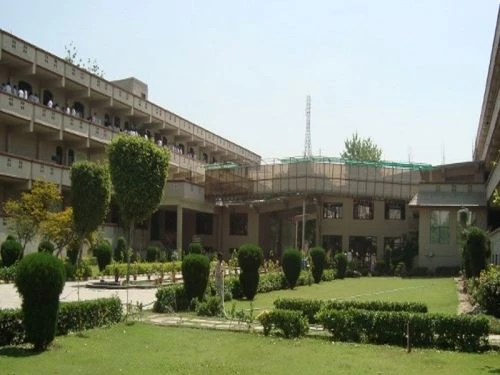
This is where student reviews become consistently positive. The campus is described as lush green, spread over 11-16.5 acres. The infrastructure is functional: a computer lab with 600 machines, a digital library with over 3500 books and e-journals, and a well-appointed seminar hall.
The hostels, however, seem to be a highlight. There are separate facilities for boys and girls inside the campus, with the boys' hostel having a 200-student capacity. Reviews repeatedly mention "enjoyable" campus life, hostel parties, and many extracurricular activities. They specifically praise a zero-tolerance policy on ragging, with active anti-ragging drives—a significant plus for student welfare.
Sports facilities are adequate, with grounds for cricket, basketball, football, volleyball, and badminton. There’s a gym, yoga classes, a canteen, and a medical first-aid facility. Transport is available from the city. It’s not a luxurious setup, but it covers the essentials and seems to foster a cohesive community.
Synthesizing the available sentiment, a clear picture emerges. Students from the past decade frequently commend the detailed course curriculum, particularly for the MBA program. The hostel life and campus culture receive strong marks for being active and ragging-free. The availability of sports and extracurricular activities is another plus, with a multi-purpose hall for events.
The negatives are less about bad experiences and more about a lack of information. The most glaring issue is the scarcity of recent reviews and a complete absence of detailed placement data in alumni feedback. Reviews don’t complain about poor teaching or bad management, but they also don’t boast about landing great jobs. The impression is of a college that provides a decent educational experience but may not be a powerful launchpad for careers without significant individual effort.
K.P. Group of Institutions is a classic case of "you get what you pay for." And what you pay is very little. For a student in the Agra region with a limited budget, seeking an AICTE-approved B.Tech or MBA degree from an AKTU-affiliated college, KPGI is a viable, no-frills option. Its strengths are its low fees, scholarship options, and a campus/hostel environment that students genuinely seem to enjoy. The anti-ragging stance is a major positive.
But you have to go in with your eyes open. The absence of any published placement statistics is a serious drawback. This college is unlikely to attract top-tier recruiters to campus in droves. It’s best suited for students who are self-motivated, who see the degree as a baseline qualification and plan to build their profile through external certifications, internships, and their own job search efforts. If your priority is a low-cost degree with a decent campus life, KPGI fits. If your priority is strong, college-driven placements with high packages, you’ll need to look elsewhere and likely pay much more.
For the B.Tech program, candidates must have passed 10+2 with Physics and Mathematics as compulsory subjects, along with one of Chemistry/Biology/Biotechnology/Technical Vocational. A minimum aggregate of 45% is required (40% for reserved category students). For the MBA program, applicants need a minimum 3-year Bachelor's degree from a recognized university with at least 50% marks (45% for SC/ST candidates).
For the 2025-2026 academic cycle, the total program fee for B.Tech is ₹2.45 Lakhs, which translates to approximately ₹61,250 per year. The total fee for the MBA program is ₹1.33 Lakhs. Fees for the Diploma in Engineering (Polytechnic) range from ₹30,150 to ₹90,450 per year.
KPGI accepts multiple entrance exams. For B.Tech admissions, JEE Main and UPTAC (UPCET BTech) scores are considered. For MBA, scores from CMAT, CUET-PG, CAT, MAT, and XAT are accepted. Admissions to BCA are based on CBSE or UP 12th board marks, and for Diploma programs, the JEECUP entrance exam score is required.
The campus features separate hostels for boys and girls, a computer lab with 600 systems, a specialized language lab for communication skills, and a digital library with over 3500 books and e-journals. Sports facilities include grounds for cricket, football, basketball, volleyball, and badminton. The institute also has an air-conditioned conference hall, a canteen, a medical first-aid facility, a gym, and offers yoga classes.
Yes, KPGI offers several scholarship avenues. These include the K.P. Gandhi Nidhi Scholarships for meritorious students, government scholarships from Uttar Pradesh for financially weak students, and institutional scholarships for those with documented financial needs (often requiring an income certificate). The college also accepts national scholarship exam qualifications.
Share what future students should know about KPGI.
Student voices are not rewritten by colleges. We remove spam and abuse.
Wider admission question? Community PulseWhat should future students know?
Tell us which course you're considering. We'll help you work out the next step.
Get instant Partner access after mobile verification. Your public edits are reviewed before they go live.
Claim this college
 Auditorium
 Cafeteria
 Campus Shuttle
 Computer Labs
 Hostel
 Medical
 Science Labs
 Sports Complex
 Study Library