
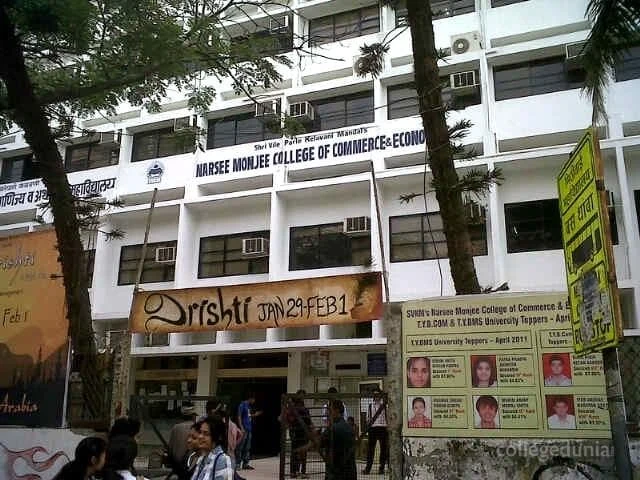

Which Narsee Monjee college this guide covers
This page is about SVKM’s Narsee Monjee College of Commerce & Economics, the empowered autonomous college at Vile Parle West in Mumbai. Its official site identifies the college as affiliated to the University of Mumbai. It is not the admission guide for NMIMS Deemed-to-be University, which is a separate institution with its own campuses, schools and admission routes. Check the name and campus on the official notice before paying a form fee or following a link; the similar Narsee Monjee name alone does not identify the institution. The college contact page lists its campus at Swami Bhaktivedant Marg, Bhagubai Mafatlal Complex, opposite Cooper Hospital, Vile Parle West, Mumbai 400056. College identity and affiliation · Campus contact details · NMIMS institutional identity
The college’s degree admissions material covers several different routes. Aided First Year B.Com has an in-house merit preference followed by outsider vacancies. Self-financed programmes have separate rules and do not receive the in-house category. BMS is governed by AICTE norms and, in the published 2026-27 cycle materials, also appears in Maharashtra State CET Cell and CAP notices. These should not be combined into one common entrance test or one merit list.
Read 2026-27 dates as historical notices
The college’s Undergraduate Admissions page links to Admissions 2026 notices, BMS allotment lists, CAP schedules, application instructions and programme eligibility. The specific notice sets located for BMS are dated 25 July, 27 August and 12 September 2026. They describe events in the 2026-27 admission cycle; they do not establish present application availability or tell applicants when 2027-28 forms will open. The site may publish newer notices, so use the college admissions page and the Maharashtra CET Cell together for any later cycle. Do not reuse an expired reporting or payment date as a current deadline. College admissions notices · Maharashtra 2026-27 BMS notice · BMS CAP Round III notice
The admissions page explains the college’s academic and eligibility framework, while cycle-specific notices specify the application portal, category, allotment stage and document steps. When they differ in detail, the notice for the named programme and cycle is the useful operational document. A candidate should confirm the programme, year, category and allotment route printed on their own letter rather than assuming instructions for B.Com apply to BMS or another unaided course.
First Year B.Com: in-house preference and outsider vacancies
For First Year B.Com, the college says its procedure follows University of Mumbai guidelines. Students from the college’s junior section are treated as in-house students, subject to the site’s stated rules. The college gives in-house applicants merit preference up to the sanctioned capacity of the FYBCom class. If seats remain after those admissions, vacancies are filled through the college’s outsider category under the autonomous college’s admission rules. The process therefore depends on category, merit and available seats; the page does not promise admission to every eligible applicant or provide a guaranteed percentage cutoff. Undergraduate admission information
The college’s eligibility matrix requires a Higher Secondary Certificate (Class XII) from the Maharashtra Board, another Indian board or an equivalent examination for the listed B.Com outsider category. The page also describes equivalent higher-secondary pathways. Applicants should read the specific notice and document checklist for their board and category. Foreign-board, International Baccalaureate and Cambridge/A-level candidates are directed to obtain a prima facie eligibility letter from the University of Mumbai before first-year degree admission. That instruction is specific to those qualifications and is not a substitute for checking current eligibility rules for a particular course.
The site’s Gujarati linguistic-minority statement has a narrow scope: the entry-level reservation is described for aided First Year B.Com after the in-house admissions. It does not say the same quota or in-house preference applies to every self-financed course. The same page explicitly says there is no in-house category for self-financed programmes. Applicants should use category documents and current notices instead of estimating seat chances from a general label.
Self-financed programmes and course-specific eligibility
The college’s general admissions page says Class XII marks are used for admission to self-financed programmes from Academic Year 2024-25, except BMS. Treat this as the college’s published general rule, not a guarantee of a particular merit position. The page lists B.Com Accounting & Finance, B.Com Financial Markets, B.Com Management & Finance (formerly B.Com Honours), B.Com Economics, B.Com Economics & Analytics and B.Sc Information Technology. It also identifies BMS separately. The current programme name matters because the college renamed B.Com (Honours) to B.Com (Management & Finance) under NEP from AY2023-24. College eligibility matrix · B.Com Management & Finance programme page
For the listed B.Com specialisations, the admissions matrix states Class XII or equivalent eligibility and merit based on the aggregate of Class XII subjects; it gives the same general merit basis for Management & Finance. The standalone Management & Finance page describes admission on the basis of Class XII/equivalent percentage marks. These statements describe the published selection basis, not an assured closing score. A cutoff can vary by intake, category, merit list and available seats, and the sources reviewed here do not support a universal or future cutoff number.
B.Sc IT has a distinct academic prerequisite: the college’s admissions matrix requires Mathematics as a Class XII subject and says merit uses Mathematics marks plus aggregate marks. Its programme page describes the three-year full-time course and says eligibility is based on Class XII Mathematics marks. Students should verify the exact year’s application notice and board equivalence before applying. None of these rules creates an entrance-test requirement for every self-financed course; the available college material treats BMS separately.
BMS: Maharashtra CET/CAP and institute-level notices
BMS needs separate attention from the general Class XII merit summary. The programme page describes it as a three-year undergraduate degree, currently affiliated to AICTE, with an intake capacity of 60 and eligibility under AICTE norms. For AY2026-27, the Maharashtra State Common Entrance Test Cell notice covers first-year BBA/BMS/BBM admissions in Maharashtra through online registration, document verification, option forms, seat acceptance and institute reporting. It names the MAH-BHMCT/BCA/BBA/BMS/BBM CET-2026 registration route and permits candidates with a CUET (UG) 2026 score valid for AY2026-27 who did not register for that CET to register for admission. The college’s CAP Round III notice is addressed to students allotted by the State CET Cell. BMS programme description · Maharashtra State CET Cell AY2026-27 notice · College CAP Round III notice
The notices distinguish the State CAP route from institute-level selection. The college published a BMS institute-level third allotment list dated 12 September 2026 and told listed candidates to complete the college form, submit the University of Mumbai pre-admission enrolment form, create an ABC ID, appear for the specified offline document verification and pay through the stated link. Its notice also says seat acceptance fees on the CET portal must be paid where applicable. This is evidence that an institute-level process existed in that named 2026 round; it is not proof that a later round is available or that candidates can bypass State CET Cell requirements.
For the 2026 CAP process, the college notice directs allotted students to complete the college form after CAP allotment, submit University of Mumbai pre-enrolment and ABC details, and choose e-scrutiny or physical scrutiny as provided by the State process. College document verification and payment followed under a dated schedule. These are historical steps from the 2026 notice. A future applicant should use the year-specific State CET Cell brochure, allotment letter and college notice to confirm whether MAH CET, CUET, category documents and reporting mode remain the same.
Documents, University enrolment and ABC ID
The college directs degree applicants to register with a new portal login rather than using a junior-college or school SAP login. Its instructions identify the University of Mumbai pre-enrolment form and ABC ID as important steps. The 2026 notices also require an admission form, category-specific evidence and original-document verification. The precise file set changes by programme, board, category and route; follow the checklist linked beside the current notice rather than relying on a generic article or old allotment PDF. The college says admission remains provisional until original documents are submitted and approved by the University of Mumbai. College admissions page · BMS 2026 CAP notice · AY2026-27 fee and document notice
For locally residing Mumbai and Thane applicants, the 2026 college notice described physical submission and verification, while outstation candidates could use the modes and upload process specified in that notice. BMS applicants allotted through CAP had to follow the State process and then the college’s subsequent form and reporting instructions. These are not interchangeable: one document may govern State application and allotment, while another governs college admission paperwork after allotment.
The college identifies its Gujarati linguistic-minority category and lists documentary evidence in its notices. It also lists other reservation or concession documentation in the cycle-specific checklist. Eligibility for a concession depends on official rules and supporting records; a fee table should not be treated as evidence that a student is eligible for a waiver. The admissions page notes that an ABC ID is mandatory for degree admission. If an applicant’s documents or board status are unusual, contact the college before submitting a final form, because portal details and original-document approval matter.
What to verify before applying
Start from the college’s official Undergraduate Admissions page, then open the notice matching the programme and academic year. Confirm whether the course is aided FY B.Com, a self-financed programme, or BMS; confirm the applicant category and the required board documents; and check the current allotment and reporting schedule. For BMS, confirm the State CET/CAP route and any eligible alternative score in the year-specific CET Cell brochure. For B.Com and the listed self-financed courses, use the college’s latest merit instructions rather than assuming the BMS test route applies.
The pages reviewed provide no reliable 2027-28 application dates or future cutoffs. They do not establish a guaranteed admission score, current seat vacancy, or a single entrance examination for all degree programmes. The 2026-27 notices are useful for understanding the college’s processes and identifying the right documents, but their dated deadlines have passed. Check for a new notice before paying an application, seat-acceptance or programme fee. Official admissions page · Maharashtra CET Cell
Keep copies of the notice, category letter, form submission and fee receipt for your records. If a college page and an allotment-specific notice appear to give different instructions, ask the admissions office to identify which notice applies to your programme, category and round. That is safer than combining a B.Com merit rule, a BMS CAP instruction and a different course’s fee schedule into one process.