
Loading Admission Guardian content
Loading Admission Guardian content
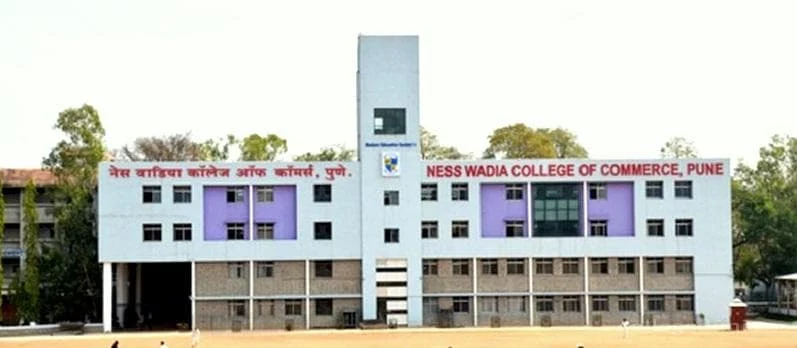

5 programmes · 1 institution. Check the admission year and requirements.
5 programmes · 1 institution. Check the admission year and requirements.
Fee amounts are not listed.
Showing 5 courses
Specializations
Eligibility: 10+2
Specializations
Eligibility: Graduation
Specializations
Eligibility: 10+2
Specializations
Eligibility: 10+2
Specializations
Eligibility: Graduation
See courses and fees at other colleges.
Explore collegesLoading programmes and admission routes.
Ness Wadia College of Commerce does not show a comparable, current 2027-28 total tuition figure on the official course pages reviewed. The B.Com page says fees follow Savitribai Phule Pune University (SPPU) guidelines and directs students to the administration office for clarification. The BBA page also refers to SPPU guidelines; the BBA-IB page says its fees are fixed under SPPU guidelines and updated from time to time. The BBA-CA page similarly directs applicants to SPPU guidelines and the office. These statements establish the fee-setting reference, not the payable amount for a particular student, year or category.
The course pages separately state a ₹150 registration fee for degree and diploma admissions and describe it as non-refundable. They say admission is confirmed after the completed form, required original documents, registration fee and complete fees are received. Treat ₹150 as the stated registration charge, not as tuition or a complete admission cost. The sources do not specify in these passages whether it is charged once per programme, whether additional university or examination charges apply, or how category-specific concessions affect the bill. Ask for the current written fee breakdown before payment and retain the receipt.
The college Admission hub lists a BBA fee-structure link within its 2026-27 course links, but the pages directly reviewed here do not expose a readable fee amount or a matching fee schedule for B.Com, BBA-IB and BBA-CA. The B.Com course page also links a PDF, but that file is a 2019-pattern syllabus document, not a current fee schedule. Do not mistake a syllabus download or an old fee notice for a current payable amount. No 2027-28 annual or full-programme total can responsibly be calculated from the sources available here.
The college describes B.Com as a three-year, full-time undergraduate programme affiliated to SPPU. It lists 720 students as the intake capacity for each of F.Y., S.Y. and T.Y. B.Com and says Government of Maharashtra and SPPU reservation norms apply. That course-page figure is an institutional statement, not a current round-wise seat matrix; applicants should not infer that all 720 seats are available in a new intake or to an individual category. The page also says optional-paper seats are limited, so choice availability may depend on the current offering.
The published first-year structure includes Compulsory English, Financial Accounting, Business Economics (Micro), Business Mathematics and Statistics, and choice groups. One group includes Organisational Skill Development or Banking & Finance; another includes Essentials of E-Commerce, Marketing & Salesmanship, Business Environment & Entrepreneurship, or Foundation Course in Commerce. A language is also selected from the listed Modern Indian Languages options. The page says five divisions use English as the medium of instruction and one uses Marathi. This is useful if language of instruction is a deciding factor, but confirm the current division arrangement before enrolment.
At second year, the page lists Business Communication, Corporate Accounting, Macroeconomics, Business Management and Elements of Company Law, followed by a special subject choice such as Business Administration, Banking & Finance, Cost & Works Accounting, Business Statistics, Business Entrepreneurship or Marketing Management. It says students continue the same special subject into the final year. The third-year page includes regulatory framework, advanced accounting, auditing and taxation, economics, and further papers in the chosen subject. Because the page combines older CBCS patterns with subsequent updates, use it as a subject overview and confirm the syllabus applicable to the student's entry cohort with the college or SPPU.
The B.Com page describes the programme as full-time and says fees follow SPPU guidelines. It states that admission depends on merit and eligibility approval, and that completing a form does not assure a place. Those points matter when comparing cost: a course page's fee reference does not guarantee admission, and a student should wait for the applicable merit process and a formal fee demand before treating a budget estimate as final.
The BBA page describes a broad management programme with Marketing, Finance and Human Resource Management specialisations in its published second- and third-year course structure. It identifies the structure as a revised CBCS 2019 pattern for those years and says first-year subjects are being customised under NEP 2020, with the complete list to be posted. Its FAQ describes BBA as a three-year full-time programme and BBA Honours as four years. Because the page contains both legacy-pattern material and NEP updates, applicants should confirm the curriculum and exit option applicable to their cohort rather than assume every table is the 2027-28 plan.
The BBA-IB page adds international-business subjects such as International Relations, International Business Law, Business Reporting and Analysis, and Foreign Exchange Management in the published upper-year structure. Its FAQ similarly describes a three-year BBA-IB and a four-year honours route. The BBA-CA page lists computing subjects including data structures, software engineering, networking, operating systems, programming choices and projects, and likewise describes the BBA-CA as three years with a four-year honours option. These published descriptions help distinguish subject emphasis; they should not be read as a guarantee that each listed elective or technology remains in the incoming cohort's syllabus.
The course pages state eligibility for the BBA degree as HSC (10+2) from any stream with English as a passing subject and 40% marks. They also list a two-year Pharmacy diploma after HSC, a three-year technical diploma after SSC, and an MCVC route with 45% for Open-category candidates and 40% for reserved-category candidates under Maharashtra rules. These are the college's currently visible course-page statements, but they sit alongside a separate admission notice saying the professional BBA-family programmes use MAH-BBA/BCA/BMS CET followed by the state CAP and counselling process. Applicants must check the current CET Cell and course notices for cycle-specific eligibility and selection. Do not treat these course-page eligibility lines as a substitute for CET registration or CAP allotment.
The BBA, BBA-IB and BBA-CA pages say their fees follow SPPU guidance, with BBA-IB explicitly noting that fees are updated from time to time. They describe a non-refundable ₹150 registration charge and require the form, documents and complete fees for admission confirmation. They do not provide a current 2027-28 tuition total. Get the course-specific amount, payment schedule and any additional charges in writing before accepting an allotment.
Before choosing between B.Com, BBA, BBA-IB and BBA-CA, request a current written breakdown for the exact programme and entry year. Ask the office to separate tuition from registration, university, examination, laboratory, add-on or other charges and to state which amounts are one-time, per semester or annual. The pages reviewed are insufficient to compare total programme costs or establish whether BBA-family specialisations have different charges. Do not multiply an unspecified annual fee by three or four years, or use the ₹150 registration fee as a proxy for tuition.
Also confirm whether any course add-ons affect the expected total. The BBA page states skill-enhancement add-on courses carry two credits and are compulsory each semester; the BBA-CA page lists specific add-on courses in its older structure. A student should ask which charges, if any, apply to those components in the current curriculum. The B.Com page also states add-on courses are compulsory but does not price them in the reviewed passage. No additional cost should be assumed without an official fee notice or written clarification.
The college admission hub is the practical starting point because it separates B.Com, BBA, BBA-IB, BBA-CA and B.Voc. links and posts cycle updates. Follow the individual course page for curriculum context, then check the current year-specific notice and SPPU fee direction. For an actual decision, compare confirmed payable totals for the same academic year and equivalent period, not older syllabus patterns, historic seat figures or isolated registration charges. As of the sources reviewed for this 2027-28 edition, the tuition amounts remain unverified; applicants should revisit the official pages when the applicable fee schedule is published.
Programme information: Official source · Source as of: 2026-11-09
Programme information: Official source · Source as of: 2026-11-09
Programme information: Official source · Source as of: 2026-11-09
Programme information: Official source · Source as of: 2026-11-09
Programme information: Official source · Source as of: 2026-11-09
5 recorded programmes · 1 institution. Admission years and conditions apply to the named programme.