Loading Admission Guardian content
Loading Admission Guardian content
Provisional score based on available data. It may change as more information is verified.
Find a program, read its fee details and explore the admission requirements.
Summary of the programs shown below. Programs record different fee periods. Compare the individual amounts and their notes below.
| Course | Stream | Fees |
|---|---|---|
| Master of Computer Applications [M.C.A] | Computer Applications | 66500 |
| Master of Business Administration [MBA] | Management | 66500 |
| Bachelor of Technology [B.Tech] | Engineering | 85000 |
| Master of Technology [M.Tech] | Engineering | 85000 |
| Post Graduate Diploma in Management [PGDM] | Management | 292500 |
All accepted exams
Eligibility: Graduation with 50%
Specializations
All accepted exams
Eligibility: Graduation with 50%
Specializations
All accepted exams
Eligibility: 10+2 with 45%
Specializations
All accepted exams
Eligibility: Graduation with 55%
Specializations
All accepted exams
Eligibility: Graduation with 50%
 Academia Guru
 Accenture
 Adani group
 Adecco
 Adobe
Adobe Amazon
 Appcino Technologies Pvt.Ltd.
 Appirio
 Asahi India Glass Ltd.
 ATMECS Technologies
 Axis Bank
 Bajaj Finserv Ltd.
 Bank of Baroda
 BestPeers
 Bharti Airtel
 Big Bazaar
 Birla Sun Life Insurance
 Birlasoft
 Bosch Ltd
 Brill Techno
 Capgemini
 Coca-Cola India
 Cognus Technology
 Compro Technology
 Convergys
 Crowne Plaza
 Cygnet Infotech
 DCB Bank
 Decathlon
 Deloitte
 Directi
 Dmart
Dmart eClinicalWorks
 Ericsson India Pvt Ltd
 Ernst & Young
 Eureka Forbes
 Expedia
 Extra Marks
 Fortis Healthcare
 Genpact
 Gigabyte Technology
 GlaxoSmithKline(GSK)
 HCL Technologies
 HDFC Bank
 Hero Group
 Hexaware Technologies
 Hi-Tech Robotic Systems Ltd.
 Hilton
 Hindustan Copper Limited (HCL)
 Holiday Inn
 Ibibo Web Pvt Ltd
 IBM
IBM ICICI Bank
 ICICI Prudential
 ICICI Securities
 IGATE
IGATE India Bulls
 IndiaMart Company
 Indian Army
 Infosys
 Intel Technology India Pvt Ltd
 Internshala
 ITC Hotels
 Jaro Education
 JCB
JCBRajasthan Institute of Engineering and Technology (RIET) has built a reputation over two decades as a solid, infrastructure-focused private college on the outskirts of Jaipur. It’s the kind of place that doesn’t make national headlines but consistently shows up in conversations about the better private options in Rajasthan, especially for its Electrical Engineering program. With an ‘A’ grade from NAAC and a sprawling 30-acre campus, it presents a classic trade-off: reliable RTU affiliation and decent facilities, but placement outcomes that require a closer, more realistic look than the brochure might suggest.
RIET operates as a constituent college of Rajasthan Technical University, which means the curriculum, syllabus, and exams are standard RTU fare. That’s neither a pro nor a con—it’s just the reality of the affiliation system. Where the college tries to differentiate is through its labs and specializations. They’ve invested in laboratories that, according to their own material, are designed for learning “beyond the RTU syllabus,” which is a smart claim. For postgraduates, the M.Tech programs offer sensible specializations like VLSI Design, Power Systems, and Digital Communication.
The faculty count sits at 139, which for the number of programs offered suggests decent coverage. The college mentions a mix of permanent and visiting industry faculty, which is common. The academic calendar for 2024-2025 is available on their official website, a small but helpful bit of transparency. They also list a roster of industry tie-ups with names like TCS, Infosys, and Siemens. It’s important to read that as a list of potential recruiters and workshop hosts, not a guarantee of deep academic collaboration. The real academic culture here seems to be one of structured, traditional engineering education with a stated emphasis on practical skill development. It’s a familiar model.
This is where you need to put on your analyst hat. The official placement cell claims an 80-95% placement rate year after year. For a private college in this tier, that’s an ambitious number. The highest package for 2026 is quoted at a striking ₹45 LPA for both domestic and international roles. The average package is stated as ₹8 LPA.
Now, the reality check. Other sources, including older student reviews and aggregated data portals, cite average figures in the ₹3-6 LPA range. That’s a significant gap. It’s not uncommon for official averages to be higher than the median experience, but a discrepancy this large warrants skepticism. The most likely scenario is that the ₹8 LPA figure is an arithmetic mean pulled up by a few very high offers, while the bulk of the class secures packages closer to the ₹4-5 LPA mark typical for mass recruiters in the region.
The recruiter list is solid and exactly what you’d expect: TCS, Infosys, Wipro, HCL, Capgemini, Tech Mahindra, and a sprinkling of core and finance names like Siemens, LIC, and ICICI Bank. These are the companies that form the backbone of campus hiring across hundreds of Indian engineering colleges. Placement success will heavily depend on your branch, with Computer Science and IT historically faring better. The college has a dedicated Training & Placement Cell that organizes training sessions and industry interactions. Your outcome here will be a function of the college’s recruiter pull, which is decent, and your own preparedness, which is critical.
The fee structure is a bit opaque, with different sources quoting different numbers. The most consistent figure for the B.Tech program is an annual tuition in the ballpark of ₹2.3 to ₹3 lakhs. One source mentions a total program cost of ₹3.5 lakhs for 3.44 years, which seems unusually low and should be verified directly with the institute. Fees for BBA, BCA, MBA, and MCA are generally cited as between ₹1.26 to ₹1.44 lakhs for the entire program duration.
Hostel and mess fees aren’t detailed in the available brief, so that’s a major cost component you’ll need to inquire about separately. When you add it all up, the total cost for a four-year B.Tech could reasonably land somewhere between ₹12-18 lakhs, depending on the hostel choice and inflation.
Where RIET does reasonably well is in scholarship options. They offer their own management scholarships for meritorious and economically disadvantaged students. More importantly, they facilitate the AICTE Tuition Fee Waiver Scheme (TFW), which provides a 100% tuition waiver for eligible meritorious students from financially weaker sections in B.Tech. They also guide students for the Rajasthan government’s SJE Post-Matric Scholarship. If you have the academic scores, there are legitimate avenues to reduce the financial burden.
Admissions are entrance-exam driven. For B.Tech, you need a valid JEE Main score or you must go through the Rajasthan Engineering Admission Process (REAP). There’s no publicly available cutoff rank data, which is typical for many private colleges under REAP—seats are filled through counseling rounds based on the scores available in that year’s pool. A certain percentage of seats are also likely filled through the management quota.
For M.Tech, GATE is the key. For MBA, they accept CAT, MAT, or CMAT scores. The application fees are straightforward: ₹2000 for B.Tech, ₹3000 for MBA/MCA, and ₹4000 for general category M.Tech applicants (₹2000 for SC/ST). The process is a mix of online and offline steps, and it’s crucial to watch the RTU and REAP portals for official notifications rather than relying solely on the institute’s website.
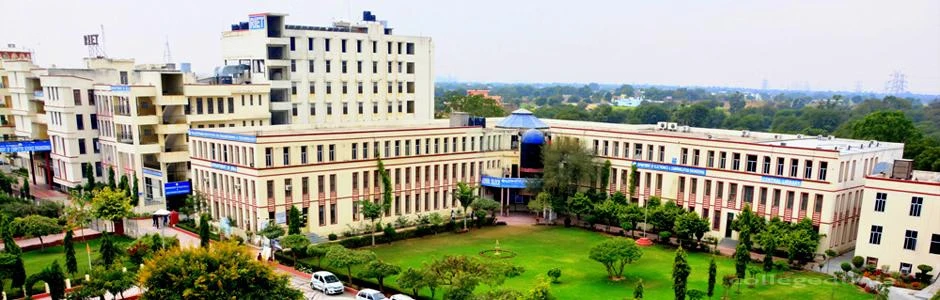
This is consistently highlighted as a strength. A 30-acre campus in Bhankrota provides space. The infrastructure described is comprehensive: air-conditioned classrooms, a well-stocked library with over 29,000 texts and digital access through DELNET, and a variety of labs. The campus is Wi-Fi enabled, which is basically table stakes now, but they claim a 16 Mbps backbone.
The hostels have a capacity for 1100 students, are air-cooled, and are separate for boys and girls. The mention of a “hygienic mess” and cafeteria is standard phrasing. Medical assistance is available in the hostels, and the college runs a fleet of buses across Jaipur, which is essential given the campus location.
Student life is organized through clubs and societies. There’s a cultural society and a technical society called “Technodiction” that organizes a national-level tech fest. They have facilities for basketball, volleyball, cricket, tennis, a gym, and indoor games. It’s a contained, campus-centric social life. The location isn’t in the middle of the city, so your world will largely revolve around the college grounds. That can be a good thing for focus, or a bit isolating, depending on your perspective.
Synthesizing the available sentiment is tricky because detailed, critical forum reviews (like on Reddit or Quora) aren’t captured in the brief. The recurring positives from educational portals align with what the college promotes: good infrastructure, a functional placement cell, and a focus on practical learning. The scholarship opportunities are also noted positively.
The glaring point of contention, as discussed, is the placement reality. The gap between the official average package (₹8 LPA) and the figures echoed in broader discourse (₹3-6 LPA) is the single biggest question mark. Students generally don’t complain about infrastructure or basic facilities. Teaching quality is described as being delivered by qualified faculty with a “no compromise” attitude towards discipline—a very traditional Indian engineering college description.
Without the raw, unfiltered complaints from student forums, it’s hard to gauge common grievances about management, administrative hassles, or specific hostel issues. The presence of anti-ragging and grievance cells is a standard, positive notation.
RIET Jaipur is a competent, infrastructure-heavy private engineering college. It’s best for a student who:
You should probably look elsewhere if:
It’s a solid B-tier choice. It won’t open magical doors, but it provides a stable platform. Your success will depend, as it does at most colleges in this segment, almost entirely on what you do with that platform.
RIET Jaipur is approved by the All India Council for Technical Education (AICTE) and is affiliated with Rajasthan Technical University (RTU), Kota, which awards its degrees. The institute holds an 'A' grade accreditation from the National Assessment and Accreditation Council (NAAC), a significant quality marker. It also previously held NBA accreditation for several of its engineering programs from 2012 to 2015.
The official Training & Placement Cell reports a placement percentage ranging between 80-95% annually. For the 2026 batch, the highest package offered is reported as ₹45 LPA, with an average package of ₹8 LPA. It's important to note that other educational portals and older reviews often cite average figures between ₹3-6 LPA, suggesting a range of outcomes. Top recruiters are predominantly from the IT and consulting sectors, including TCS, Infosys, Wipro, HCL, Capgemini, Tech Mahindra, Accenture, and Microsoft, alongside companies like Siemens, LIC, and ICICI Bank.
RIET offers multiple scholarship avenues. These include its own management scholarships for academically outstanding and economically disadvantaged students. Crucially, it facilitates the AICTE Tuition Fee Waiver (TFW) Scheme, which provides a 100% tuition fee waiver for eligible meritorious B.Tech students from financially weaker sections. Students can also apply for the Rajasthan Government's SJE Post-Matric Scholarship and other state-level schemes for which the college provides guidance.
RIET operates its own fleet of college buses that cover various routes across Jaipur city, providing connectivity for day scholars and hostel residents. The campus is located in Bhankrota on Ajmer Road. It is approximately 22 km from Jaipur International Airport, 11 km from Jaipur Junction Railway Station, and about 7 km from the central Sindhi Camp Bus Stand, making it accessible by major transport links.
RIET offers a range of undergraduate, postgraduate, and doctoral programs. At the UG level, it offers B.Tech in branches like Computer Science, Electrical, Mechanical, Electronics & Communication, Civil, and Information Technology, along with BBA, BCA, and B.Arch. PG programs include M.Tech (specializations in CSE, VLSI, Power Systems, etc.), MBA, and MCA. The institute also offers Ph.D. programs in various disciplines under its research centre.
Share what future students should know about RIET.
Student voices are not rewritten by colleges. We remove spam and abuse.
Wider admission question? Community PulseWhat should future students know?
Tell us which course you're considering. We'll help you work out the next step.
Get instant Partner access after mobile verification. Your public edits are reviewed before they go live.
Claim this college
 JK Cement
 Just Dial
 Krishna Maruti Group
 Kurl-On
 LIC
LIC Lifestyle
 Linkruit
 Locus Rags
 Mahindra & Mahindra
 Maintec
 Manlift India Pvt. Ltd.
 Maruti Suzuki
 MetaCube
 Microsoft
 MindTree
 Motherson Sumi System Limited
 Mphasis
 Muthoot Finance
 Narayana Health
 Nokia
Nokia Persistent Ltd
 Pinnacle Infotech Solutions
 Polycab
 Publicis Sapient
 Radio Mirchi
 Radisson
 Reliance
 Reliance Jio Infocomm
 Reliance Retail
 Shipping Corporation of India Ltd
 Shriram General Insurance
 Siemens
 Sopra
Sopra State Bank of India
 Sutherland
 Synergy Technics
 Tata
Tata Tata Consultancy Services
 Tech Mahindra
 Telecom Sector Skill Council (TSSC)
 Teleperformance
 Uber
Uber UCO Bank
 Unisys
 Universal Hunt
 Videocon
 Vodafone
 Wipro
Wipro Zensar
115 named recruiters in the recorded data. Company names are deduplicated.
 Auditorium
 Bank & ATM
 Cafeteria
 Campus Shuttle
 Computer Labs
 Gym
Gym Hostel
 Medical
 Science Labs
 Sports Complex
 Study Library